Twenty works from the Groeningemuseum in Bruges: Early Netherlandish panels by Van Eyck, Van der Goes and Bosch, and later paintings and drawings through to Ensor and Spilliaert.
The Groeningemuseum in Bruges is best known for its Early Netherlandish painting, by artists including Jan van Eyck and Hans Memling, though its collection continues into much later centuries. Van Eyck is represented here by two works: the portrait whose sitter is commonly identified as his wife, Margareta, and the Madonna with Canon Joris van der Paele. With them are works by Hugo van der Goes, Gerard David, Petrus Christus and Lancelot Blondeel, and Hieronymus Bosch's triptych of the Last Judgement.
This selection of twenty works opens with Van Eyck, Van der Goes and Bosch, then moves freely across the centuries. It takes in a pair of portraits by Pieter Pourbus, a banquet and an inn scene, river views by Jan van Goyen and Paul Jean Clays, landscapes at Fontainebleau and near Voreppe, a market among Italianate ruins, a self-portrait drawing by James Ensor, an ink-and-watercolour by Léon Spilliaert and a portrait on ivory. Memling, as it happens, is not among them. Several of the earlier pictures assume some familiarity with saints and their attributes, and with the conventions of donor portraits. Some survive only in part: one is a wing from a triptych, and museum research has found evidence that another was cropped at an earlier date.
Artline selected these works from documented museum holdings, independently of the museum. Dates and attributions keep the qualifications given in the linked records.
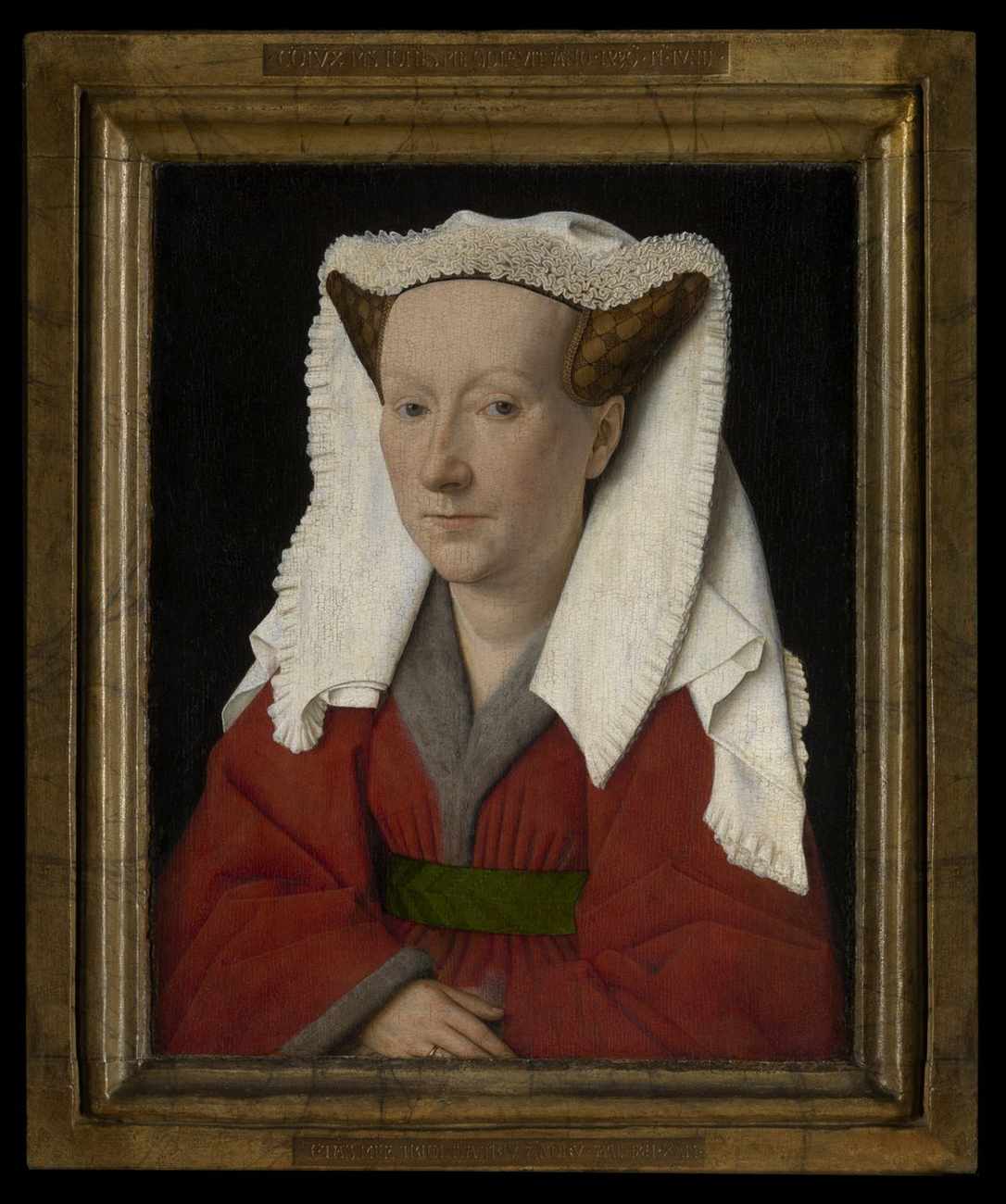
The panel bears an inscription and a date, and the sitter is commonly identified as Margareta, Jan van Eyck's wife. Nothing dramatic happens in it. A crisply folded white headdress frames her face, the dress is dark and her hands rest along the lower edge. From these few elements, and a face recorded with close attention, Van Eyck makes a portrait of striking directness.
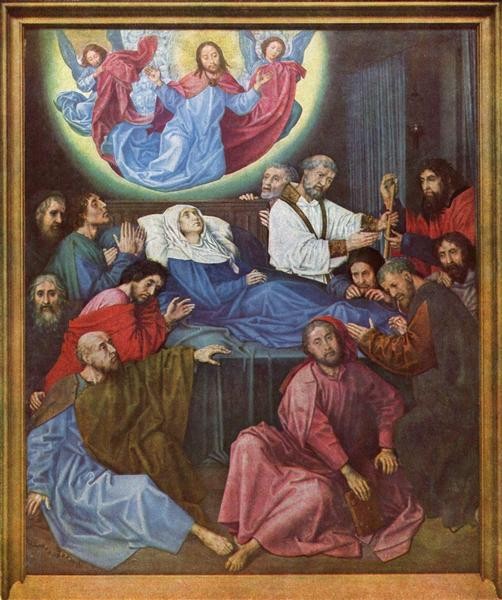
The apostles crowd round the bed where Mary lies, but Van der Goes does not give them one shared expression. Grief registers differently from face to face. Gazes and gestures point in so many directions that the eye moves restlessly over the group, away from her body and back to it.
The picture has not come down to us intact. Recent research by the museum found evidence of painted curtains and of cropping at some earlier date.
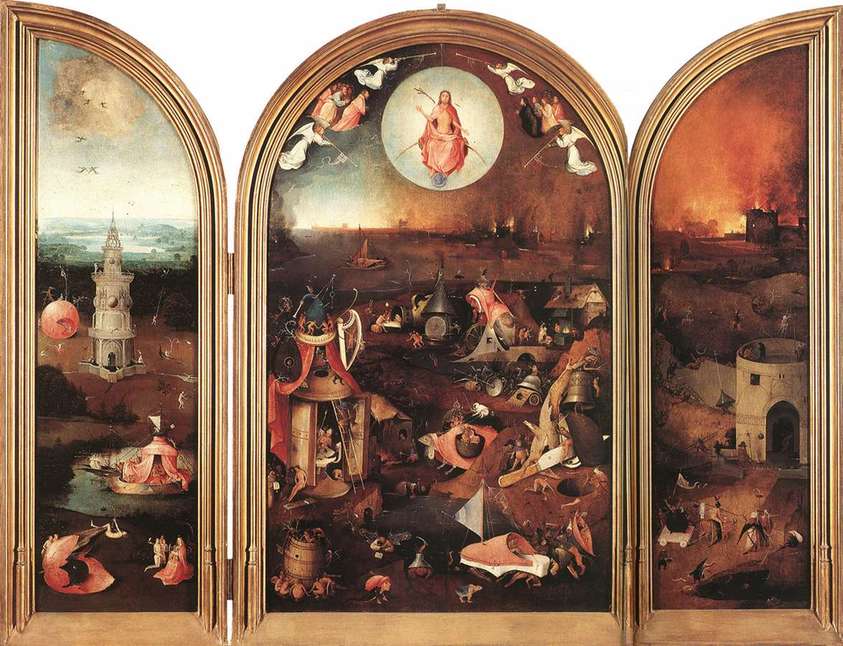
The scheme is clear enough: paradise on the left wing, the Judgement in the centre, hell on the right. What Bosch does within it is far less orderly. He packs in incident after incident, and the earthly world of the central panel already looks close to a place of punishment. The boundary between judgement and torment is softer than the three-part plan suggests. His strange creatures are part of that vision.
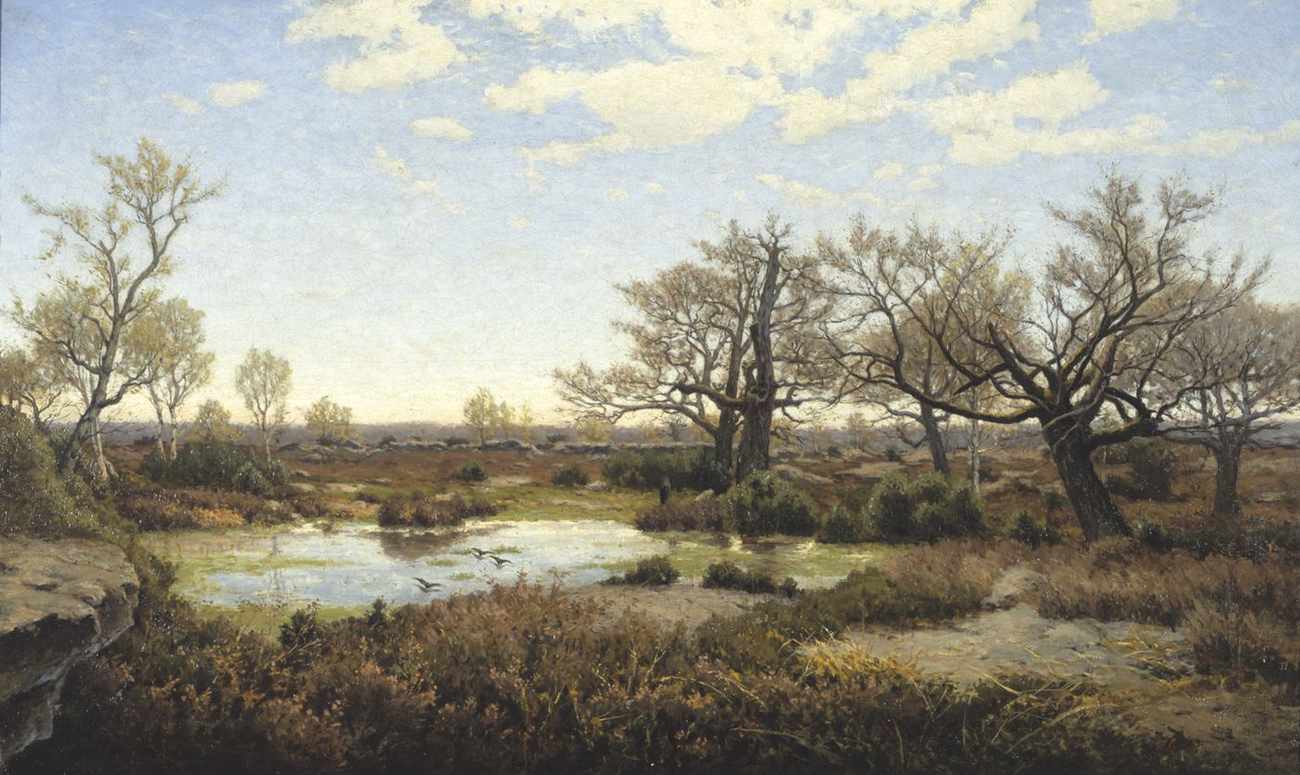
The title means "the fairies' pond". What Asselbergs actually painted is a modest patch of woodland at Fontainebleau, with no mountain or landmark to organise the view. The edge of the pool keeps changing direction among grasses and trees, so that land and water meet unevenly, and a broad sky stretches over it all.
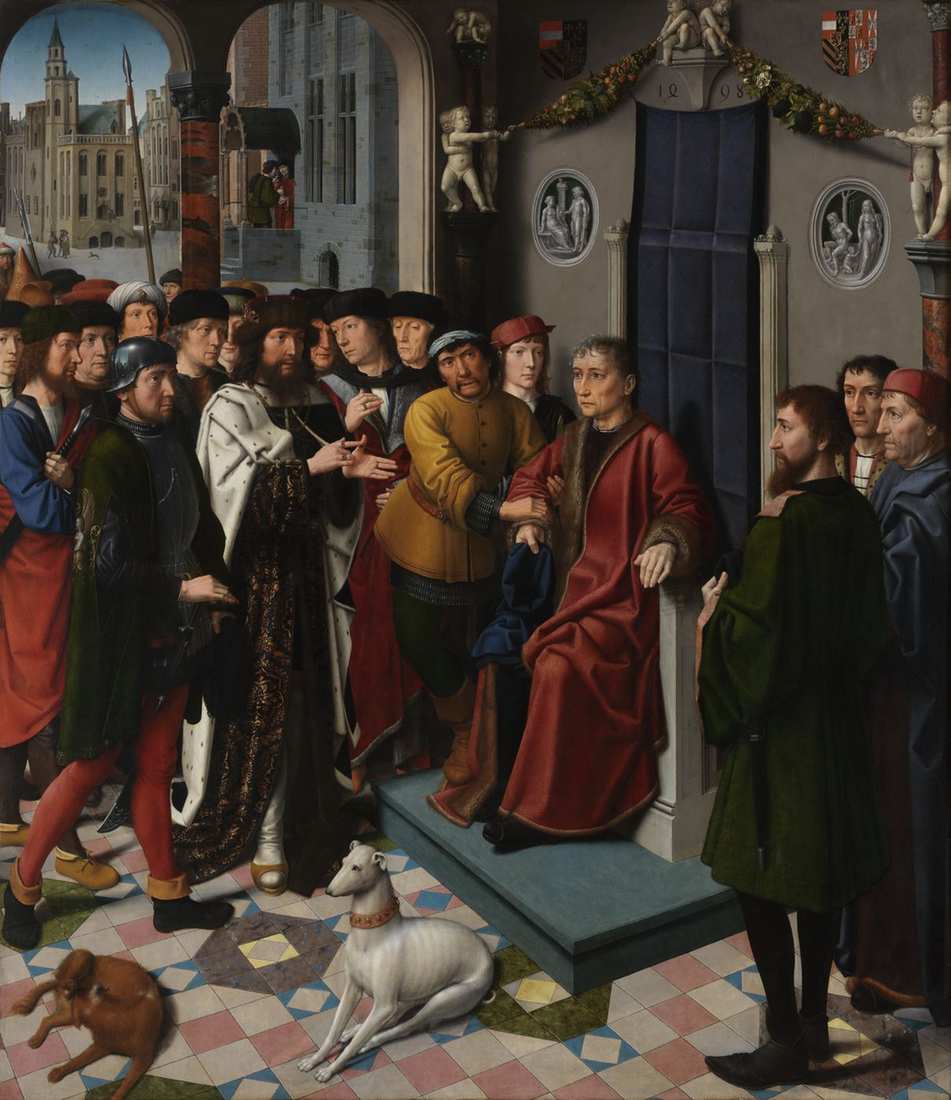
Hands point at the seated man and faces watch him. The accusation is made in public, before witnesses in rich clothing who belong to an ordered civic world. They stand so close that his own place in that world suddenly looks precarious. David makes the pressure felt largely through how near everyone is.
Claeissens turns his banqueters outwards, so they present themselves to us as much as to one another. Costumes, vessels and decoration all announce abundance. The picture seems less concerned with the meal than with being seen at it.
c. 1502 - circa 1508 · Oil on panel · Groeningemuseum
Beside the Sisamnes, this panel shows David working in a quite different register. A landscape running far into the distance takes the place of the crowded civic scene. The accusers in the earlier panel press in on their man, but here David leaves small intervals around the principal figures and keeps their gestures measured. A raised vessel marks the act of baptism clearly enough to hold its own against all that space and abundance.
Ensor drew himself in Conté crayon, head inclined, and left much of the sheet empty. The marks gather density where the likeness needs them and loosen into suggestion elsewhere. The bare paper does the rest.
After Claeissens's outward-facing banqueters, Dirck Hals's company is taken up with itself. A glass, an instrument and an outstretched hand each link one person to another across the table, and the scene is built from these small exchanges rather than from any ranking of the figures. No one commands the group.
A coat of arms and a city seen through an opening give Jan van Eyewerve a public identity beyond the record of his features. His dark clothing keeps the figure compact against the panel. Pieter Pourbus painted a companion portrait of Jacquemyne Buuck on a separate panel, and it is the next entry here.
Here the white collar does much of the work. It cuts a sharp shape into the black dress and draws the eye up from her hands to her face. Lower down is a small dog. The composition reverses that of Jan van Eyewerve's portrait, so the two panels read as a pair, though each sitter keeps a self-contained space.
Peeter van Bredael sets his market beneath antique ruins far larger than the people moving among them. Traders and animals go about their business while the architecture dominates, and through the arch the view opens onto a more distant landscape. The title calls the scene Italianate, and it shows everyday trade carried on amid picturesque decay.
Saint Luke, patron of painters, is shown painting the Madonna, yet the two occupy a surprisingly small area at the centre of the canvas. Columns, arches and ornament fill most of it, and the eye has to work its way through all of this before it reaches the devotional subject. In a picture about the act of painting, is the real subject Luke at work, or the architecture that all but swallows him?
1943 · Oost-indische inkt en waterverf · Groeningemuseum
Spilliaert places a violinist among trees in the snow. Working in Indian ink and watercolour, he spaces the trunks at even intervals, like bars, and her curved posture breaks their strict verticals. The snowy ground is almost featureless, and nothing else keeps her company.
Van Goyen sets the horizon low and gives most of the panel to the sky, so the weather, more than land or water, sets the character of this river view. Against the greys of cloud and river, a brown sail is enough to stand out. The rest of the distance is built from quieter shifts of tone, and the boats hold their places without any need for sharply separated colours.
Isabella of Portugal kneels as donor, accompanied by Saint Elizabeth, in a space that opens outwards through an arch. The panel is a wing from a triptych, and on its own it is plainly incomplete. Her prayer is directed beyond the panel's edge, towards the rest of an ensemble that is not here.
Embroidered robes, stone, gleaming armour and the canon's white clothing: Van Eyck uses these materials to keep each figure distinct, even though all are gathered closely around the Madonna and Child. What lifts the picture above a display of technique is Joris van der Paele himself. His individual, visibly ageing face is admitted to this sacred company, and Van Eyck examines it as closely as he examined Margareta's.
Fourmois has the mountains that Asselbergs's woodland lacks. Small figures near the water give a measure of the valley without taking it over. They are just large enough to establish the foreground and set a scale for the receding space, and beyond them the terrain runs on into the mountains. It is a conventional arrangement, soundly carried out.
c. 1852 - circa 1875 · Oil on canvas · Groeningemuseum
Van Goyen's river view depends on subdued tone. Clays's is busier, and the shipping carries the interest. Sails lean at varied angles across the open water, setting the river in motion without crowding it. There is a brownish sail here too, a larger tan one in the nearer middle ground. Van Goyen's stands out against grey, but this one sets the scale for the smaller, more distant vessels.
c. 1825 - circa 1830 · Oil on ivory · Groeningemuseum
Pourbus surrounded Jan van Eyewerve with a coat of arms and a city. Van Acker, in this oval in oil on ivory, gives Kinsoen almost nothing beyond head, shoulders and a pale collar that stands out crisply against a dark coat. With no surroundings to place him socially or professionally, the likeness has to carry his identity alone.
Explore this selection in Artline
See the selected works alongside books and events from their period, or compare when the artists lived. The books and events provide context, not evidence of direct influence. Works without confirmed dates remain in this guide.
Display and visiting
Any of these paintings may be on loan or off view at a given time, and drawings such as Ensor's self-portrait are not always shown. It is worth checking Musea Brugge's current visitor information before a visit.
Further reading
Leonardo da Vinci; translated by John Francis Rigaud · Read free · English
Rigaud's English translation of Leonardo's notes on painting covers light, drapery and the arrangement of figures. Read beside the earlier panels, it gives a Renaissance painter's own thinking on problems those pictures also take on, from Van der Goes's varied apostles to Van Eyck's textiles.
 Art, literature & history