Among the best-known works at the Detroit Institute of Arts are Diego Rivera's Detroit Industry murals, painted for the museum. But its holdings range widely. This selection of twenty works includes biblical subjects by Caravaggio, Poussin and Jordaens, Fuseli's Nightmare, and two panels of Saint Jerome with different attribution histories. There are landscapes by Church and Bierstadt, a Kokoschka view of the Elbe near Dresden, Matisse's Window, and more recent work by Bacon, Bourgeois and Shahn. Some works may be off display or on loan.
Artline selected these works from documented museum holdings independently of the museum. Individual works may be on loan or off display. Attributions and dates retain the qualifications in the linked records.
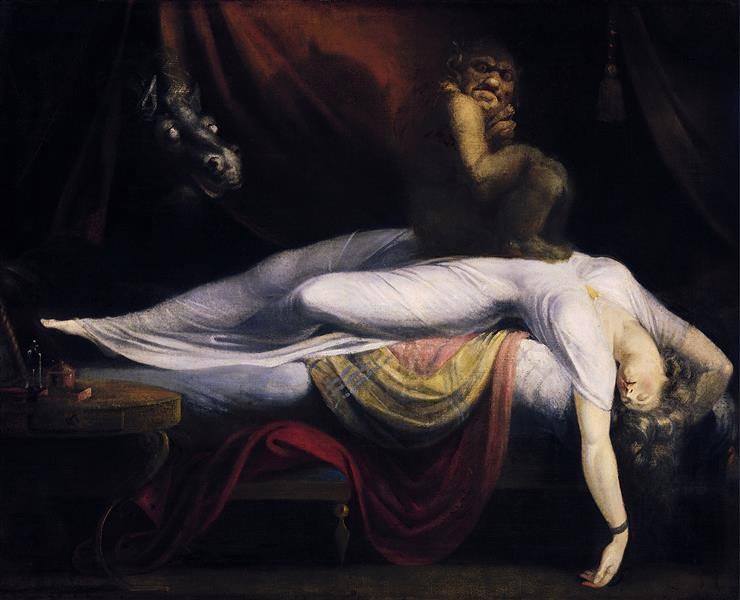
A woman lies asleep across a bed. A strange creature sits on her chest; behind them a horse's head emerges from the darkness. Fuseli makes each element perfectly legible while keeping the whole scene impossible. The sleeper is unaware, but her nightmare has taken solid form in the room and we are looking straight at it.
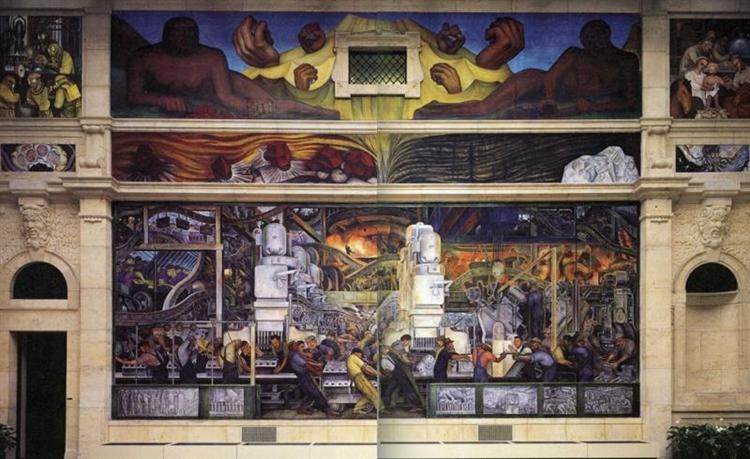
Rivera painted this wall as part of a fresco cycle surrounding an entire room. The north wall shows the factory floor: workers each busy with a particular task, bodies and pipes repeating across the scene, individual actions drawn into a single system of production. The scale matters. Reproductions can show what each figure is doing, but they cannot give the effect of industry filling the room, of mural painting turned into an account of collective labour organised across an architectural space.
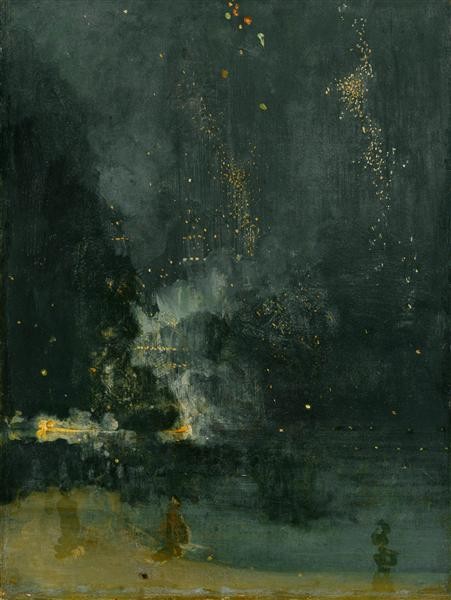
Gold marks fall through darkness. A few dabs suggest water, figures and distance, but Whistler gives just enough for recognition and no more. The firework is barely there, scattered into points of light and colour rather than drawn. The picture works through colour, tone and mood more than through description.
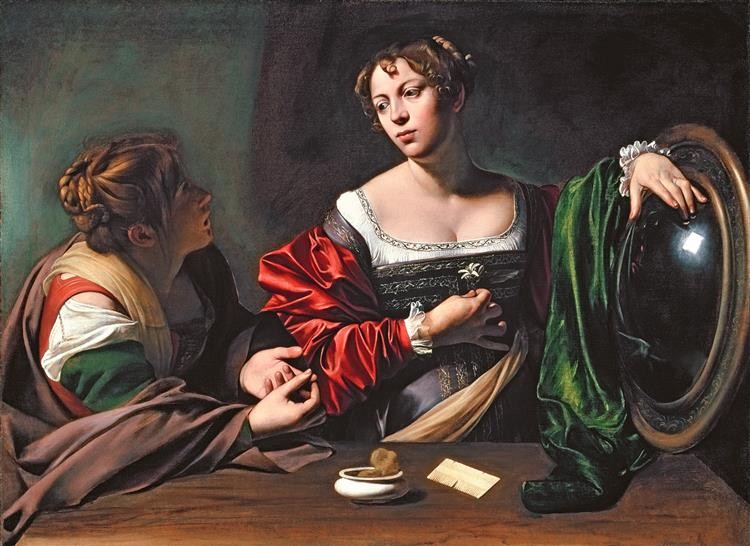
A mirror enters the conversation between the two women as a physical object. It is both an argument and a physical fact: the mirror is an object you can pick up and point. Caravaggio compresses the whole encounter of Martha and Mary Magdalene into this exchange, two figures in close quarters with no setting beyond them. One speaks, while the other's hand draws attention to her own body. The subject is religious, but what we see is a conversation about appearance conducted with an actual reflecting surface.
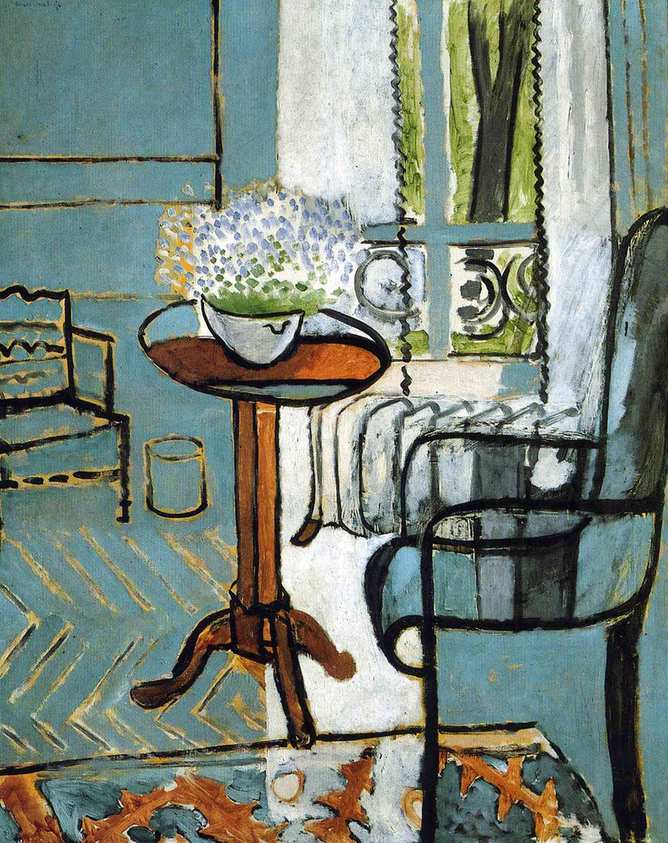
The window divides the canvas into blue interior and green exterior, but Matisse flattens the division so severely that inside and outside become adjoining colour planes. Table, chair, flowers remain recognisable, yet their edges also function as the borders between areas of pigment. The painting keeps its double nature in view: an opening onto space, and a flat arrangement of colour.
Smoke rises from the volcano and spreads across the sky, turning the light red over the whole landscape. The foreground is worked in careful detail, its small features giving us a scale to measure the eruption against. But the horizon is unstable, the air itself altered by the event. Distance gives the painting its drama: we are far enough away to see the whole scene, too far away to do anything about it.
c. 1435 · Oil on linen paper on oak panel · Detroit Institute of Arts
This tiny panel—about twenty centimetres high—shows Jerome at work in a room crowded with books and instruments, with the lion from his legend at his feet. It is painted in oil on linen paper mounted on oak. The Detroit Institute currently attributes it to Jan van Eyck and dates it to around 1435, though the attribution has changed over the years. Whatever the hand, the panel rewards close looking: every object is distinct, and the space is both compressed and entirely coherent.
1450–1465 · Oil on oak panel · Detroit Institute of Arts
The other Jerome panel shows the saint outdoors, beside the lion whose paw he is tending. Angular rocks press in around them, making the desert feel as enclosed as an interior. The museum attributes this to the workshop of Rogier van der Weyden, which places it within his practice but not necessarily by his own hand. Comparing the two Jerome panels—one in a study, one in the wilderness—shows how differently artists approached the same subject, and how attribution histories can diverge.
Men stand and lean at the bar; the walls are thick with pictures, fittings, the accumulated stuff of a room in steady use. A worker dressed in white stands out against the dark interior. This painting from 1912 has no centre of action, no main character. It is a record of a place arranged by habit, by where people stand when they come in, not by narrative.
Figures, a pink heart-shaped form, bright signs and small incidents scattered across a yellow field, each sized according to its role in the picture rather than its physical dimensions. Stettheimer's painting does not establish a unified space with consistent scale. Instead it reads as a series of events happening at once, flat and decorative and deliberately unresolved. The title promises flight, but nothing here suggests a single direction.
The words come first: Hebrew Books, Holy Day Books, set out in clear lettering on the shop. Shahn uses the sign to identify what kind of shop this is before the figure at the threshold tells us anything about who is there or when. The thin lines, the red entrance, the precise typography—all of it marks this out as a particular place, a small specialised business defined by what it sells and by the script on its front.
Bacon draws a geometric cage around the crouching body but leaves the figure itself unstable, half-dissolved. The enclosure is clear, the anatomy is not. Vertical streaks run down the dark background. The title says this is a study, which suggests something provisional, but the sense of confinement is deliberate: the structure leaves the body almost no room, and the pose looks cramped even without bars.
Rousseau's view from the riverbank shows factories and chimneys as clean, separate shapes on the far side of the water. Industry appears as architecture, not as labour. There are no people at work, no indication of what goes on inside these buildings. The painting is oddly still: a record of the edge of Paris in 1896, with production visible only as built form seen from outside.
Early–mid 16th century · Detroit Institute of Arts
Three figures, closely grouped, connected by hands and glances. But what is happening between them does not resolve into a clear story, and both the title and the attribution have shifted over time. The museum now catalogues it as The Appeal by Titian, dated to the early to mid sixteenth century. The painting holds attention without explaining itself, which may be why its identity has remained uncertain.
Mary bends towards the cradle, Joseph stands further back. Poussin measures these different degrees of closeness within a firm architectural setting: drapery, a tall opening, the structure of the room all clearly defined. The painting organises space carefully, but the care itself is directed towards a small domestic act at the centre. Architecture and intimacy, held in balance.
Pink uprights joined by a horizontal bar, each tapering towards the base. The title refers to people, but Bourgeois gives them no heads, no individual bodies. What we see are repeated elements, abstract and precarious, narrowing to points that look incapable of holding the structure upright. The instability is built into the form itself, a group that shares a single failing.
The church tower and the town remain identifiable in this view of the Elbe near Dresden, but Kokoschka's handling makes the whole view unstable. Blue water, bands of red and green along the banks, and the same turbulence continuing into the sky. The buildings do not sit still; they move with the surface, part of the same agitated colour. Kokoschka painted this in 1921, and the whole scene looks unsteady.
Tents and figures in a clearing, painted from far enough away that people become part of a broader pattern of light and shade under tall trees. The painting is dated 1859. The camp is plainly inhabited, but the figures are too small and too distant to tell us much about the people living there. Scale and distance shape what the painting can and cannot say.
Both hands on the mandolin, the head turned away in another direction. The pose has energy because it is slightly awkward, because face and hands do not align. Tiepolo brings pale skin and bright fabric out of a dark background, but the picture's life comes from that small asymmetry, the woman caught between the instrument and whatever has drawn her attention elsewhere.
c. 1620 · Oil on oak panel · Detroit Institute of Arts
Jordaens builds this from a weathered face, a bare chest, an upward gaze. Light falls across exposed flesh that looks vulnerable and particular. The painting keeps Job individual—an old man in physical distress appealing for relief—rather than turning him into an abstract sign of patience. It is painted in oil on oak panel, and the suffering it shows stays specific.
Explore this selection in Artline
See the selected works alongside books and events from their period, or compare when the artists lived. The books and events provide context, not evidence of direct influence. Works without confirmed dates remain in this guide.
Before visiting
These works are drawn from the museum's collection and do not form a set route. Some may be on loan or off display. The museum's current records give up-to-date information on display and attribution. The Rivera entry covers only the north wall of the Detroit Industry murals, not the complete cycle.
Harold Speed's treatise addresses mass, line and tone in general terms. It does not discuss the Detroit collection, but it offers a practical account of how drawing works that applies across periods and scales, from small panels to large figure compositions.
 Art, literature & history