The Cleveland Museum of Art collects across many centuries and cultures. This selection keeps to one part of that range, its European and American paintings and works on paper, and runs from fifteenth-century Italian panels in tempera and oil to Dalí's The Dream and O'Keeffe's enlarged morning glory. The subjects are deliberately varied: martyrdom and classical myth, a road gang mending a street under plane trees, prizefighters at Sharkey's, an elevated railway seen steeply from above. Antoine Pesne's Lot and His Daughters, in chalk and wash, is the only drawing. Some pictures answer one another across the centuries. Matteo di Giovanni's orderly Crucifixion, painted with gold, can be set against Caravaggio's Saint Andrew, pressed close in darkness. Gentileschi's Danaë, awake to a shower of gold, and David's sleeping Psyche both lie on beds, in two very different myths.
Artline selected these works from documented museum holdings, independently of the museum. Being included here does not mean a work is on view: works on paper rotate, and paintings may be on loan or off display. Dates and attributions keep the qualifications given in the linked records.
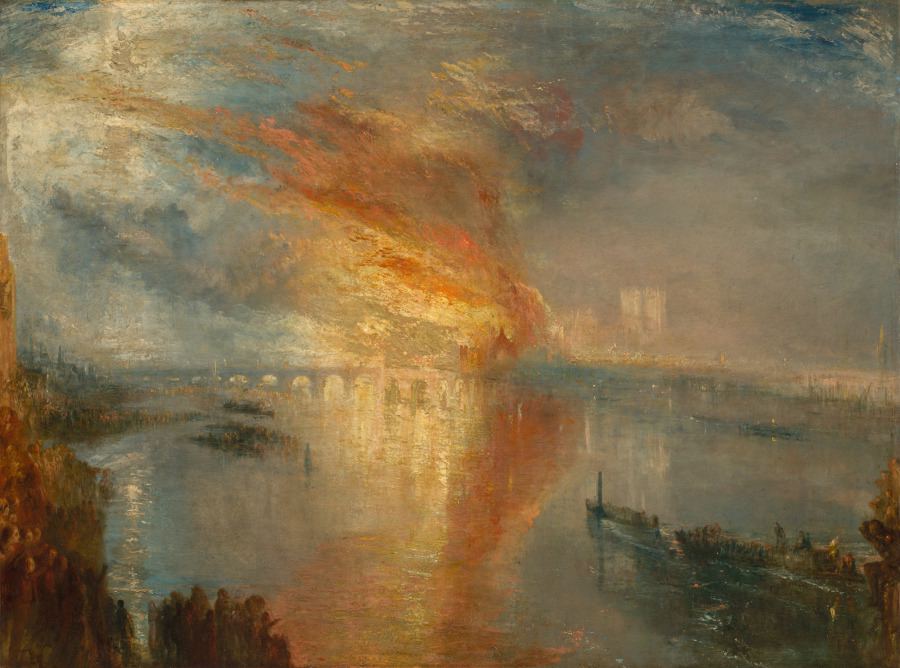
Fire destroyed much of the old Palace of Westminster in 1834, and it drew a large audience. Turner paints the crowds watching from the banks of the Thames and from boats as the flames reach high and their reflections spread across the water. He pushes light and smoke close to overwhelming, yet the spectators never vanish in the glare, and the burning building and the people watching it stay visible together. Turner painted the fire more than once: the Philadelphia view of the same blaze is a different canvas.
c. 1868–73 · Oil on fabric · Cleveland Museum of Art
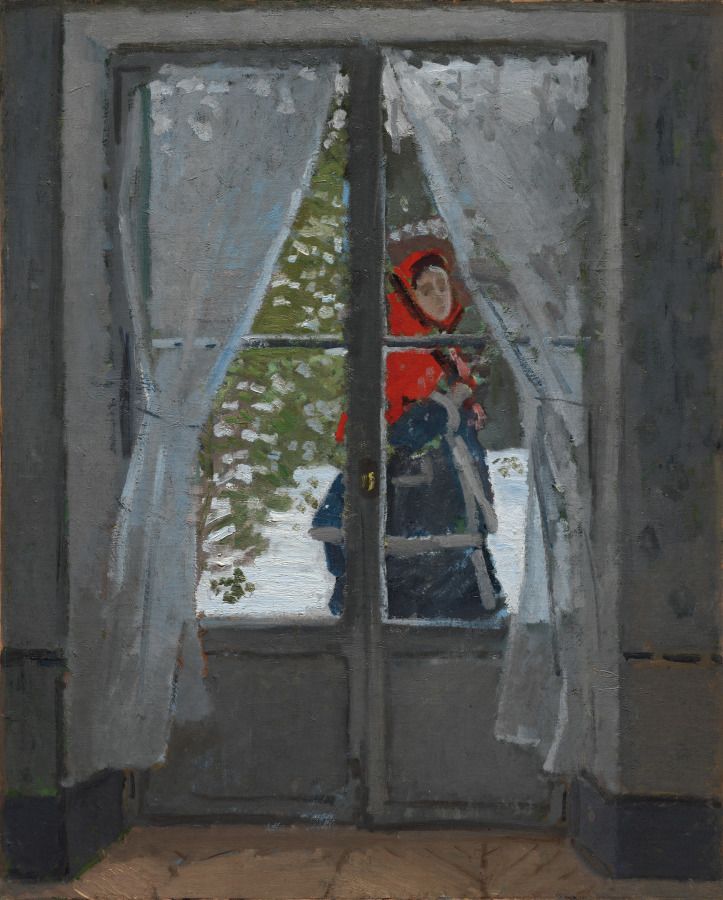
Camille Monet, out in the snow, looks in through the French doors. Her red kerchief catches the eye through pale curtains and glass, and the panes keep her side separate from the room. That puts the viewer indoors, looking out at someone looking in, through the doors of an ordinary house.
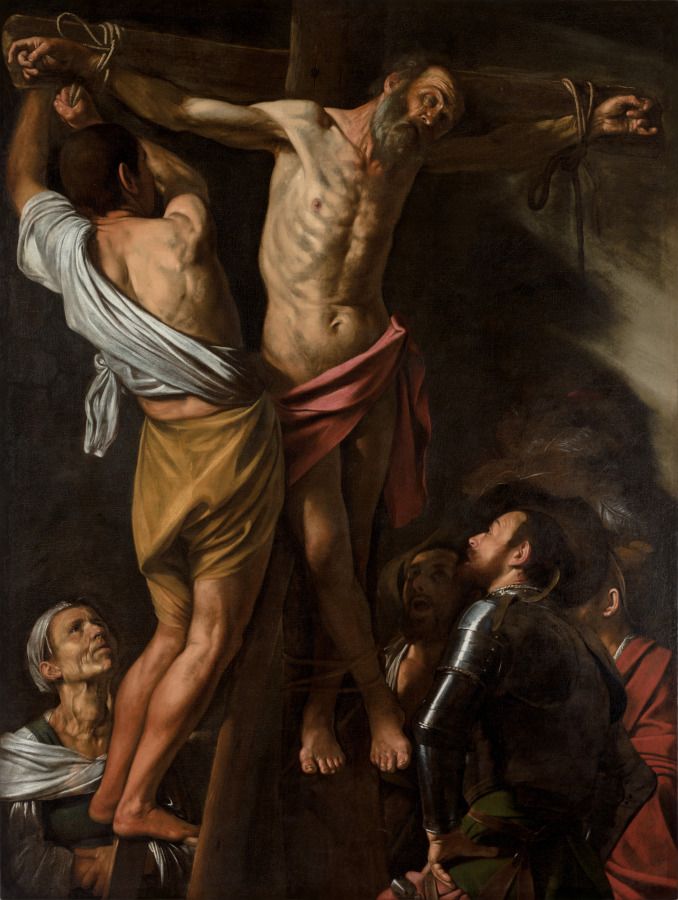
Caravaggio leaves little room to stand back. Andrew's ageing body, the people holding him and their coarse clothing loom out of a darkness that hides most of the setting. What is left is the physical business of the execution: weight, hands, strain, and faces close enough for suffering to register without rhetoric.
c. 1488–93 · Tempera and oil on wood · Cleveland Museum of Art
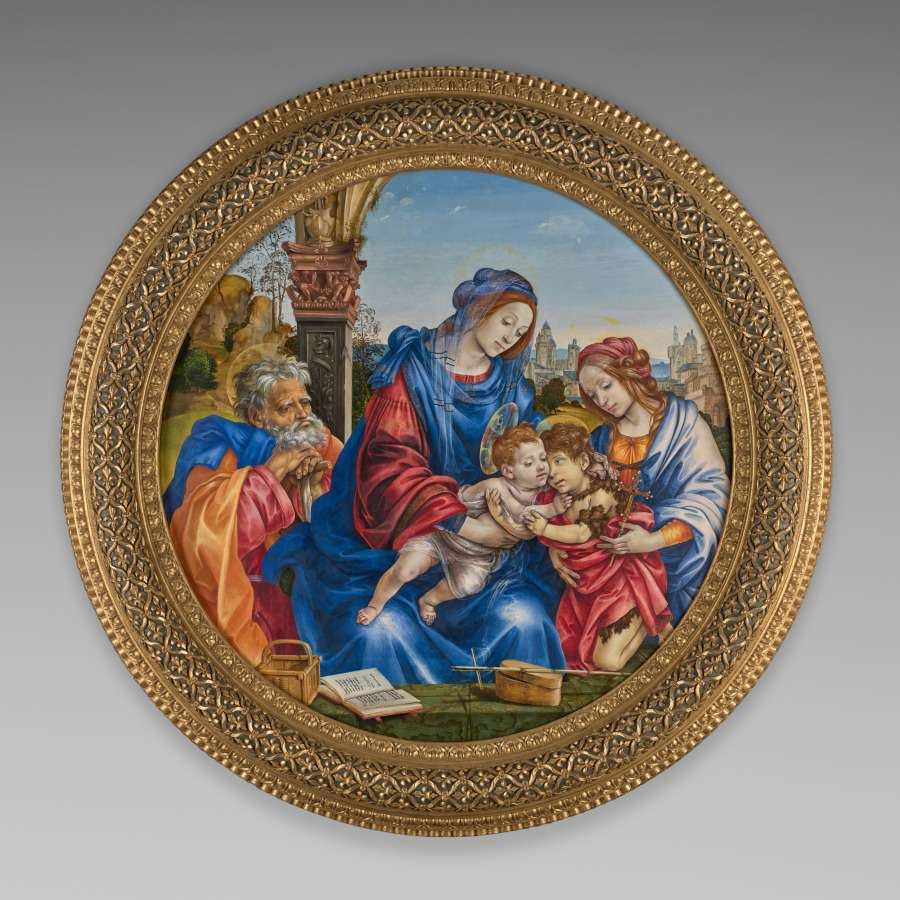
A round picture has no corners to leave empty. Filippino Lippi fits the Holy Family and Saints John and Margaret inside the curve by overlapping their gestures, and small glimpses of landscape ease the crowding. The design is held together by turned heads and linked hands rather than by symmetry.
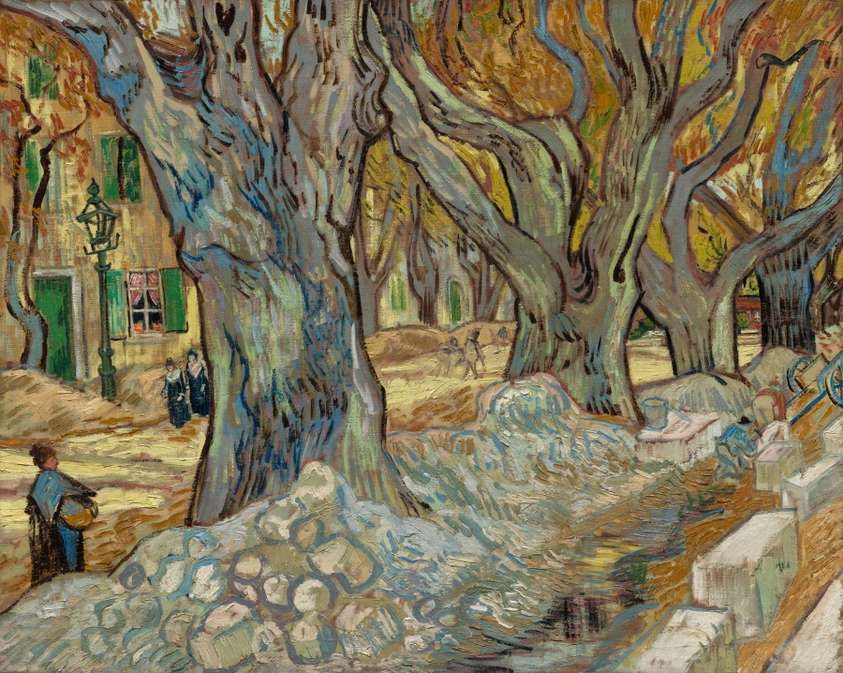
The title gives the trees top billing, and the painting agrees. Their great trunks rise through the picture while road workers repair the street, small, beneath them. Van Gogh varies his strokes to tell bark from paving and foliage, and gives the trees at least as much painted activity as the people at work.
1756 · Black and red chalk wash, gray wash, heightened with white gouache; framing lines in black ink · Cleveland Museum of Art
Black and red chalk wash, grey wash and white gouache heightening, inside framing lines in black ink: the sheet shows a composition still being worked out. Pesne fits three figures together on uneven ground. Warm washes suggest their volume without closing every contour, and darker touches add weight to the faces and drapery. The subject is the biblical one named in the title, but the drawing can just as well be read as a group being adjusted, pose by pose and overlap by overlap, until it holds.
Every element of The Dream is painted with disconcerting clarity: the head, the distant column, the streaming, hair-like forms. What unsettles is how they relate to one another. Scale and substance behave unpredictably, and recognising each thing does little to explain how they belong together.
A Black man rests just outside the doorway. The music reaches him through the opening, and his posture shows he is attending to it, but the wall keeps him physically apart from the musicians inside. Mount builds the picture around that threshold, so pleasure and exclusion share a single scene. The title speaks of music's power, and the listener's absorption bears that out. How far does that power reach, though? Through the doorway, plainly, but not, the composition suggests, past the wall that keeps him outside.
c. 1895–1900 · Oil on fabric · Cleveland Museum of Art
A stream leads into wooded ground, but Cézanne never draws its banks as continuous edges. Patches of blue, green and ochre meet, overlap and separate, suggesting water in one place, vegetation in another and the space between them. Plenty of single strokes cannot be pinned to any object, yet the brook stays recognisable.
1470s · Tempera and oil with gold on wood panel · Cleveland Museum of Art
Matteo di Giovanni gives each witness a separate place beneath the tall cross. Firm contours and distinct colours keep their gestures legible on the small panel, and the orderly arrangement lets the eye move deliberately from one figure to the next.
Church puts his most intense colour high in the red clouds, above a valley with no one in it. Dark trees give the foreground a near foothold, and from there water and distant hills lead the eye back towards the sky. Nothing happens on the ground. The empty valley is the wilderness of the title, and the twilight supplies the only event.
The boxers collide above a crowd pressing up against the ring. Bellows handles the paint roughly, so arms, torsos and faces never settle into smooth, separate forms. Turner's spectators watch the fire from banks and boats. The crowd at Sharkey's is close enough to be implicated, part of the cramped reality of the fight.
A boy and a woman go about their tasks in a sparse household, and Zurbarán leaves a gap between them so that each posture reads clearly. Small objects, flowers and birds emerge only on slower looking. The title names the pair as Christ and the Virgin in the house at Nazareth, yet the painting keeps its attention at the scale of a table, work in hand and time spent together indoors.
Seen steeply from above, the El, or elevated railway, and the buildings around it become interlocking planes. Sheeler cuts out the incidental detail that would make this a busy street scene. The city stays identifiable, but the track reads as a geometric line, and a shadow can seem as solid as the structure that casts it.
Psyche sleeps while Cupid turns outwards, so only he seems aware of being seen. David surrounds the myth with luxury, an elaborate bed with a landscape opening beyond, but Cupid's direct glance cuts through all that distance, as if he has caught the viewer looking at the sleeping Psyche.
Gold falls from above, and hands move across the pale bed to meet it. Gentileschi stages this supernatural visitation among fabrics whose folds and weight seem insistently tangible, closed in by dark curtains. The story is told through reach and response between the reclining Danaë and what arrives from the sky.
West brings the child's face close to his mother's cheek and encloses the boy in her arms. There is almost nothing else: no furniture to place them in a household or signal their status, only light joining the two faces against the dark.
1540 · Oil, originally on wood, transferred to masonite · Cleveland Museum of Art
No rider in the chase could have seen it like this. Cranach sets the vantage point high above, and horsemen, dogs and deer spread across woods, water and clearings, so that each incident can be followed in turn and the hunt reads as an organised spectacle. The picture has had a history of its own: it was painted on wood and later transferred to masonite.
c. 1830–31 · Oil on fabric · Cleveland Museum of Art
Pale, uneven ground stretches between sparse trees. Corot holds the view together with broad divisions of earth and sky and puts no dramatic incident at the centre. The figures and animals are there to show the scale of the terrain and do nothing more, which leaves the rough country of the Campagna as the subject.
O'Keeffe enlarges the morning glory until almost nothing else fits in the frame. At this scale the folded petals read less as botanical detail than as surrounding space. The black of the title comes as a dark curve at the bottom, breaking into the pale surfaces. It gives the soft gradations an edge, which makes their shifts of light easier to follow.
Explore this selection in Artline
See the selected works alongside books and events from their period, or compare when the artists lived. The books and events provide context, not evidence of direct influence. Works without confirmed dates remain in this guide.
Planning a visit
The order of this selection is not a route through the galleries. Check the museum's current object records and visiting information before planning a trip around a particular work.
Harold Speed's general manual of drawing deals with line, mass and composition in practical terms and sets exercises for the reader. Those exercises bear most directly on the difference between Pesne's worked sheet, where wash models the figures without closing their contours, and the more fully modelled paintings. His account of line, mass and composition also provides practical terms for comparing the crowded and the sparsely arranged works in this selection, from Lippi's packed tondo to Corot's thinly peopled Campagna, though it is not a study of this museum or its pictures.
 Art, literature & history