The Centre Pompidou's collection belongs to the Musée national d'art moderne, which holds France's national collection of modern art. Its holdings go well beyond painting and sculpture into design and photography, and they trace many of the major developments in twentieth-century art. Twenty works can only be a small, partial sample, and this one leans heavily towards painting. Most are recorded as oils, with Braque's Fruit Dish combining oil with charcoal and gouache. Exceptions include a pastel by Joan Miró, and no medium is recorded for Sophie Taeuber-Arp's painted head on its stand, Matisse's cut forms, Valadon's The Blue Room or Kandinsky's Yellow-Red-Blue and Sky Blue.
Several artists appear more than once, so some works can be compared with others from the same career. Picasso is here with a fractured bust, a still life built round a classical bust and a serenade. Braque has a Cubist fruit dish and a later red pedestal. Kandinsky has a picture split between yellow angles and dark circles, and a field of separate shapes on blue. Suzanne Valadon has a close portrait of the composer Erik Satie and a reclining woman on a patterned bed. Around these pairs are pictures of very different things: Otto Dix's mirrored halls in Brussels, a poultry yard by Henri Rousseau, a courtyard seen through a window by Balthus and a largely black surface by Pierre Soulages.
Artline chose these works from the museum's documented holdings, independently of the museum. Dates and attributions keep the qualifications given in the linked records.
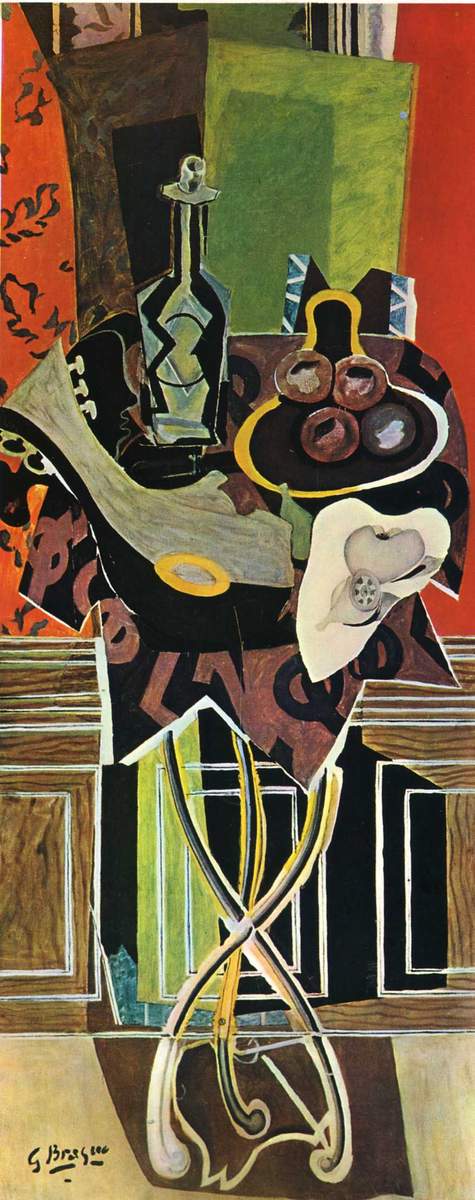
1939 · Oil on canvas · Musée national d’art moderne — Centre Pompidou
Braque gathers objects round a red stand and lets their outlines overlap and slip into one another, so they can be recognised only in part. The pedestal is spared. It keeps its solid colour and its shape, the one stable structure in the picture. Much Cubist painting builds familiar things out of fragments, which is why a single intact object stands out so firmly here. In Braque's earlier Fruit Dish, also in this selection, nothing gets that kind of wholeness.
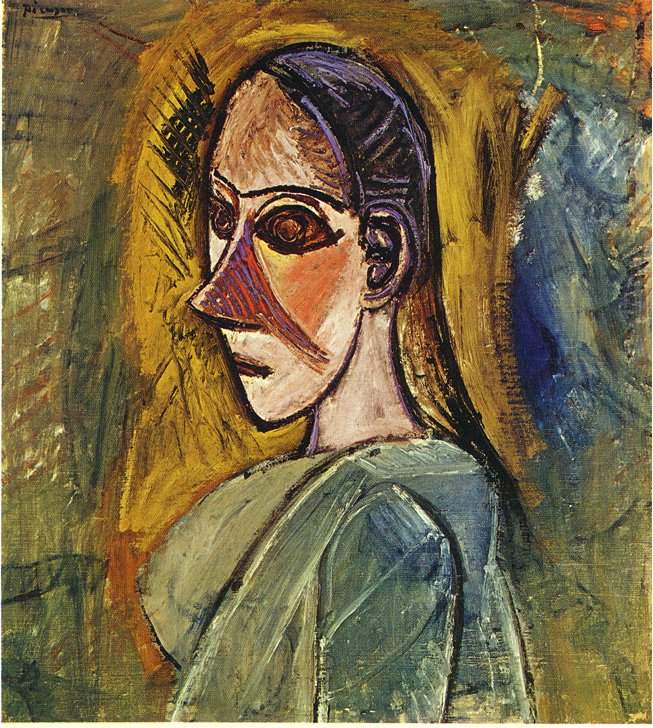
1907 · Oil on canvas · Musée national d’art moderne — Centre Pompidou
Dark contours cut the face into separate areas. Each plane keeps to its own angle, so the flesh never smooths into a continuous surface. A broad shoulder and a turned head are enough to make this a bust, a familiar format, yet the parts will not settle into a single viewpoint. As for the sitter, the title says only that she is a young woman from Avignon, and the painting tells us little more.
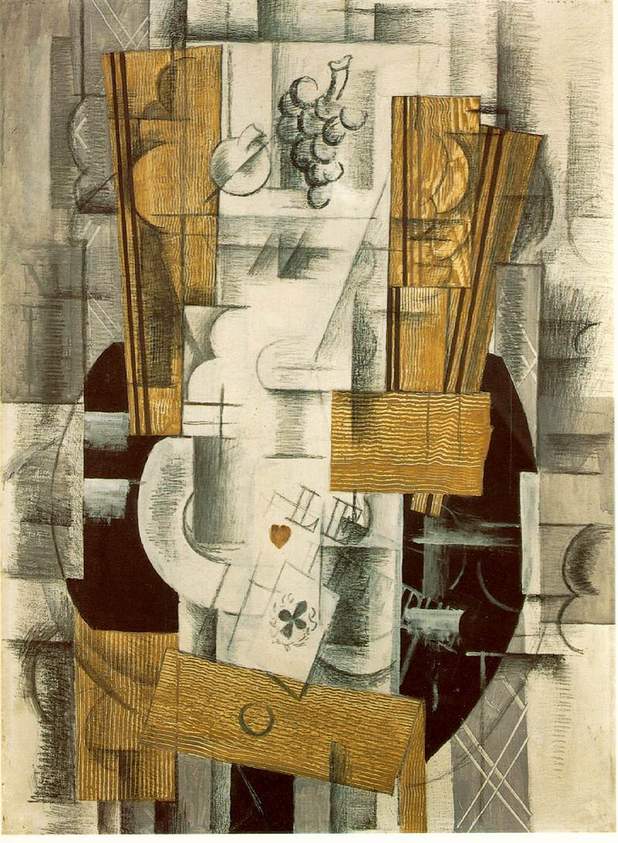
1913 · Charcoal, gouache and oil on canvas · Musée national d’art moderne — Centre Pompidou
Charcoal and gouache share the canvas with oil, and dish, fruit and table have to be pieced together from incomplete clues. A line will run on across an area whose tone or texture pulls it firmly back to the flat surface, so depth is suggested and then withdrawn. The different kinds of mark stand for objects without ever adding up to a view you could check against a real table.
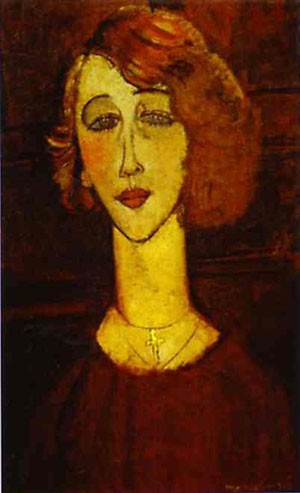
1916 · Oil on canvas · Musée national d’art moderne — Centre Pompidou
Modigliani makes no pretence of natural proportion. The neck is drawn out between dark clothing and red hair, continuing the picture's vertical movement, and curves repeat throughout. With so much stylisation, it is the face that keeps Lolotte from dissolving into pattern. It is neither perfectly symmetrical nor generic: small differences in the eyes and mouth break the overall regularity.
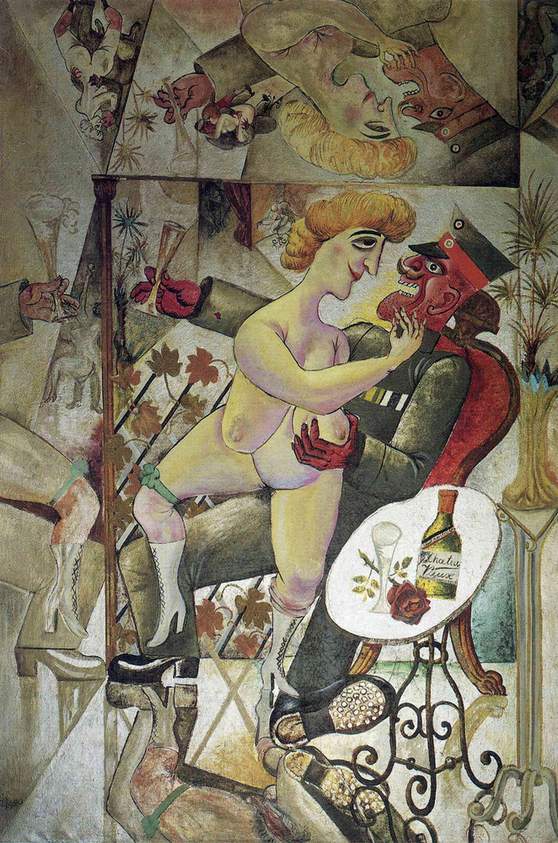
1920 · Oil on canvas · Musée national d’art moderne — Centre Pompidou
Figures, furnishings and reflected fragments meet at abrupt angles. The mirrors multiply the room until its actual layout is hard to work out, and Dix leaves few reliable routes through the crowded interior. The title calls the picture a memory, not a survey of the place, which may explain why the confusion counts for more than the plan.
1925 · Musée national d’art moderne — Centre Pompidou
The title names colours and nothing else, and the picture tells no story. Instead it is divided against itself. Angular yellow forms spread across one side, darker circular masses and curling lines gather on the other, and red areas mediate where the two meet. What movement there is comes from unequal weights and from contrasting kinds of edge, the angular against the curved, and the balance never quite settles.
1930 · Oil on canvas · Musée national d’art moderne — Centre Pompidou
Dalí lights this low landscape with precision, and the shadows seem more certain than the things casting them. All that exactness does not make the forms any easier to name. Their contours suggest more than one possible body, and because everything is drawn so clearly, every identification looks justified and tends to push out another. The hyphen in the title, fastening woman to horse, describes the result fairly well.
1950 · Oil · Musée national d’art moderne — Centre Pompidou
Soulages titles the work like a catalogue entry, giving its dimensions and a year and nothing that points the eye towards a subject. What remains is the black. It covers much of the surface but is far from uniform. Broad strokes cross and overlap, and their edges show differences of direction and pressure. Between them are small pale openings, and the shape of each changes the weight of the black around it.
c. 1892 · Oil on canvas · Musée national d’art moderne — Centre Pompidou
Valadon frames Satie so closely that there is room for little beyond his hat and coat. Warmer colours pick out the face and beard against the dark surround, and her attention goes to the angle of his head and the direction of his gaze. Nothing in the picture refers to his work as a composer.
1925 · Oil on canvas · Musée national d’art moderne — Centre Pompidou
Picasso's second bust in this selection is a different kind of object: an antique sculpture set among vessels in a still life, not a sitter in a portrait format. A bust of this kind brings an expectation of solid, modelled volume, but the room it enters is divided by sharp planes, and areas of orange, white and black make the depth hard to follow. Picasso gives the classical object no special treatment. It gets the same unstable planes as the vessels beside it.
1943 · Oil on canvas · Musée national d’art moderne — Centre Pompidou
Suggestions of figures surface among the dense lines and coloured marks, but none is cleanly separated from the activity around it. A curve or a pointed form may belong to a body, may interrupt the larger pattern, or may do both. The title promises a character and an action, and the painting is slow to supply either. It offers a "moon-woman", but where exactly is she, and which circle is she cutting?
1942 · Oil on canvas · Musée national d’art moderne — Centre Pompidou
Tanguy's low plain follows the rules of a plausible landscape. The scattered forms on it cast clear shadows and seem to stand firmly in space, and that firmness only makes them stranger, since they have no evident use. Dalí's forms in Paranoiac Woman-Horse invite too many identifications. Tanguy's look as if they belong somewhere, but the picture never explains what they are for, and the title, with its palace and its window rocks, does not settle the matter.
1896 - 1898 · Oil on canvas · Musée national d’art moderne — Centre Pompidou
Rousseau gives an ordinary yard a pronounced order, with paths, fences and buildings dividing it into clear compartments. The small birds inside seem not to have noticed. They move irregularly and ignore the straight lines laid out for them.
1942 · Oil on canvas · Musée national d’art moderne — Centre Pompidou
The room is all angles and neither body in it is drawn naturalistically, yet the situation is clear at once: one figure performs and the other listens. Picasso separates them by colour and posture. The listener reclines in yellow while the musician is upright, and each is set at a different angle.
1951 · Oil on canvas · Musée national d’art moderne — Centre Pompidou
The building opposite is seen through the open window, past the sill and the objects near it, inside a series of enclosing edges. Balthus gives these intervals more weight than any activity in the courtyard, so the picture seems to be as much about the measured distance between room and view as about the view itself.
1934 · Pastel on paper · Musée national d’art moderne — Centre Pompidou
Miró needs only a head, curved arms and feet to suggest a body, though its proportions could not hold up a person in ordinary space. The pastel outline is sharp and the colour around it softer. With so few parts, the gesture reads from the way they relate to one another. The title is as plain as the drawing.
1923 · Musée national d’art moderne — Centre Pompidou
The Satie portrait leaves almost nothing around its sitter. Here, competing patterns surround a reclining woman, from striped trousers to a blue patterned bed. Books give the room an everyday use, so it is more than a backdrop for a pose. Valadon gives the figure bodily weight without idealising her anatomy, and for all its busyness the pattern never crowds her out.
1920 · Musée national d’art moderne — Centre Pompidou
Unlike most of the works here, this one has volume: a rounded form mounted on a narrow stand. It suggests a head, but the painted geometry on it never resolves into a naturalistic face. Taeuber-Arp's colour does not describe the form underneath. It divides that form according to an order of its own, so the construction stays as visible as the likeness.
1940 · Musée national d’art moderne — Centre Pompidou
Where Yellow-Red-Blue sets two halves against each other, Sky Blue keeps everything apart. Each small floating shape has its own curves, stripes or appendages, none merges into a larger mass, and the gaps between them are as noticeable as the shapes themselves. The unbroken blue holds them all in one field.
1952 · Musée national d’art moderne — Centre Pompidou
Matisse's cut forms suggest figures and a performance without modelling them in depth. A yellow instrument and scattered leaf-like shapes add small movements to the broad areas of colour, and the clean edges keep the overlapping activity readable in a crowded scene. The sadness in the title is harder to find. None of the shapes imitates a sorrowful expression, and the picture leaves open how far cut colour can carry such a feeling, and how much is left to the title.
Explore this selection in Artline
See the selected works alongside books and events from their period, or compare when the artists lived. The books and events provide context, not evidence of direct influence. Works without confirmed dates remain in this guide.
Finding the works
Being in the collection does not mean a work is on display, and some of these may be on loan or off display. Before setting out to see a particular one, check the Centre Pompidou's current programme and the object records.
Further reading
Wassily Kandinsky; translated by Michael Sadleir · Read free · English
Kandinsky's own account of what he hoped colour and abstract form could achieve, in Michael Sadleir's English translation. It sets out one painter's historical argument in his own words and makes a useful companion to Yellow-Red-Blue and Sky Blue.
 Art, literature & history