The Belvedere occupies a Baroque palace complex in Vienna and holds one of the central collections of Austrian painting from the nineteenth and early twentieth centuries. Klimt's The Kiss is among the best-known paintings in the city, and it is included here. The artist with the most entries, though, is Anton Romako, who is less familiar than his younger compatriots.
Romako is not easy to sum up. He could load a portrait with lace, a bow and an open fan. He could paint a woman from behind at a balcony door, or make a forest picture out of little more than thistles and undergrowth. Taken together, his pictures cover more ground than any other group in the selection.
Around him are the painters most visitors come for. The Klimts run from the portrait of Sonja Knips to the unfinished Adam and Eve, while Schiele, Richard Gerstl and Oskar Kokoschka bring sharper angles and rougher paint. Ferdinand Georg Waldmüller and Carola Nahowska add further Austrian work. A smaller group comes from beyond Austria, including David's equestrian Napoleon and paintings by Corot, Monet and Van Gogh.
The works were chosen from documented Belvedere holdings, independently of the museum. Dates and attributions keep the qualifications given in the records they come from.
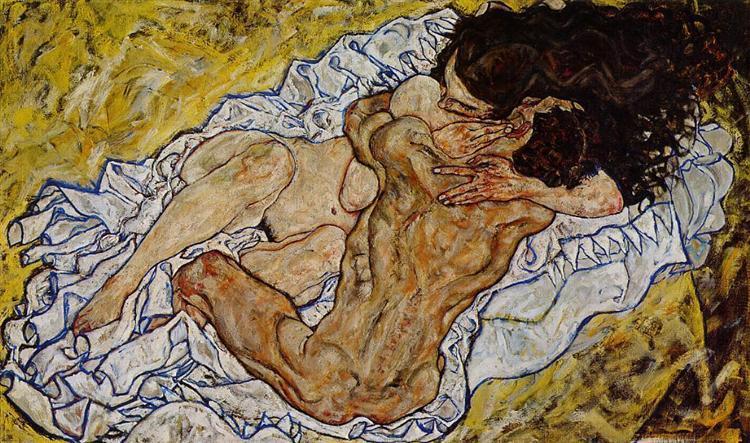
Schiele's couple lie entwined on a creased sheet against yellow surroundings, their angular bodies pressed into a compact mass. The sheet is no soft resting place. Its folds are as sharp as the limbs lying on it, and the pressure of the embrace seems to run on into the fabric.
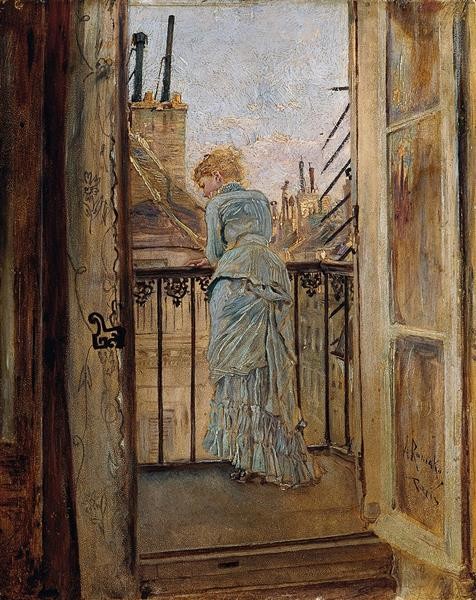
We are left in the room. A woman in a pale blue dress stands at a narrow balcony door with her back to us, looking past the railing to roofs and a street, and we see the view only past her figure. Romako gives the cramped doorway as much weight as the outlook it opens on to.
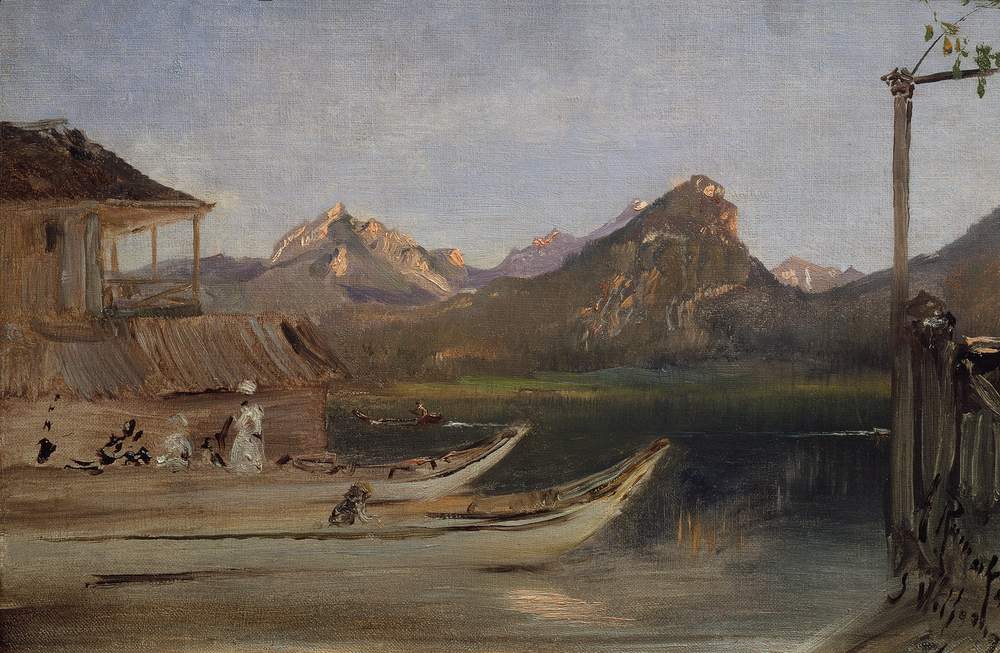
A wayside cross is a devotional marker, set up beside roads and paths. Romako puts a tall one by the water, in a foreground it shares with low boats, while mountains rise behind. The rest of the shore is given over to transport and shelter. He does not single the cross out, and he hardly needs to: among boats that lie flat, it is set apart simply by being upright.
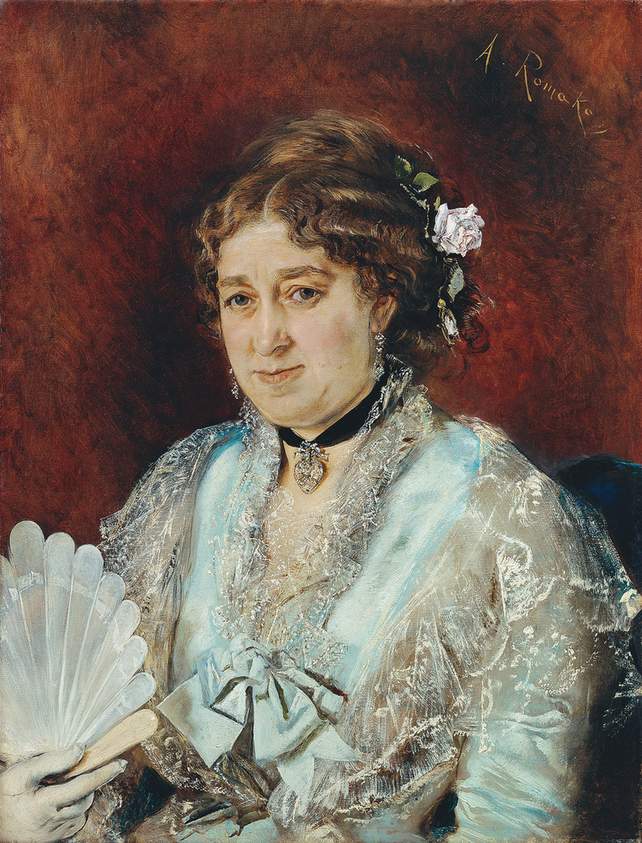
Babette Tapecierer's face has a great deal to compete with, and it still holds its own. Below a busy neckline, an open fan makes a broad pale shape. Above it, lace, a bow and blue fabric frame her face against a warm red. That makes several different kinds of surface for Romako to balance in a single portrait.
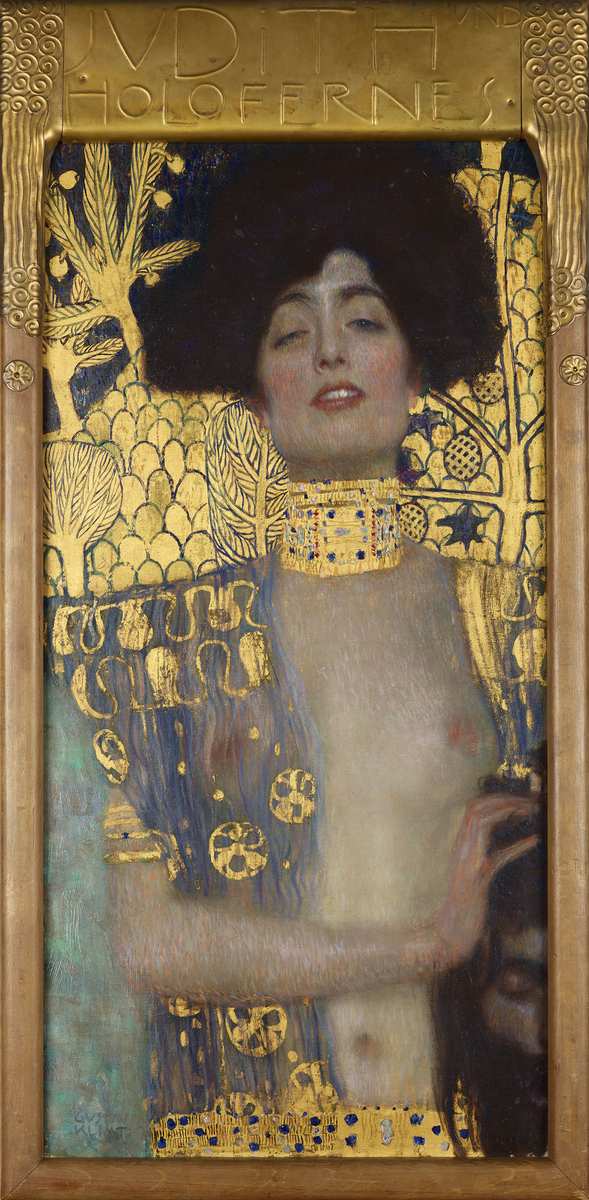
In the biblical story, Judith beheads the enemy general Holofernes. For a picture of a killing, Klimt's is in no hurry to show the victim. Nearly all of the canvas goes to Judith herself, presented almost as a portrait sitter, with jewellery, bare skin and patterned gold to the fore. Holofernes' severed head is pushed to the lower edge and partly out of view, and it is easy to take in the woman and the gold before you notice it at all.
For a picture called a clearing, this one is remarkably closed. Thistles fill the foreground, where another landscape might have had a path or a figure to lead the eye in. Behind them, branches and undergrowth build up in dense, overlapping layers. Small openings let in light but do little to thin the growth. Romako has built his picture out of plants that a wider view would pass over.
c. 1907–1909 · Gold, silver and platinum leaf; resin-oil colours on primed canvas; composition gold (brass), glazes and metal-leaf flakes in background · Belvedere
Two figures embrace on a narrow flowering bank, wrapped together in patterned gold. Their bodies do not quite vanish into it: a bare foot, hands and a turned face remain visible. Each figure is covered by a different pattern, so the two stay distinct even as the gold binds them together.
Strictly speaking, some of that gold is brass. Klimt used silver and platinum leaf as well as gold leaf, with resin-oil colours on primed canvas. In the background he added glazes, flakes of metal leaf and composition gold, which is brass. Judith, by comparison, is recorded simply as oil and gold leaf on canvas.
Babette Tapecierer is posed with a fan and lace. This girl takes her pose from the tree. She reaches up with both arms among the apples and leaves to hold a branch, and Romako builds the whole composition around that small piece of work.
Without the lamb, the flowers and the vessel would make an ordinary tabletop still life. With it, is this still a still life? The title says so, and Kokoschka paints it as one. He gives the dead animal no place of its own and sets it among the other objects as one more item in the arrangement. Uneven, restless marks unsettle the whole surface.
1917–1918 · Oil on canvas (unfinished) · Belvedere
Eve, pale-skinned and upright, takes up most of the picture. Adam, darker, is partly hidden behind her, so the two are unequally exposed: she is shown to us, while he is half withheld. Pattern gathers below their bodies rather than around them. The canvas is unfinished, so there is no knowing how much of this arrangement Klimt would have kept.
A high pale collar sets the sitter's profile against a darker room. Nahowska frames her closely and keeps only a slice of the interior. That slice includes a framed picture on the wall with a figure of its own, so the portrait contains a second image and a second figure. Unlike Sonja Knips or Babette Tapecierer, this woman goes unnamed in the title.
Spring has only half arrived in Waldmüller's woods, and bare branches still stand above patches of new green. Children gather on a steep woodland slope. He is just as exact about the close, uneven ground as about the season, showing where they have to stand and move.
Madame Legois sits upright, her hands joined and resting, in red above a white skirt, against a subdued setting. Corot gives her almost nothing else, so those blocks of colour and the steadiness of the pose carry most of the likeness.
The occasion is the crossing of an Alpine pass, but David has painted a carefully organised image of command rather than a record of a journey. Horse, cloak, pointing arm and steep mountainside follow related diagonals and add up to a single upward thrust, so even the mountain has been recruited. The horse rears, and Napoleon appears to hold all that force in check.
White teeth show through an open mouth, in a face built from rough, energetic brushwork. The paint around the head is just as broken, so the expression has no calm border to settle against. Nothing remains of the composed manner expected of a formal self-portrait.
This is the earliest of the Klimts in the selection, painted in oil without the metal leaf of Judith or The Kiss. The pale pink dress fills much of the canvas, but Sonja Knips sits forward at the edge of her chair, upright and gathered, and a small red book makes a sharp accent against the pink. Her alert posture and that touch of red keep the spreading dress from taking over.
Kokoschka's lamb picture has restless brushwork too, but there the subject itself is disturbing. Corinth's flowers are harmless, and the agitation is all in the handling. Streaks of colour run from the petals into the background, so the crowded bouquet is as much a mass of active marks as a group of flowers. You can still pick out the chrysanthemums and amaryllis, but never as a neat inventory of separate blooms.
Bottles make a modest subject, and Van Gogh keeps the palette just as spare, mostly greens and browns. Small differences of height, silhouette and reflection therefore count for a great deal. The upright bottles stand close together, and a vessel lying on its side cuts across their bases.
There is no kitchen here and no scene of labour. Le Père Paul wears his working clothes, and the white cap alone is enough to announce his trade. Monet frames the bearded face closely against a muted background, so the eye moves between the cap and the individual likeness beneath it. The title makes the same move, from the trade to the man.
A squatting man, a seated woman and a child low in the picture form a compact triangle. They are packed into the same space, yet no gesture joins them, and each remains a separate figure. The title calls them both a couple and a family, but it does not say who they are.
Explore this selection in Artline
See the selected works alongside books and events from their period, or compare when the artists lived. The books and events provide context, not evidence of direct influence. Works without confirmed dates remain in this guide.
Couples
Klimt and Schiele each have more than one couple in this selection, and it is worth asking what holds each pair together. In The Kiss and The Embrace, part of the answer lies outside the bodies. Klimt's gold and Schiele's creased sheet take part in the embrace: one binds the lovers in pattern, and the other takes up their angles. In Adam and Eve and in Schiele's squatting family, the surroundings no longer do that work. Klimt's pattern stays underfoot, and Schiele's man, woman and child share a cramped space with neither fabric nor gesture to join them. Adam and Eve also has a link with Judith, the grimmest pairing here. In both pictures Klimt gives the canvas to the woman and keeps the man partly out of sight. The difference is that Adam stands behind Eve, while Holofernes has been reduced to a head.
Further reading
Wassily Kandinsky; translated by Michael Sadleir · Read free · English
Kandinsky's short book, in Michael Sadleir's English translation, argues that colour and form can carry meaning of their own, apart from the objects they represent. It belongs to the same years as the work of Klimt, Schiele and Gerstl. It is worth having in mind in front of several pictures here, among them Gerstl's laughing self-portrait and Corinth's flowers, because it sharpens a simple question: how much is carried by handling and colour, and how much by the thing depicted?
 Art, literature & history