The Art Institute of Chicago holds one of the major public art collections in the United States. Its paintings range across French Impressionism, American art and several centuries of European work. Many visitors come for one famous image, perhaps Seurat's island in the Seine or a well-known American scene. This selection of twenty includes some of those pictures and sets less familiar ones beside them.
It reaches back to Tiepolo's Armida and Rinaldo and an Ingres portrait, and forward to Georgia O'Keeffe's aerial view of clouds. In between come a diner at night, a wet Paris street, a woman bathing a child, fishermen hauling in a net and young acrobats at the circus. Van Gogh appears more than once, with his bedroom, a peasant woman digging and his reworking of a Daumier. Some pictures answer one another across the selection, and the entries point these out where they help: two women at work on the land, Caillebotte's street beside Monet's Gare Saint-Lazare, and O'Keeffe's two canvases. A few were made by going back to an earlier image, whether the painter's own or another artist's, and the closing section follows that thread.
Artline chose these works from the museum's documented holdings, independently of the Art Institute. A painting's place in the collection does not mean it is on view. Dates and attributions follow the linked records, qualifications included.
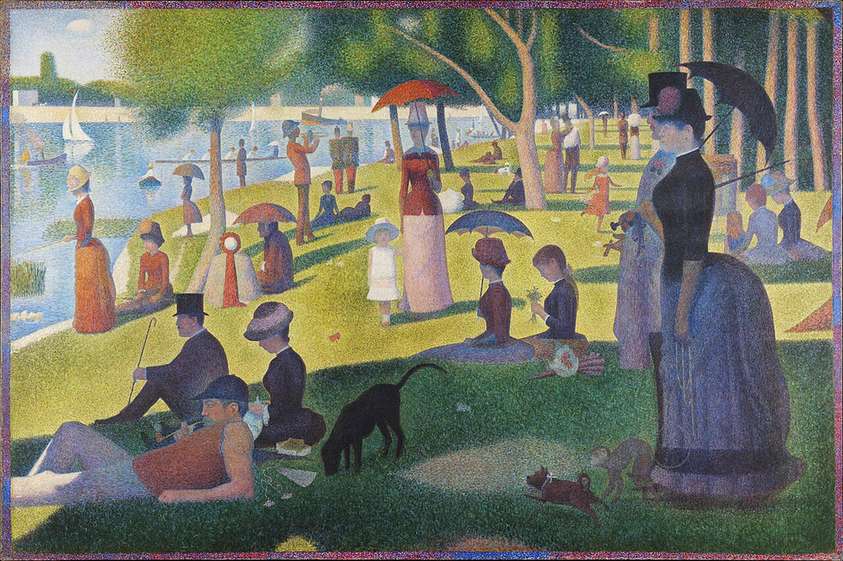
1884–86, border added 1888–89 · Oil on canvas · Art Institute of Chicago
This Sunday took years. Seurat's title names 1884, but he went on working on the large canvas after that year, and the border came later still. The surface is built from countless small strokes and dots of colour, which look separate close to and draw the scene together from further back. A Parisian crowd's leisure is here the product of painstaking work in the studio, and that may be why the figures look so unusually still, more posed than caught.
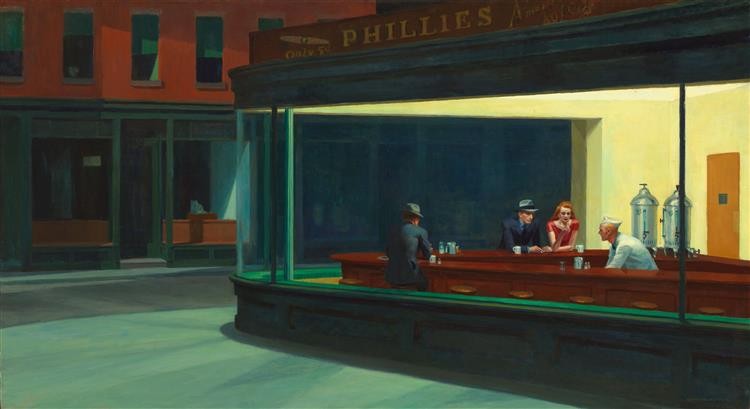
We stand outside in the dark street, looking through glass into a brightly lit diner. The glass keeps us out, and the light hides nothing, showing the server as plainly as the customers. What it leaves unclear is what any of them feels. It is tempting to read a single mood into the whole group, but Hopper does not give the customers and the server the same private feeling.
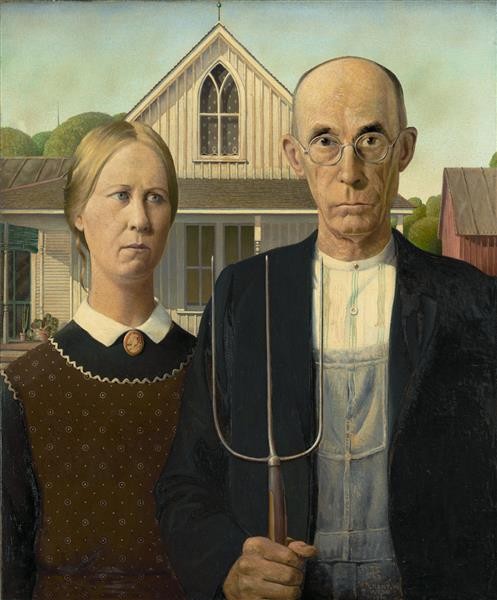
1930 · Oil on beaver board · Art Institute of Chicago
Wood painted on beaver board, the only support in this selection that is not canvas. Is the picture a tribute to rural life or a joke at its expense? The poses and expressions are more complicated than either verdict allows. The construction, at least, is clear. Upright forms recur across the two figures and the house, in the pitchfork, the clothing and the pointed window, and Wood builds the picture on these verticals until the pair's stiffness spreads into everything around them.
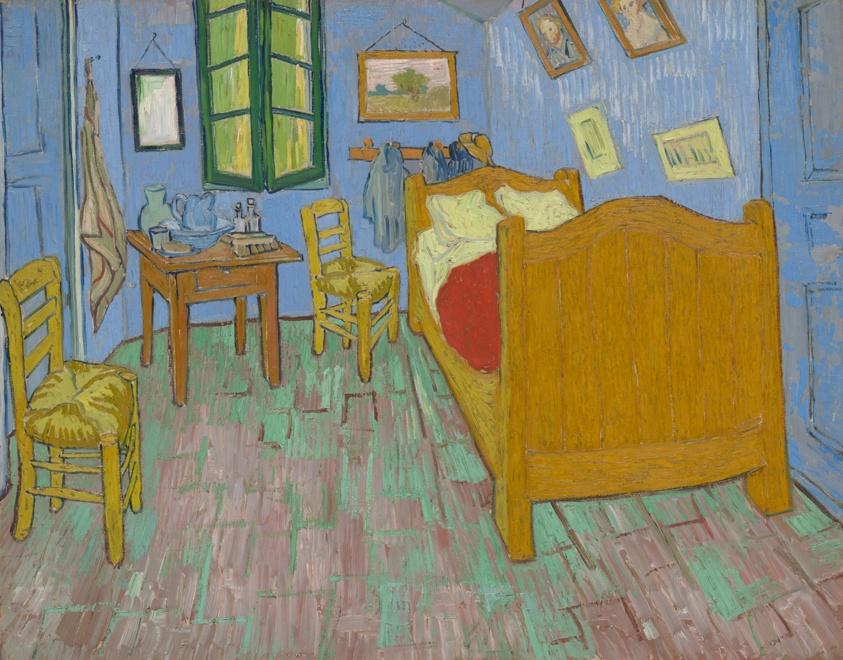
Chicago's Bedroom is a repeat, painted after the version now in Amsterdam. The bed, the chairs and the pictures on the walls were all there in the earlier canvas. Because repetition was part of how this one was made, it is no evidence that Van Gogh had the room in front of him as he painted. What the repeat does not settle is the space. The room slopes, and its contents sit in a looser relation to one another than so plain an inventory of furniture would lead you to expect. Strong outlines fence each area of colour off from its neighbours, and the placing of each piece gives it a character of its own.
1892–95 · Oil on canvas · Art Institute of Chicago
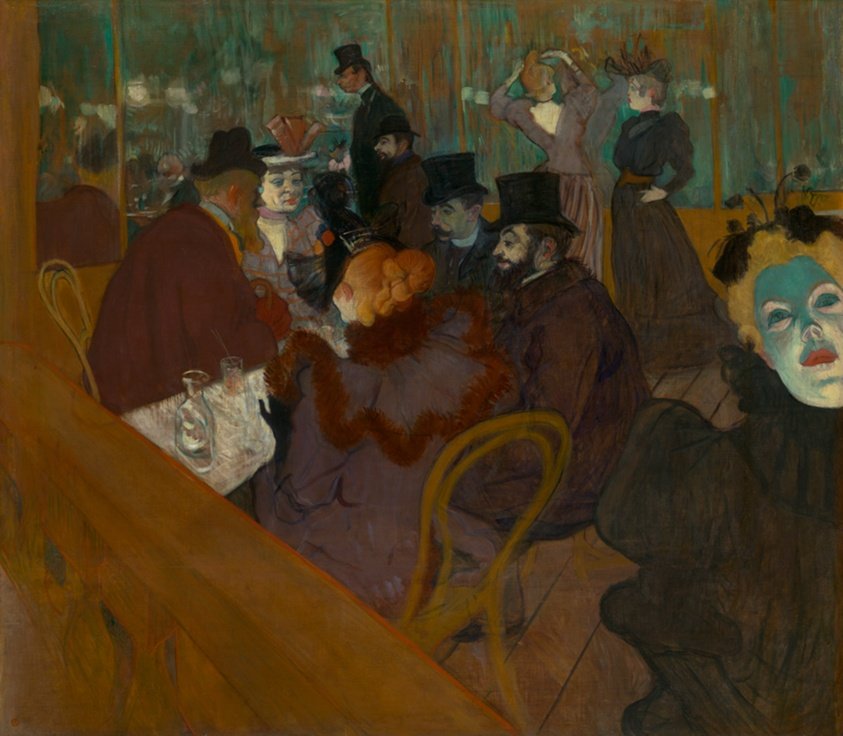
The party around the table might have made a comfortable group portrait, were it not for the green-lit face at the edge of the picture. Under the artificial light the seated group competes for attention with mirrors and moving figures, and the room becomes an uneven place to see and be seen. Hopper keeps us behind glass. Toulouse-Lautrec's cropping instead thrusts some people into the foreground far more abruptly than others.
Beside Monet's Arrival of the Normandy Train, painted in the same year, Caillebotte's Paris looks measured out. Monet lets steam soften iron and glass; Caillebotte keeps the structure of his city in plain sight. A lamppost divides the broad street, the architecture sets the distances, and other pedestrians carry umbrellas across the wet paving. The couple close to us fit that order less neatly. They bring a nearer, less predictable encounter into it, and however firmly the buildings organise the view, they do not govern every movement of the people passing by.
The woman supports the child and washes its foot in one continuous action, holding and working at once. We look down from a high viewpoint on the basin and on the curves of the two bodies, closely bound together, with patterned fabric around them. Cassatt puts the tenderness into the practical business itself, into how the weight is carried and the job done, and adds nothing to declare it.
c. 1893 · Oil on canvas · Art Institute of Chicago
Try following the edges of the table across the picture: they do not line up into one consistent space. Yet the apples, the bottle and the biscuits each look convincingly solid, and the tilted basket and folded cloth add shifts of their own. Colour and shape hold the firm objects and the unstable whole together, where no single viewpoint could.
Seen from the air, white cloud forms repeat towards a narrow pink horizon, separated by intervals of blue. They run on past the side edges, so the arrangement seems larger than the canvas that holds it. There is no ground, and so no trees, buildings or standing figures to measure the view by, which gives the clouds a scale and rhythm unlike those of a landscape organised around such things. O'Keeffe had built a picture from repetition and interval decades earlier, in Blue and Green Music, which closes this selection, though there the title pointed towards sound rather than sight.
The woman's sickle is at rest and her face is turned upwards. The title supplies what paint cannot, naming a moment of listening. Her bare feet and the idle tool keep that moment within the working day on the land: she has stopped without leaving her field.
1909–10, 1913, and 1916–17 · Oil on canvas · Art Institute of Chicago
Four bodies occupy sharply divided vertical zones. The faces are reduced, the surroundings stylised, and the divisions between the figures count for as much as the bathing they share. Severity like this can look like a first decision. It was not. Matisse came back to the canvas in separate phases, years apart, and arrived at this arrangement only across all of them.
c. 1885 · Oil on canvas · Art Institute of Chicago
This is probably the earliest of the Van Goghs here, and the nearest in subject to Breton's Song of the Lark, though the two women could hardly be posed more differently. Breton's pauses and looks up. Van Gogh's is bent over the ground beside a low cottage and seems part of the plot she works. Muted colour links body, soil and roof while keeping their forms distinct. Home and labour share one small setting, with the cottage standing right beside the earth that has to be dug.
Homer's real subject may be weight. Two fishermen haul in the net together, and their coordinated effort is what tells us how heavy the net is. The boat is small and the water keeps moving around them, so the catch and the work of landing it have to be managed at once.
Here Van Gogh borrowed. The arrangement comes from an image by Daumier: men raising drinking vessels around a table, with a child standing near the group. What Van Gogh changed was the character of the scene, through colour and handling. Curving strokes run through bodies and ground alike, so that the drinkers and the earth beneath them share a related movement.
A circus picture without the stunt. Renoir's young performers stand on the circus floor rather than at the height of an acrobatic feat. Costumes, fruit and raised hands keep the entertainment in view, but the moment shown falls between or around the acts. Like Breton's woman in her field, the performers are seen in a pause from their work, and Renoir gives that interval enough bodily presence that they become more than demonstrations of skill.
1823–26 · Oil on canvas · Art Institute of Chicago
Ingres surrounds his sitter with remarkably little: a desk and an enclosing green drapery, and within them the count's body, his face, a hand and formal clothing. No crowd of attributes announces Pastoret's public standing. The arrangement has to do that work, which is why the exact placing of the body matters and why so little is allowed to compete with the face and the hand.
1888 · Oil on jute canvas · Art Institute of Chicago
Pattern takes charge of this landscape. Trees and emphatic areas of colour break it up, and in places the space offers no unbroken route through. The Arlésiennes of the title hold together regardless. Their dark silhouettes merge into one shape as they move, and their bent heads show which way they are going even where the ground does not.
c. 1742–45 · Oil on canvas · Art Institute of Chicago
The oldest painting here turns on a look that cannot be returned. The title calls it an encounter, but only one of the pair knows it is happening: Armida, richly dressed, approaches Rinaldo while he sleeps. Flying fabric and small figures fill the space around them with light, restless movement, and Rinaldo's still body is the fixed point of the whole composition.
The title promises an arrival, and the picture half hides it. A glazed roof on iron supports encloses the station, while steam partly veils the train and filters the light around scattered figures. Monet gives the machinery no hard, evenly visible outlines, and the train becomes one part of a changing atmosphere rather than the clear centre of the scene.
1919–21 · Oil on canvas · Art Institute of Chicago
No instrument or performer explains the title. The music, such as it is, lies in rhythm: curving bands of blue, green and paler colour set up direction and recurrence, and darker wedges break in across them. Nothing suggests a code in which particular colours stand for particular notes.
Explore this selection in Artline
See the selected works alongside books and events from their period, or compare when the artists lived. The books and events provide context, not evidence of direct influence. Works without confirmed dates remain in this guide.
Returns and borrowings
Several of these pictures were not made in one continuous effort, and the returns take different forms. In the Bedroom Van Gogh went back to a picture of his own. In The Drinkers he worked from someone else's, taking the arrangement from Daumier. Matisse came back to Bathers by a River in campaigns spread over years, and Seurat returned to La Grande Jatte after the painting itself was done, to give it a border. The headings record only some of this. Matisse's lists each campaign and Seurat's notes the border, but the Bedroom carries a single date that says nothing of the Amsterdam canvas behind it, and the heading of The Drinkers does not mention Daumier.
Further reading
Anne Dayez, Michel Hoog and Charles S. Moffett · Read online or download · English
The Metropolitan Museum's exhibition catalogue gives historical context for Seurat, Caillebotte, Cassatt, Monet and their contemporaries. Its wide range of examples helps to separate approaches that the single label Impressionism tends to blur. Tiepolo, Ingres and the American pictures by Wood, Hopper and O'Keeffe fall outside its subject.
 Art, literature & history