Twenty works from Venice's Gallerie dell'Accademia, from Giambono's tiered Coronation of the Virgin to Longhi's masked Soothsayer, by way of Carpaccio's Venice and Leonardo's Vitruvian Man
The Gallerie dell'Accademia in Venice holds paintings by Bellini, Giorgione, Titian and Tintoretto, many of them made for churches and public buildings. This selection gives particular room to a group of narrative pictures in which the city plays itself. Carpaccio, Bastiani and Mansueti set miracles and ceremonies of the Cross in places Venetians knew, the wooden Rialto Bridge and the campo at San Lio among them, and in these pictures buildings and bystanders often compete with the miracle for attention. Around them the range is wide: Giambono's tiered heavenly court, Tintoretto's plunging Saint Mark, Giorgione's unexplained Tempest, Tiepolo's flying Holy House, Longhi's masked fortune-telling party and Rosalba Carriera's pastel self-portrait. The collection also includes a drawing, Leonardo's Vitruvian Man.
Artline made this selection from the museum's documented holdings, independently of the museum. Dates and attributions follow the linked records, including any qualifications.
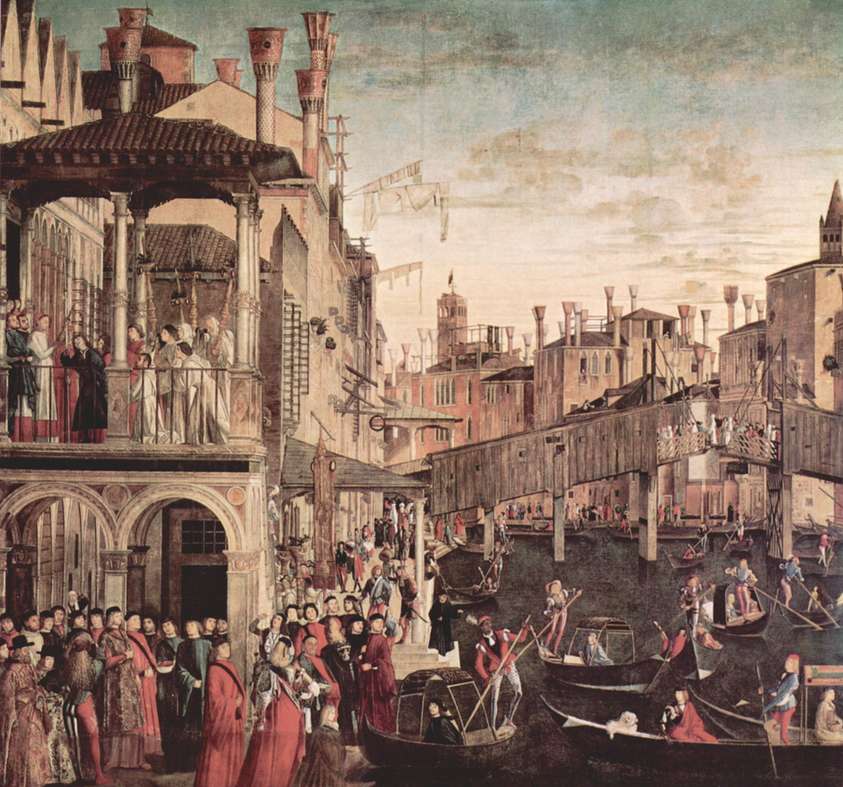
1494 · Oil and tempera on canvas · Gallerie dell’Accademia
Carpaccio was commissioned to record a miracle, and the miracle is here, but Venice takes up most of the canvas. Gondolas crowd the canal, the wooden Rialto Bridge rises behind them, and people fill the banks and the windows; the miracle itself occupies only one part of the scene. For a Venetian viewer, recognising the city and the public ceremony taking place in it may have been as absorbing as the miracle.
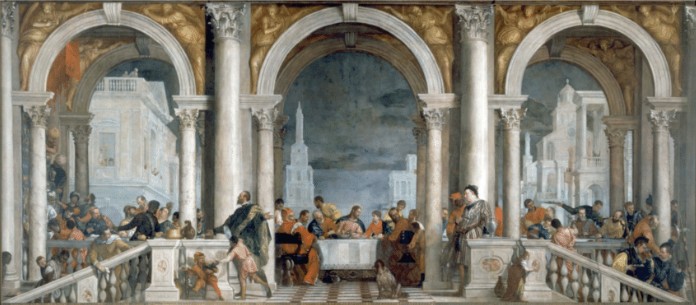
Three monumental arches give Veronese's banquet its great width, and he fills every bay. The central table ought to hold the eye, but servants, animals and figures at the edges keep pulling it outwards.
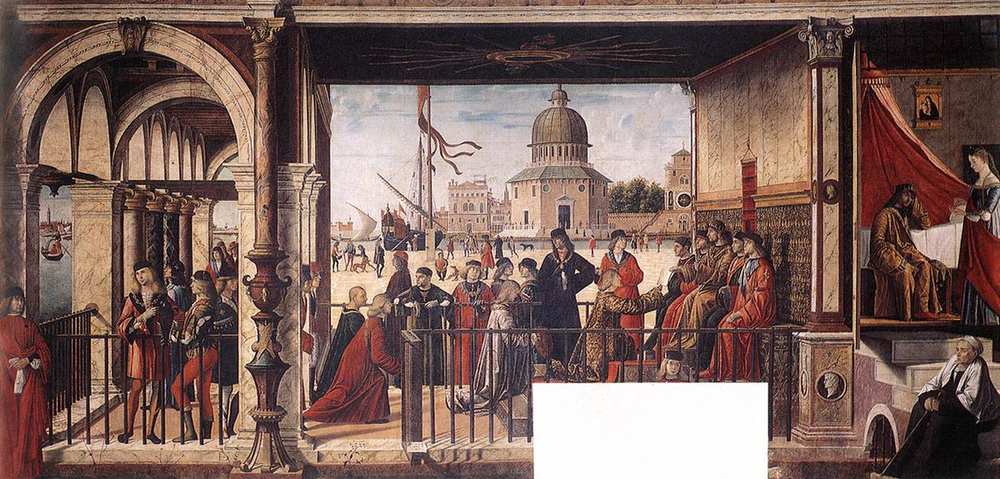
Where the Rialto miracle lets the city swamp its subject, here Carpaccio uses buildings to put a story in order. Halls, steps and openings divide the figures into groups, and the passages between them stay in view. There is no single central encounter. Separate moments of the narrative sit side by side instead, so that moving across the picture can also mean moving forward in time.
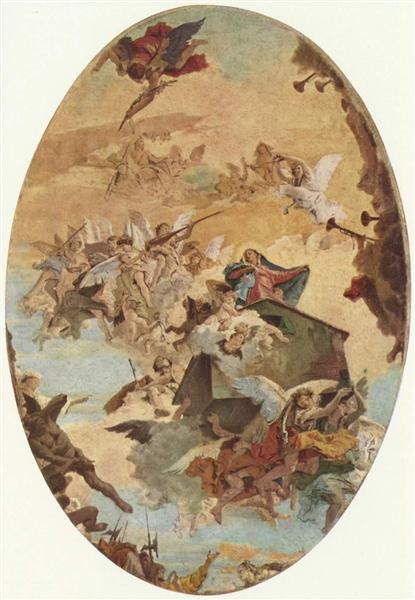
The Holy House of Nazareth travels diagonally across the oval among clouds, angels and airborne drapery. Everything around it floats, but Tiepolo keeps the masonry solid and heavy. The weight seems to be the point: a building that still looks like a burden can be moving through the air to Loreto only by miracle.
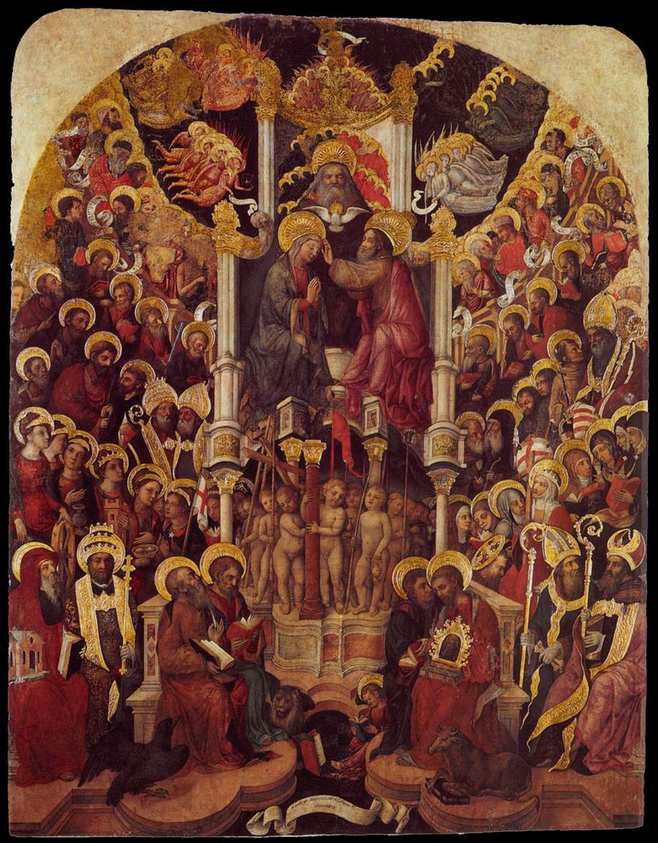
Heaven, for Giambono, is a matter of seating. Christ and the Virgin are raised above a dense assembly of haloed figures stacked in tiers, and a figure's place in the stack tells you its rank; there is no attempt at believable distances between bodies. Gold and red run through the crowded ranks, yet individual heads can still be told apart.
The cross rises from a small group of mourners into a wide landscape. Previtali leaves open space around the event instead of crowding it, and changes of light separate the hill from the land beyond.
Fumiani gives the Temple its full weight of columns and steps, and the young Jesus takes up only a small part of the gathering inside it. What picks him out is not size but the people around him, caught up in argument and attention.
Tiepolo designed this composition for a ceiling. Limbs and drapery are sharply foreshortened, as if seen from below, and pale openings break through the darker figures massed near the edges. The space was meant to open upwards and continue above the viewer's head, not to recede like a window in a wall.
1503–1509; usually dated c. 1504 · Canvas; paint medium not specified · Gallerie dell’Accademia
Who are these people, and what has the storm to do with them? A standing man and a woman nursing a child are set apart in the landscape, with ground, ruins and distant buildings filling the considerable space between them, while lightning breaks from the clouded sky. Nothing in their gestures says how they are related, and the title the picture goes by names the weather, not them. Interpretations have been offered; none has been confirmed. Even the date is uncertain: it is given as a range from 1503 to 1509, though the picture is usually dated c. 1504.
The arms and legs overlap because they show different positions within the circle and the square, not a single pose. Leonardo is testing the proportions of the body against geometric figures, and the written notes make the sheet a working diagram. That is easy to forget when the image has been reproduced so widely as an emblem. The drawing is fragile and, for conservation reasons, is not on permanent display; it can be shown only under limited conditions.
Benedetto Diana gives most of this unusually tall picture to architecture, an arch and a wall. The small group involved in the miracle, a child among them, is placed in the lower section, so the action takes a while to find.
A procession in white makes a conspicuous band across the crowded campo. Mansueti surrounds it with detailed façades and spectators, and the onlookers count for as much as the participants: this is a ceremony in a particular Venetian neighbourhood, watched by its people.
Figures crowd round a pale body near the ground, bending and reaching towards it. Leandro Bassano lights this knot of effort and support and leaves the architecture above in darkness, so that the miracle is shown through what hands and bodies are doing.
The Virgin rises in the upper half; below, the apostles look and gesture upwards. Palma Vecchio leaves a gap between the two groups, and only the apostles' attention crosses it, so neither half makes a complete scene without the other.
Mansueti moves indoors here but keeps his crowd. A broad staircase divides the interior of the house, and witnesses watch from the steps and from passages at different levels, attending to the healing below. The miracle is seen from several positions, not only by those closest to it.
Bastiani records the handing-over of the relic of the Holy Cross to the Scuola di San Giovanni Evangelista, a Venetian lay religious confraternity for which this was a defining ritual. The ceremony takes place in front of the church and its neighbouring buildings, with contrasting robes distinguishing the participants. By setting it in the open, Bastiani presents the transfer as an event that belonged to the city as well as to the Scuola.
Around the fortune-teller is a small gathering, some faces masked and others uncovered, and Longhi gives the social occasion as much attention as the prediction. The masks are a neat complication: people who have come to learn something about themselves are concealing part of their own appearance. Bright clothes and dark headwear keep the groups distinct.
Away from the crowds, Carpaccio furnishes a quiet room with care: a tiled floor, windows, furnishings in orderly arrangement. Ursula is asleep, not receiving her visitor, when an angel appears in the doorway. The title calls this a dream, but the angel arrives by the doorway like any visitor, and because the room is so measured and believable, the entrance registers as an interruption of a different order.
Rosalba Carriera built up this self-portrait in pastel, and its softness is everywhere: there are no hard outlines, and skin merges into clothing. The likeness is still particular. Her pale face beneath grey hair is modelled through small shifts of tone, and the transitions around her features are recorded as they are, not smoothed into an ideal.
Saint Mark plunges from the sky above a body stretched horizontally below, and the two set up opposing axes, so the space between heaven and ground becomes the path of the miracle. The saint's foreshortened limbs set him apart from the onlookers, who react with sharply different gestures. In Leandro Bassano's Raising of Lazarus the effort comes from the figures gathered round the body; here help arrives from above.
Explore this selection in Artline
See the selected works alongside books and events from their period, or compare when the artists lived. The books and events provide context, not evidence of direct influence. Works without confirmed dates remain in this guide.
Before visiting
A place in this selection does not mean a picture will be on show, since works go out on loan or into conservation. Check the museum's current displays before you go, particularly if Leonardo's drawing is the reason for the trip.
Further reading
Leonardo da Vinci; translated by John Francis Rigaud · Read free · English
Leonardo's own writings on proportion, perspective and movement, in John Francis Rigaud's English translation. The passages on proportion take up the questions the Vitruvian Man works through on paper, and those on perspective and foreshortening supply a working vocabulary for the Venetian city views and for Tintoretto's figures. It is a treatise for painters, not a commentary on these pictures.
 Art, literature & history