The Yale Center for British Art in New Haven was built to house a collection of British art assembled largely through Paul Mellon's generosity, in a building designed by Louis Kahn. The collection covers several centuries of paintings, drawings and other works, and it is particularly strong in portraits and landscapes.
The twenty works chosen here have very different subjects: a royal zebra, a young marquess in an embroidered coat, a family beneath a tree, a packet-boat waiting for wind, Vesuvius in eruption, a crowded railway compartment, a college crew on the river and a comet. Their purposes differ just as much. Some were made for great houses and public display; others began as small personal studies or working sheets. Alongside J. M. W. Turner, Constable, Gainsborough, Stubbs, Hogarth, Mary Beale and Rossetti are Samuel Palmer, Blake, Spencer Gore, Hannah Emma Palmer and William Turner of Oxford, who is represented by several landscapes. He was a different artist from J. M. W. Turner.
Artline selected these works from documented museum holdings, independently of the museum. Dates and attributions keep the qualifications given in the linked records.
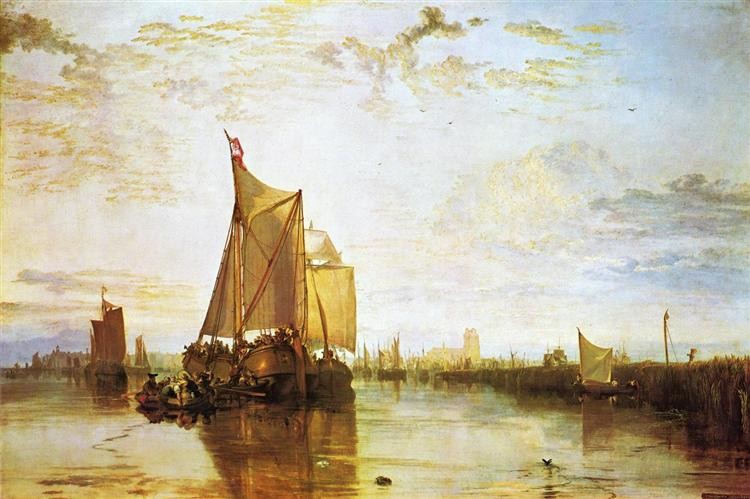
1818 · Oil on canvas · Yale Center for British Art
The key word in the title is the last one: the packet-boat from Rotterdam is becalmed. Its large sail looms over still, reflective water, and there is too little wind to carry it on. Around it, smaller vessels and people keep the harbour busy, so the stillness belongs to the air and water rather than to the crowd. Behind them the town lies low under a luminous sky, which leaves the cluster of boats plenty of room.
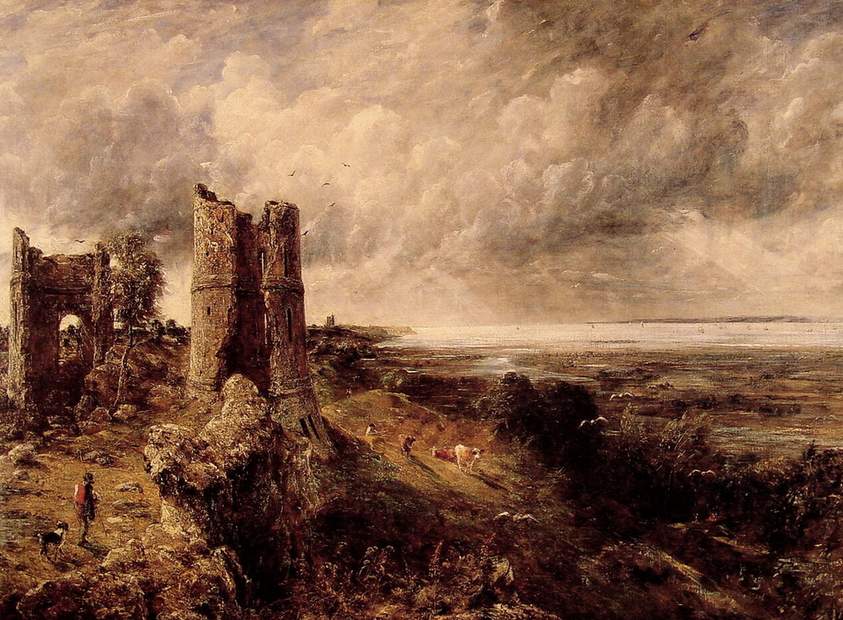
1829 · Oil on canvas · Yale Center for British Art
Broken towers stand above the estuary, their rough outlines set against an unsettled sky. The ruin anchors the composition, yet Constable does not let it look stable or whole. On the near slope, a path and small figures show that the ground beside the damaged masonry is still in use.
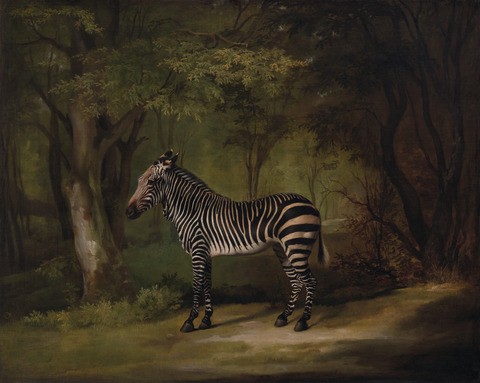
This was Queen Charlotte's zebra, brought to Britain as a gift in 1762 and put on public show. Stubbs treats the royal curiosity as a sitter. He paints it in profile, with the close attention he would give an individual portrait, so the striped body is seen at full length, and its lit stripes stand out sharply against dark trees. A wood is not the zebra's natural habitat. Whatever else these trees are doing, they make a very effective foil for the stripes.
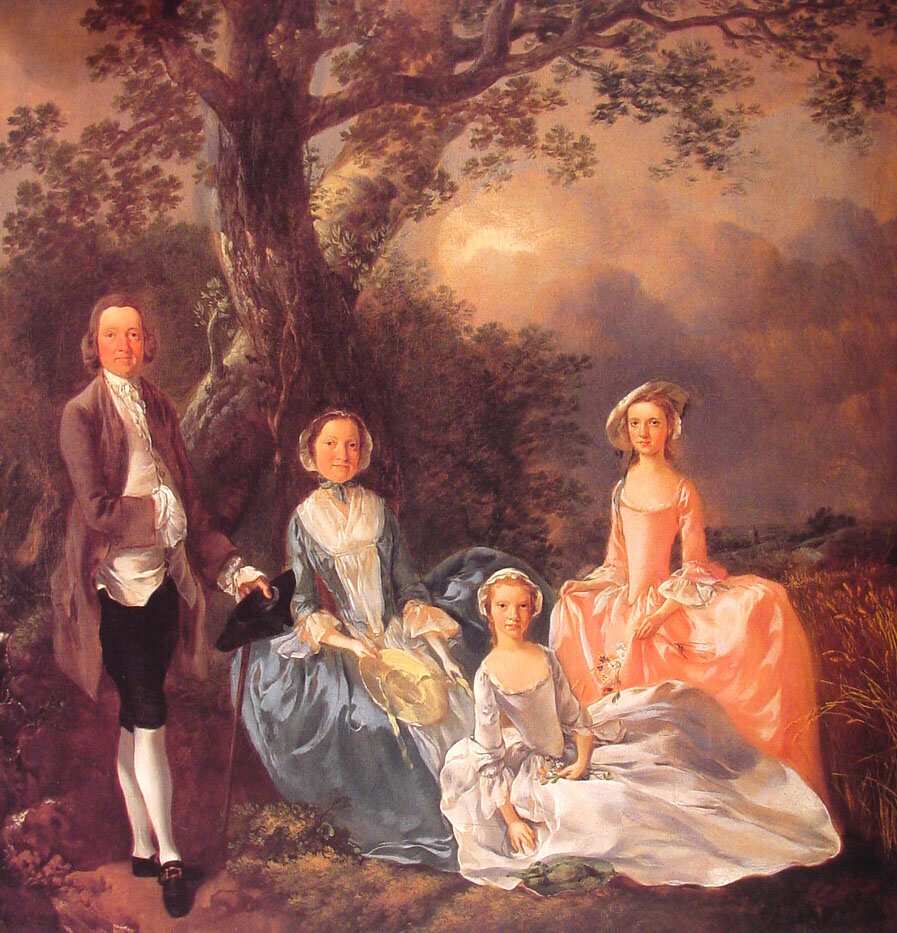
c.1752 - 1754 · Oil on canvas · Yale Center for British Art
A man, a woman and two girls form a compact group beneath a tree. Nobody is doing anything in particular, and no domestic incident is acted out. Gainsborough shows how they are related through where he places each figure and how their differently coloured clothes meet. The landscape gives the family a shared piece of ground, and the way they occupy it sets out their positions within the family as well as their social standing.
Rank, in this portrait, is largely a matter of embroidery. It spreads across the young marquess's coat, and Hogarth turns the body so that the elaborate garment falls into shifting planes instead of being displayed flat. The pale face and white neckcloth stand out against the dark background, and for all the detail of the coat, the face stays in command.
1817 · Watercolour on paper · Yale Center for British Art
In the Dort picture Turner shows a boat waiting for a wind that does not come. Here, in watercolour rather than oil, he paints a force of nature at full strength. Fire and lit smoke rise above dark slopes and are reflected in the water below, and the small boats and figures in the foreground give a human scale to an eruption that dwarfs them. Turner's light spreads from the volcano into its surroundings, so the mountain is hard to see as a separate object.
This is almost entirely a picture of sky. Trees and low ground are kept to the bottom edge. Above them are blue sky and the pale track of the comet, and the still horizon beneath gives a measure of the comet's scale and the direction of its path. Next to the other Turner's Vesuvius, this comet is an understated presence, a pale track rather than a blaze.
Siddal leans against a chair, her hands gathered over a full skirt. Rossetti sets the pose down broadly and concentrates darker hatching around her head and upper body, the only area he describes in any detail.
After Hogarth's embroidered marquess, Mary Beale's portrait of a child offers almost nothing but the head. There is no setting and there are no possessions, only a pale collar at the lower edge. The face turns slightly beneath loose hair, one cheek catching more light than the other, and small differences of tone make the head look solid. That slight turn keeps this close likeness from becoming stiffly frontal.
Two men talk across a railway compartment while a young woman sits near the window. Bags and clothes crowd the foreground, narrowing the space between the passengers. Solomon uses that confinement to stage a social encounter, and the title gives its setting: a first-class carriage, where the travellers have to share the compartment even though their attention is divided.
Palmer's sheet holds only curved tools and a small group of other objects on otherwise spare paper. The larger scene named in the title is nowhere to be seen. Instead, the edges and overlaps of these things can be studied on their own. The blank paper around them is working space, not emptiness.
This Palmer could hardly be further from the tool study. Dense lines gather a cottage, bare trees and dark foliage into the same winter darkness, broken by a small lit area at the cottage. A cloaked figure passes nearby, with a path through the scene. The title supplies the occasion, but the image stays general. It shows a winter journey past a lit house, not a particular story.
The title puts the building first, and so does Gore. Tall arches and decorative divisions rise above a small crowd. He sets out the structure of the interior in darker passages and catches the audience below in quicker marks, and he does not give every figure or ornament the same detail. The people show how tall the building is, and the hall gathers them into one public space.
The coloured design at the top of this sheet and the sparer sketches beneath are doing different jobs. In the developed scene of figures and animals, trees, water and ground are laid in as broad areas that would have to hold together as decoration. The smaller studies deal with particular decisions separately. Working out one pose is a different problem from fitting many poses into a continuous design, and the sheet shows Gore working on both.
The layout is the same as in the deer-hunting study, but here the main design holds a single standing figure in a narrow, brightly coloured landscape. Below it, separated by blank paper, outline sketches try alternative poses. Whatever wall decoration might have followed, at this stage it exists only as separate decisions on the same sheet.
The title is precise: not simply Hayley's house but its entrance front. Blake outlines the building lightly among trees, adds small touches of colour and leaves broad areas almost bare. He draws the trees more firmly than the faint architecture, and they do much of the work of locating it. He records enough to make this particular building recognisable without filling the sheet.
The Exeter College crew get the title but not much of the picture. The long rowing boat follows the horizontal lines of the banks and the calm water, trees and low buildings stretch beyond, and reflections take up much of the foreground. William Turner of Oxford places the eight within a wide view of the river and does not bring them close. They form a narrow band of movement in a largely still scene.
A small stone bridge crosses a rough cleft among thin branches and rock, painted in subdued washes of colour. Hannah Emma Palmer keeps its built shape clear while fitting it into the uneven ground it spans. Layers of vegetation complicate the view, but what the bridge is for, linking the two slopes, stays plain.
A windmill rises above a low horizon. The title names the church as well, but the ground is only lightly marked and other details are kept faint, so it is the upright mill that stands out, with proportions that are easy to take in. Much of the open paper is left to stand for light and distance.
Water lilies spread across the near part of the river, and the banks close in towards an opening further off. Close to, the leaves are separate shapes. Further back they merge into a pattern over a continuous stretch of water. William Turner of Oxford uses that change to connect the detail on the surface with the river's course into the distance.
Explore this selection in Artline
See the selected works alongside books and events from their period, or compare when the artists lived. The books and events provide context, not evidence of direct influence. Works without confirmed dates remain in this guide.
Paper left bare
The comet and the eruption are dramatic subjects, but several of the works on paper are quieter and more provisional, and their bare paper does different jobs. Around the Tysoe windmill it stands for light and distance. On Palmer's study for The Shearers and Gore's mural designs it gives room to work and keeps separate problems apart. Rossetti and Blake are selective about where they put their effort, on Siddal's head and upper body and on the trees around Hayley's house, and they state the rest lightly.
Ruskin's exercises train close attention to leaves, buildings, light and edges. These are much the same concerns as in the landscapes here, from the lily leaves near Shipton to Blake's faint house among firmer trees at Eartham.
 Art, literature & history