Twenty paintings from the Tretyakov Gallery in Moscow, from Kramskoi's portraits and Levitan's landscapes to Vrubel's demon and Malevich's Black Square.
The State Tretyakov Gallery in Moscow grew from the collection Pavel Tretyakov put together in the nineteenth century. It now holds one of the principal collections of Russian painting, from religious icons to portraits, historical scenes and the art of later periods, and many of its pictures are much better known in Russia than elsewhere.
The twenty paintings here leave out the icons. Portraits make up a large share: Kramskoi's Tolstoy, his unknown woman and his beekeeper, Repin's Mussorgsky, Serov's Vera Mamontova and the collector Ivan Morozov, and Nesterov's philosophers out walking. Savrasov and Levitan paint a rutted road, a thaw and monasteries across water. Vasnetsov and Roerich turn to legend and an imagined past, and Repin to a violent historical scene. The rest do not group easily: Vrubel's cramped demon, Petrov-Vodkin's red horse, Kustodiev's giant Bolshevik and Malevich's Black Square.
Several painters appear more than once, so some entries compare pictures as they go: Kramskoi's sparest portrait beside his more furnished ones, Repin's and Vasnetsov's scenes of aftermath, and Levitan's return to monastery buildings seen over water.
This selection was made independently of the museum. A painting's place in the collection does not mean it is on show, and any of these works may be on loan or off display.
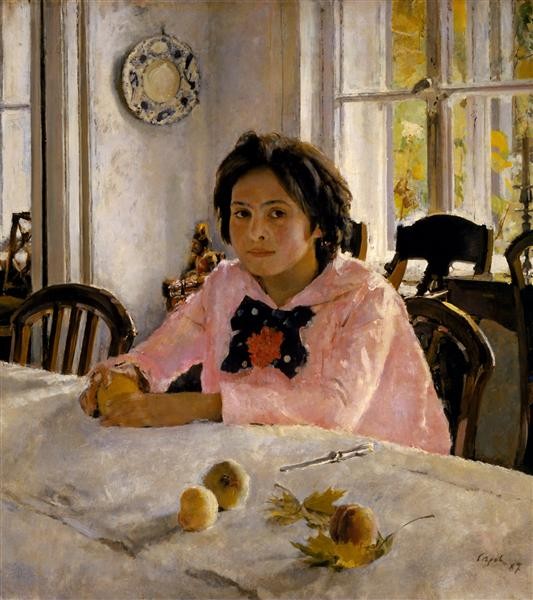
Serov painted Vera Mamontova at her family's home in Abramtsevo, and he lets the house into the picture. Peaches and a knife lie on the table, the ordinary clutter of a room in use, and light from the windows falls across the tablecloth, the furniture and her face. She sits poised but alert, as though she might get up at any moment.
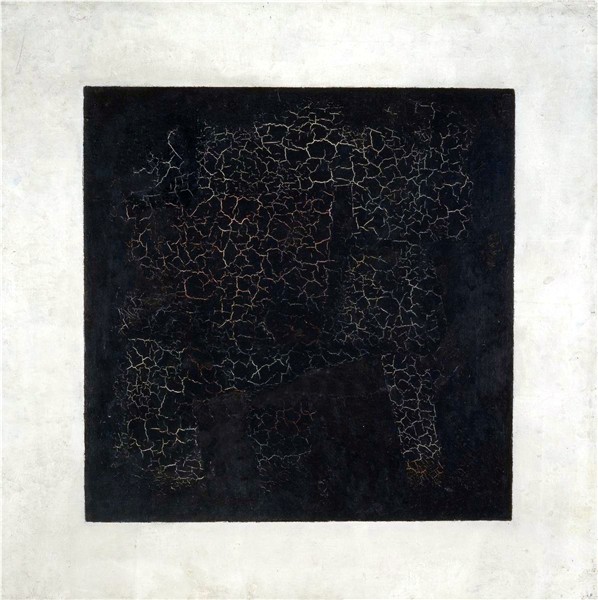
A dark quadrilateral on a pale field, and nothing else: no figure, no landscape. The relationship between the two is the painting's declared subject. The form looks absolute, but look longer and the hand shows. The edges are not mechanically drawn, and the aged surface has cracked. In a busier picture that cracking might go unnoticed. With so little else on the canvas, it becomes part of what you see.
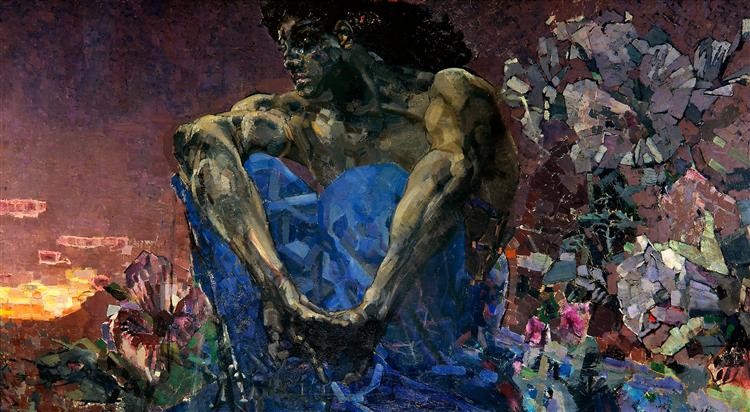
Vrubel gives his demon a powerful body and then denies it room. The low format squeezes the figure, and it draws inward in response: hands clasped, posture hunched, it holds its strength in. Angular, flower-like forms surround it and bind it into the patterned surface, as if the decoration were part of the confinement.
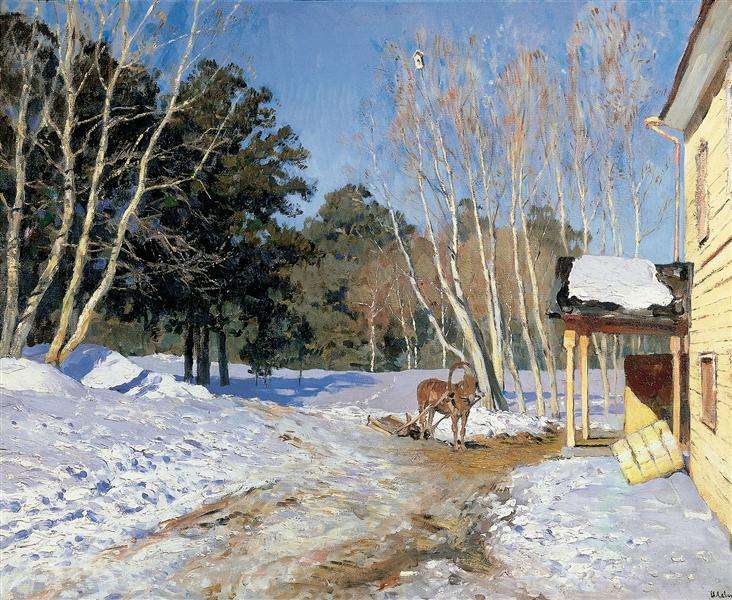
The month in the title shows in the ground. Snow is melting from the track, leaving it partly snow-covered and partly bare earth, and the colour turns with the season too: warm light on the wooden building, blue shadow among the trees. A horse stands waiting.
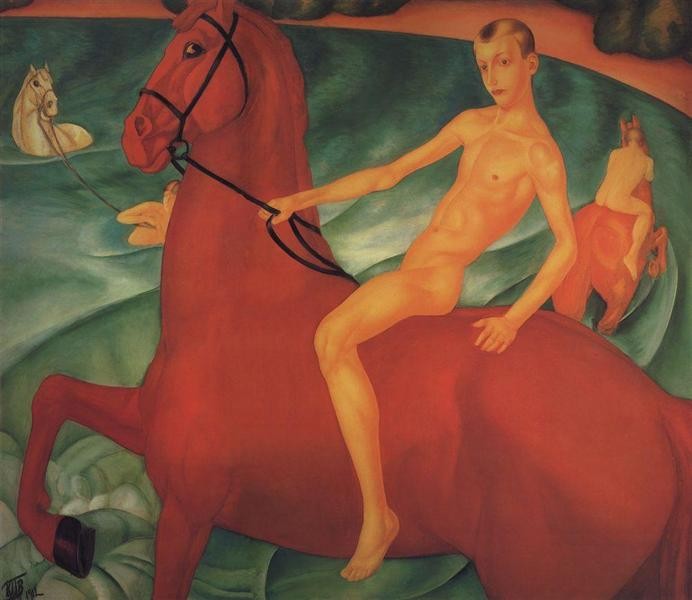
Horses are not this colour, and in a bathing scene they do not usually take over the canvas. Petrov-Vodkin's does both. Yet the picture never stops being a bathing scene. The figures and the water read clearly, and the animal keeps its bodily weight. Only colour and scale have been pushed, and that is enough to invite symbolic readings without the painting settling on any one of them.
The title names the two men as Ivan the Terrible and his son, and Repin paints the aftermath, not the violence itself. The older man holds the younger, their bodies joined around a wound his hands cannot undo. Patterned carpets and rich furnishings fill the room around that desperate embrace. This is Repin's historical reconstruction, not an eyewitness record.
Who is she? The title calls her unknown, and her identity has not been established. Kramskoi sets her on a raised carriage seat above a snowy street, looking straight out, in dark, fashionable clothes, her public appearance carefully managed. The encounter feels particular, yet neither her costume nor her expression gives us a name or a story.
The title calls it a vision, but Nesterov keeps the sacred episode at human scale. A boy and a hooded monk meet at the edge of a broad landscape, and the encounter is carried by inclined heads and small gestures. The fields and woodland around them stay ordinary, recognisable country.
Vasnetsov takes a battle known from both literature and history and paints it only once the fighting is over. Birds, scattered weapons and shields mark the open ground where the warriors lie, and no hero is shown in action. Repin's Ivan also comes after the violence, but it closes in on two figures in a furnished room. Here the aftermath spreads across an open field.
Mussorgsky is not dressed for posterity. He wears a loose dressing gown, not the formal dress expected in a portrait of a distinguished composer, and Repin gives the untidy hair and reddened features as much attention as the likeness itself. The signs of frailty are recorded exactly. Repin neither softens them nor offers a diagnosis or a judgement.
Kramskoi gives his most celebrated sitter here the least to lean on: a dark, loose shirt, a restrained background, and no library, desk or literary emblem to announce the writer. His other two sitters in this selection are partly defined by their surroundings, the beekeeper by his hives and the unknown woman by her carriage and fashionable clothes, though not by her name. Tolstoy's name needed no such help. Attention goes to the gaze, the beard and the hands, gathered low.
A narrow bridge crosses reflective water towards monastery buildings in the distance, while trees and water break the approach into stages. Levitan makes the religious site somewhere you could reach, not an isolated piece of architecture seen across empty space. No large figure appears, but the bridge suggests that someone might cross.
The title names a sound the painting can only suggest. Monastery buildings stand across broad water, at about the distance bells might carry, and Levitan describes that space precisely, with reflections, boats and evening clouds. In A Quiet Monastery a bridge carries the eye over the water. Here the title asks the ear to make the crossing.
Roerich builds an imagined historical scene from strong colour and ornament. The ship, with its red sails and row of shields, is a bold pattern as much as a means of travel. Boats and rocky shores set the scene, but the decorated vessel is what holds the eye.
An elderly man in a pale shirt, staff in hand and head lowered, is seen among plants and wooden hives. Kramskoi leaves him in his working surroundings instead of lifting him out as a general emblem of the countryside, and sets his slow, bowed posture against the dense growth.
A road leading into a picture usually serves to carry the eye into the distance. Ruts and pools interrupt Savrasov's, and what the painting shows is how the weather has marked its surface, not how perspective organises it. Broken clouds and changing light tie the near ground to the sky. Levitan's March also reads the season from the state of a track.
In her pale costume the Snow Maiden, a figure from legend, stands out against the dark forest that closes round her. Vasnetsov places her between lit snow and the trees, exposed, and that position alone shows how precarious she is. The picture has no need to retell the tale.
A giant with a banner strides over the streets and roofs of a crowded city. Kustodiev gives revolutionary force an allegorical body, and the deliberate mismatch of scale carries the argument. Petrov-Vodkin's red horse also breaks with ordinary scale but leaves its meaning open. Here the title settles what the giant stands for. This is a constructed image of political power, not an impartial account of the events it refers to.
Nesterov shows the philosophers S.N. Bulgakov and P.A. Florensky walking side by side. There is no emblem of philosophy, only an ordinary shared activity. As in his Vision of the Young Bartholomew, the picture rests on two figures and small differences of bearing: one wears pale clothes, the other dark, and their looks and gestures differ. They share a path but not an expression.
Serov places the collector Ivan Morozov, in sober clothes and with his hands clasped, against pictures in far livelier colour. The portrait defines him partly through the art he chose to have around him, and the man himself is perhaps the quietest thing in it. Serov set Vera Mamontova in her family's house. Morozov he sets among his pictures.
Explore this selection in Artline
See the selected works alongside books and events from their period, or compare when the artists lived. The books and events provide context, not evidence of direct influence. Works without confirmed dates remain in this guide.
Finding the works
The Tretyakov spreads its collection across several buildings, and this selection does not follow a route through any one of them. Check where each painting is before you set out.
Further reading
Wassily Kandinsky; translated by Michael Sadleir · Read free · English
Kandinsky's essay, in Michael Sadleir's English translation, makes the case for painting that goes beyond literal representation. It belongs to the same period of early modern art as Black Square but argues from a different position. That makes it a voice from the same moment on the same questions, though it does not set out Malevich's own aims.
 Art, literature & history