Portraits, landscapes, everyday scenes, a still life, a botanical watercolour and a marble group: twenty works from the Smithsonian American Art Museum.
The Smithsonian American Art Museum in Washington is devoted to art made in the United States. Its collection spans several centuries and includes artists from many communities, so the twenty works chosen here are a mixed group. Raphaelle Peale cuts open a melon and Mary Vaux Walcott sets out a bitterroot on bare paper. Frederic Edwin Church paints the polar lights and Thomas Moran the Yellowstone canyon, and Edmonia Lewis turns a story into a marble group. Most of the selection, though, is about people: people reading, working, singing, posing and receiving a visitor.
A few threads run through it. Books keep turning up. Eastman Johnson's young woman holds hers tight against the wind, his reader has one open, and every reader in Jacob Lawrence's library is absorbed in one. So does the business of making images. Thomas Le Clear paints a photographer bent beneath his equipment, Malvin Gray Johnson paints himself among his brushes and pictures, and George Catlin arranges a portrait and a ceremony for viewers outside the communities concerned. The titles repay attention too, and the closing note looks at how they name, or do not name, the people in the pictures.
Artline chose these works from the museum's documented holdings, independently of the museum. Being in the collection does not mean a work is on view. Dates and attributions keep the qualifications given in the linked records.
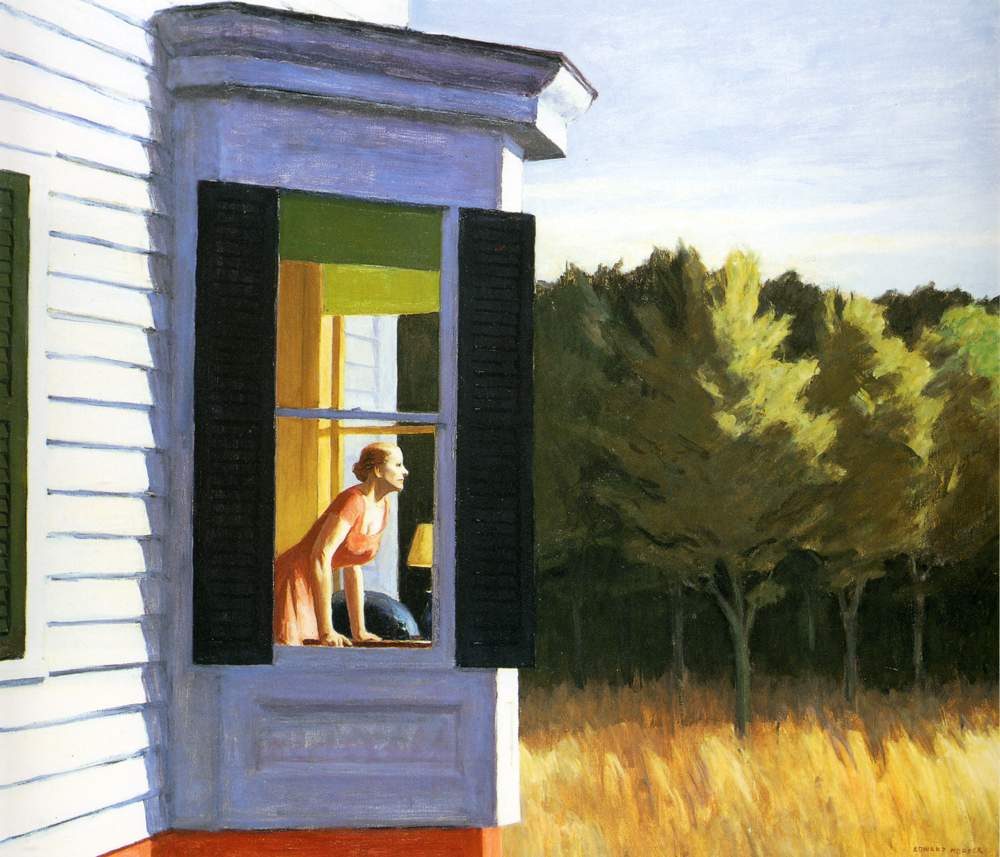
1950 · Oil on canvas · Smithsonian American Art Museum
A woman leans forward at a window, looking at something we cannot see. Strong light falls on the house, and the landscape outside seems almost empty. What has she noticed? Hopper gives no clue, so the forward pull of her body has to stand in for whatever is out there.
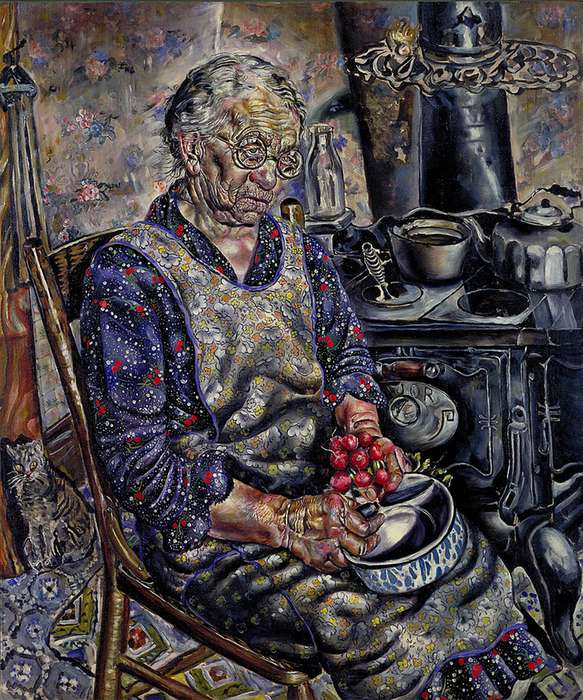
1934 · Oil on canvas · Smithsonian American Art Museum
Albright gives the woman's skin, the vegetables and the worn kitchen surfaces the same insistent detail, and he handles her face no more gently than anything else in the room. Age and long use mark the kitchen as thoroughly as they mark her. Nothing about this picture of domestic work is soft or generalised.
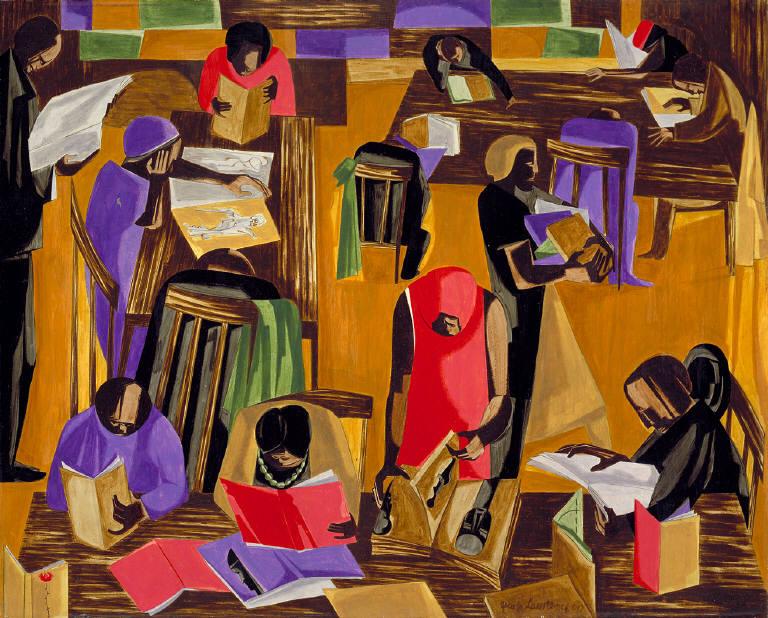
1960 · Tempera on board · Smithsonian American Art Museum
Lawrence gives the room no centre. Readers sit around tables and none of them is singled out. Working in tempera in simplified areas of colour, he repeats shapes until shelves, furniture and bodies settle into a single pattern, and small differences of pose are enough to keep each reader separate within it. That suits the subject. A library is a shared space whose resources are open to whoever uses it, yet everyone in it is absorbed in their own reading.
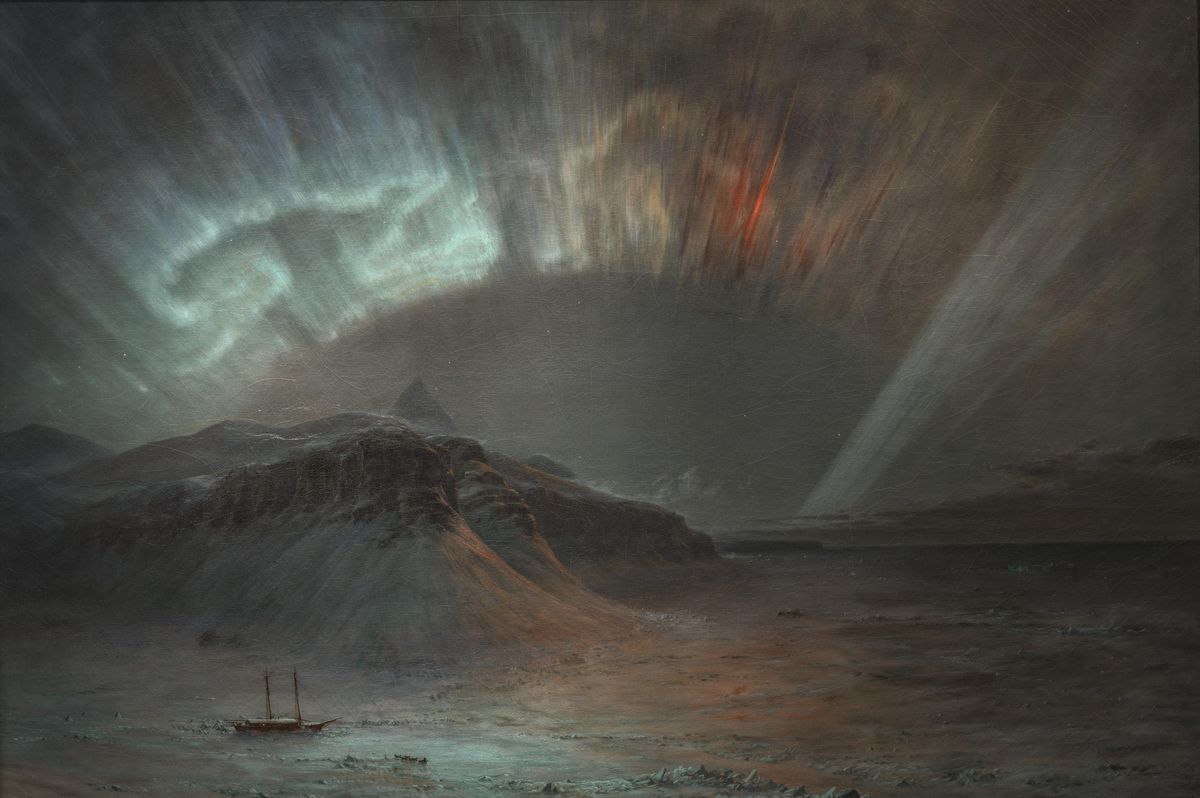
1865 · Oil on canvas · Smithsonian American Art Museum
A small vessel gives the human scale beneath the polar lights. Church makes the sky vast enough to dwarf it, while ice and mountains break up the darkness below. There is a voyage here, but no particular incident and no adventure story; the size of the ship is enough to suggest how exposed it is. The title does not mention it at all.
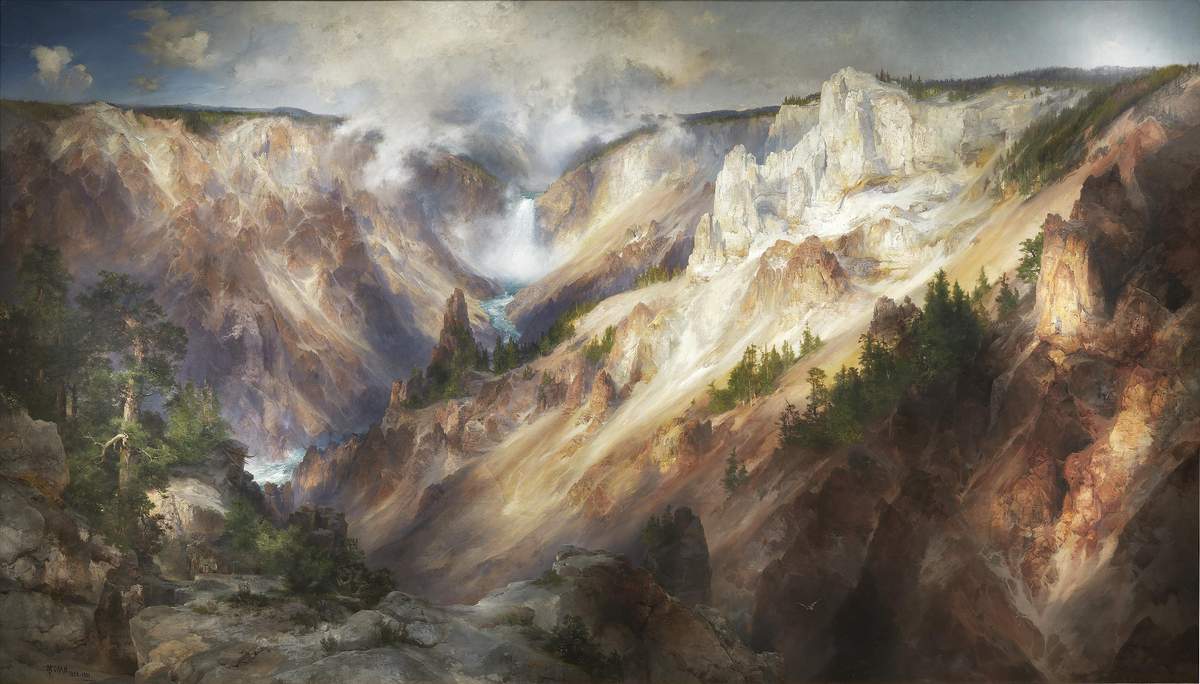
1893-1901 · Oil on canvas · Smithsonian American Art Museum
Where Church sets a small ship beneath a vast sky, Moran sends the eye downwards. Figures in the foreground give one measure of the canyon and the water far below gives another. Nearby rocks and vegetation lead into the long descent, and changes of light separate the cliffs in between, so that a view too large to take in at once is laid out in stages for the onlooker.
c. 1872 · Oil on canvas · Smithsonian American Art Museum
A young woman holds books firmly against her body as the wind pulls at her hair and clothes. The title speaks in the voice of someone who has gone away, yet the picture shows only her. Neither the absent speaker nor the place is identified.
1876 · Oil on canvas · Smithsonian American Art Museum
Homer's title is precise: the former enslaver has come to visit the Black women, who have not gone back to her household. It is she who has had to make the journey. The museum notes that one woman stays seated, withholding a deference that slavery once enforced. Posture and spacing record an encounter changed by emancipation, between people whose unequal history remains.
1863 · Oil on fiberboard · Smithsonian American Art Museum
Johnson painted this during the Civil War, when freedom and access to learning for Black Americans were deeply contested. In that setting a Black man absorbed in reading was not a neutral subject. The painting gives him its full attention: the light that picks out the open book also falls on his hands and face, so that reader and text are lit together.
1934 · Oil on canvas · Smithsonian American Art Museum
Two boys sit beside a fence in similar hats and overalls, and the title explains the likeness. Even so, Malvin Gray Johnson does not let them settle into a matched pair. Each has his own posture and his own expression.
1934 · Oil on canvas · Smithsonian American Art Museum
Johnson paints himself with palette and brushes beside him and pictures and carved forms all around: a working artist among things made, used and studied. The portrait can be read as a claim to that identity. It is the one picture in this selection in which the person portrayed also decided how he would be seen.
1893 · Oil on canvas · Smithsonian American Art Museum
Sargent places his sitter among patterned furnishings and expensive materials, an elaborate social setting, and keeps her pale face and hands distinct from all of it. Her held pose carries more weight than anything around her. The decoration stays in view without defining her.
c. 1903 · Oil on canvas · Smithsonian American Art Museum
The title calls the sitter ‘Mother’ and gives her name, Annie Williams Gandy, without saying whose mother she is. Sargent has to keep his sitter distinct from a room full of pattern. Eakins lets little in the surrounding space compete with the seated figure, and brings her face and hands out of the dark clothing through restrained shifts of tone.
1813 · Oil on canvas · Smithsonian American Art Museum
Peale's melon is cut open to show what the whole fruit hides: seeds, flesh, and the way rind meets interior. Beside it, the curling stems and blossoms of the morning glories stand against a dark background, so that outer surface and inner structure can be studied together.
Lewis gives a literary subject the form of a marble group. A seated man, presumably the arrow maker of the title, works beside a younger woman, and his task links his hands and body to her. Because the subject comes from a story, the group is an interpretation shaped by Lewis's choices as a sculptor, not firsthand documentation of Indigenous life.
c. 1895 · Oil on canvas · Smithsonian American Art Museum
White clothing set against pale surroundings comes close to merging with them, and it is the face and dark hair that stay distinct. Thayer varies how sharply he defines the standing figure, so that even where dress and light almost merge, the body never dissolves into the light.
1912 · Oil on canvas · Smithsonian American Art Museum
Henri gives the seated singer no elaborate performance space, only a dark setting against which shirt, face and guitar stand out. The title calls him blind, Spanish and a singer, and leaves it there; he is not named. The painting is chiefly concerned with the last of these. The guitar gives his hands something specific to do, and what we see is a musician at work.
1834 · Oil on canvas · Smithsonian American Art Museum
Catlin shows the sitter in profile against an open background. She does not meet our eyes, but her clothing and ornaments are easy to make out. He chose these features for an audience outside her community. The portrait is useful historical evidence, but what it preserves is Catlin's selection of what mattered, not her own account of herself.
1835-1836 · Oil on canvas · Smithsonian American Art Museum
Here too Catlin arranges things for an outsider. People and horses are spaced around an open circle so that they can all be taken in at once. This makes the gathering clear, but it places the viewer outside it, where no participant stands. The painting does not explain the ceremony. Its meaning depends on Indigenous knowledge and historical context that the picture cannot supply.
1915 · Watercolour on paper · Smithsonian American Art Museum
Walcott sets the buds, open flowers and narrow leaves of the bitterroot apart on largely unpainted paper. Without the competing growth of an outdoor setting, the plant's small structures can be examined closely. Peale isolates his fruit against darkness and cuts into it to show the interior. Walcott leaves the paper bare and gets a similar clarity by separating the plant into its parts.
c. 1865 · Oil on canvas · Smithsonian American Art Museum
This is a painter's picture of a photographer at work. He bends beneath his equipment while the children hold their pose. Le Clear includes the apparatus and the other images in the studio, so the making of a likeness becomes part of the subject, along with the sitters. The title does not say which portraits it means: the images already in the room, or the one being made.
Explore this selection in Artline
See the selected works alongside books and events from their period, or compare when the artists lived. The books and events provide context, not evidence of direct influence. Works without confirmed dates remain in this guide.
What the titles say
Side by side, the titles name people in very different ways. Only Sargent's sitter, Elizabeth Winthrop Chanler, is identified by name alone. The title of Eakins's portrait pairs a name with a family role. Thayer's bride has a role instead of a name, Lewis's arrow maker is known by his craft, Catlin's Choctaw woman only by her people, and Henri's singer by a description. Homer's title names the visitor by her former position and leaves the women she visits unnamed, and Brothers records a kinship and nothing more. A name presents someone as an individual. A role, a people or a description tends to make them an example of something, and that difference matters most where a picture was made for viewers outside the sitter's community. Read the individual collection records alongside these entries, especially for the depictions of Indigenous people by Catlin and Lewis.
Harold Speed's book is a general manual on drawing. Its discussion of tone and arrangement turns readily into questions to put to these pictures: where the strongest light falls, which edges stay distinct, and how a figure holds against its background. Thayer's bride and Eakins's Annie Williams Gandy make good test cases. One is a study in white against pale surroundings, and the other brings face and hands out of dark clothing. The book deals with how pictures are made, not with the history of these works.
 Art, literature & history