 Art, literature & history
01
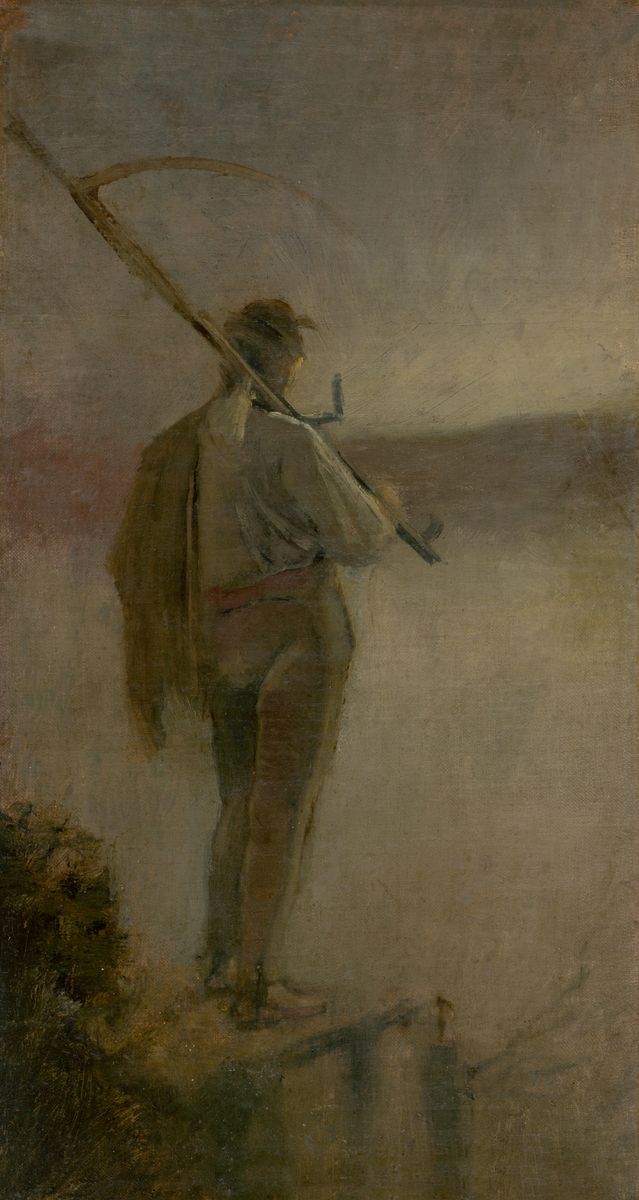
Mower by a River
Mednyánszky has the mower simply stand with his scythe. With no stroke to follow, attention goes to the man's clothes, his posture and his narrow build. The picture is nearer a portrait of a worker than a scene of mowing.
Bratislava and other locations, Slovakia
Twenty paintings from the Slovak National Gallery's holdings of regional and European art
The Slovak National Gallery holds European painting more widely. It also holds work made in what is now Slovakia by painters whose careers seldom appear in the standard histories of Western art.
This selection of twenty includes several pictures by László Mednyánszky: a mower, a lake at nightfall and a painter at the front in wartime. There are town views of Košice and Bratislava, the ruined walls of Devín, the Tatra Mountains by night, and the French Riviera with a car in it. Árpád Feszty contributes a religious scene and Joža Uprka a peasant wedding. Portraits of children and adults make up much of the rest, along with a range of landscapes and a single still life, of a skull and a forget-me-not.
Artline chose these works from the gallery's documented holdings, independently of the museum. Dates and attributions keep the qualifications given in the collection records.
Mednyánszky has the mower simply stand with his scythe. With no stroke to follow, attention goes to the man's clothes, his posture and his narrow build. The picture is nearer a portrait of a worker than a scene of mowing.
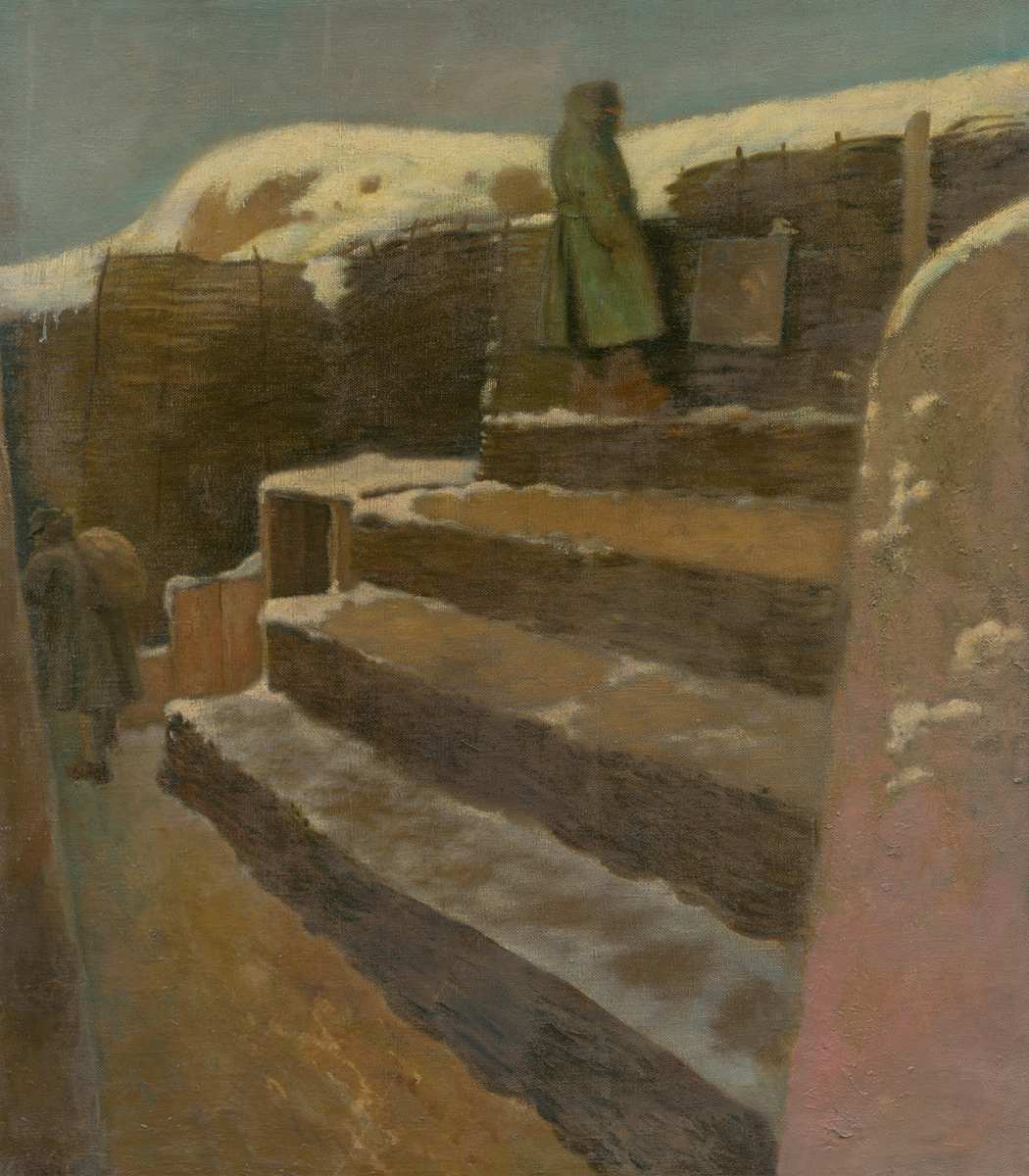
The man in the title is a painter, but the surroundings belong to the war. Rough steps and makeshift structures, awkward and improvised, stand between the viewer and the figure. Mednyánszky's low viewpoint keeps us down among them, with nowhere to take in the scene at a glance.
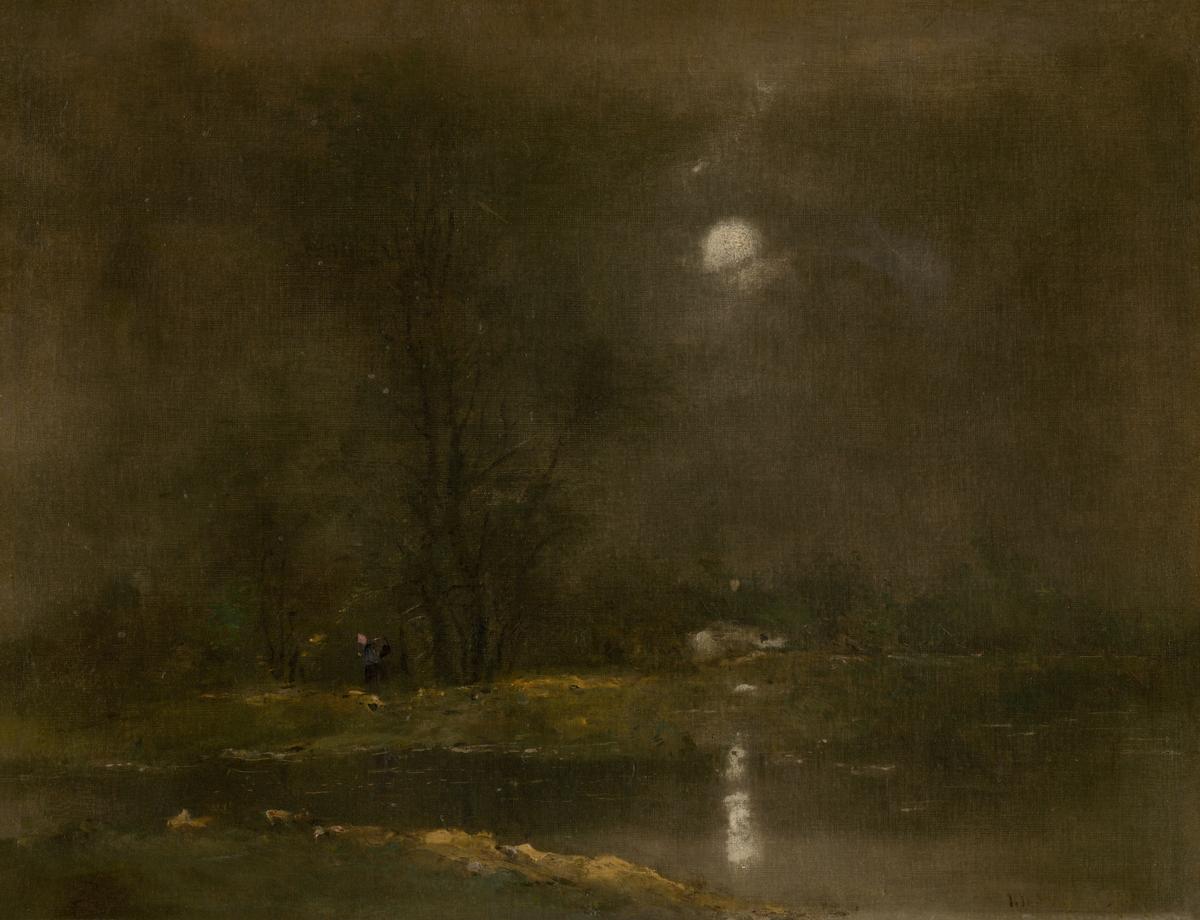
In the near darkness, water, trees and low ground separate from one another only gradually, and the small moon gives little help. Mednyánszky builds the depth of the landscape from close differences of tone. The struggle to make out what is there becomes part of the subject.
Broad roof shapes link the clustered houses across the picture. Their outlines stay irregular, though, so the compact town never hardens into a set of identical blocks. Brown and violet hold the buildings together beneath an opening of blue sky.
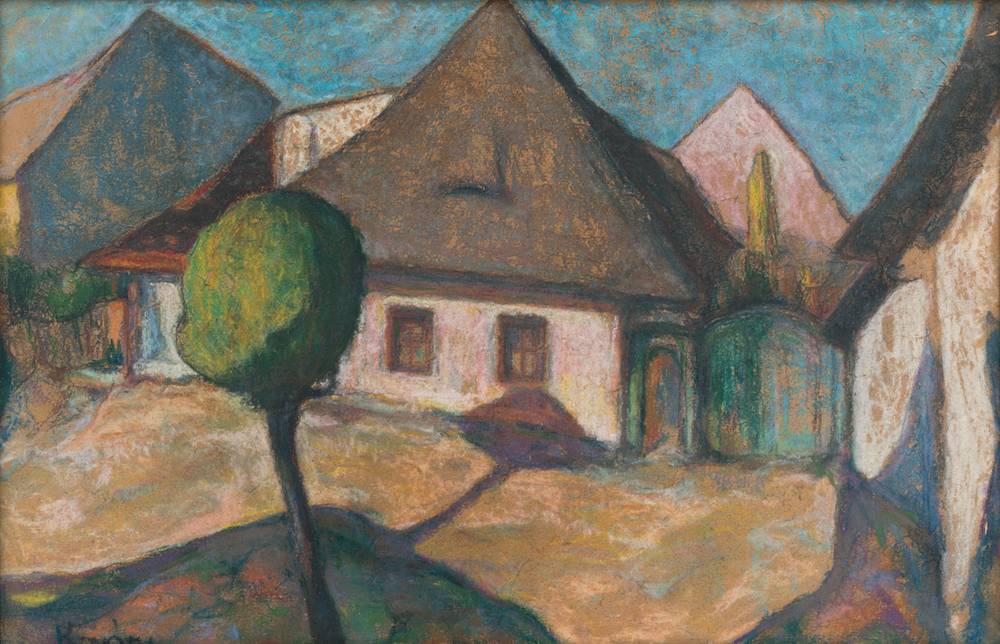
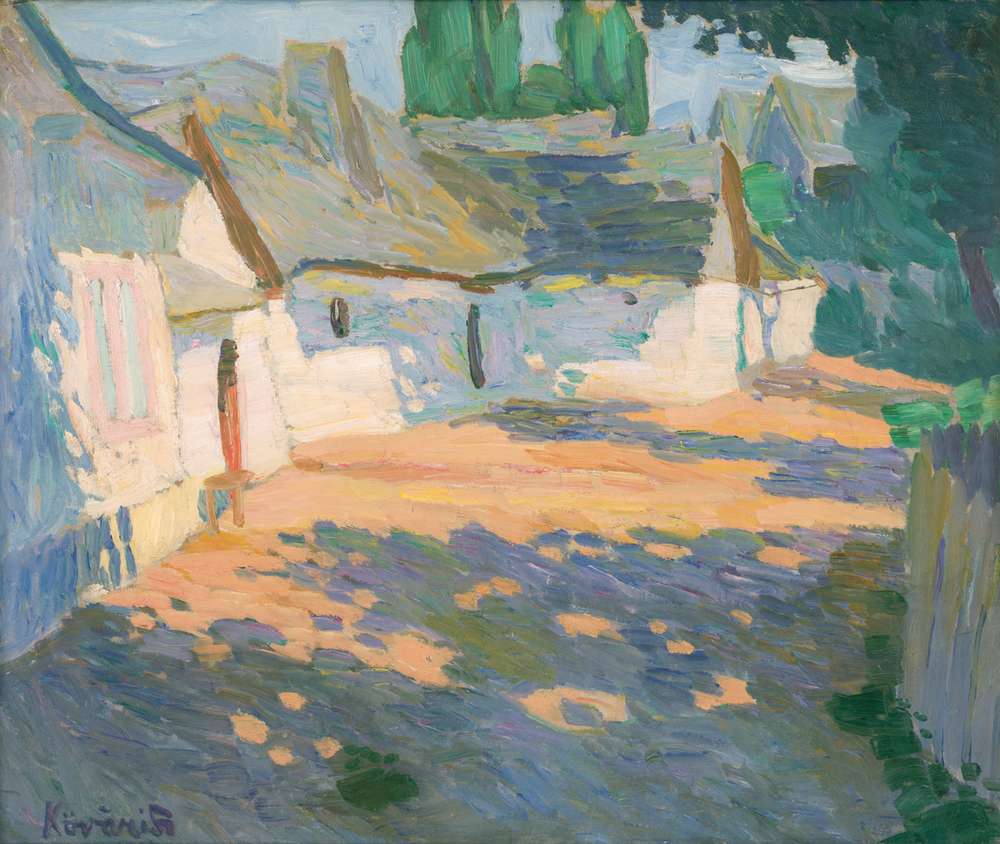
Kővári-Kačmarik's courtyard is really a picture of the light falling into it. Yellow sunlight and blue shadow divide the space, most clearly on the white walls of the houses, and that division counts for more than any architectural detail. Where trees and rooflines interrupt it, the edge of the light turns ragged.
A small flowering sprig lies across the crown of the skull, touching the bone. Klimkovič keeps the arrangement spare, so the contact stays clear and the picture never becomes an elaborate display of symbols. Because the title names the flower as a forget-me-not, the pairing can be read as remembrance laid over mortality, much as the sprig is laid over the skull.
The seated man rests his head on one hand, and the pose has a visible heaviness. Kukán leaves much of the room unresolved. The dark red shirt and the posture are what establish the figure. Only the title makes him a miner, since no mining is shown. It is tempting to read the heaviness of the pose as the toll of the work, but nothing in the picture makes that connection for us.
Short touches of pale colour and pink keep breaking into the green of the field. Frida Konstantin gathers them into clusters of flowers, and the many small marks together describe the meadow's growth. Close to, they make a pattern. They also open out into a wide stretch of ground beneath the trees.
Beside a white stove, a woman and a child lean towards each other over a modest exchange of food. Zemplényi keeps the room sparse, so you notice how small the meal is. The poverty of the title comes across through this one room and through a need the two figures share.
A figure has fallen near a horse. Intense yellow light picks out the centre of the scene, while other figures react in the shadows around it. Feszty treats the revelation as something that throws balance and sight into disorder together. The disturbance reaches the onlookers as well as the man on the ground.
Tomec gives the foreground to an open stretch of paving and sets the repeated arches and rising tower behind it. Small birds occupy the paving without pulling attention from the building. The picture rests on a contrast of scale: the courtyard is sheltered and at ground level, and the town hall around it rises much higher.
Devín's ruined walls grow out of a rocky promontory beside the river. This is a study, and the handling is open. Masonry, rock and atmosphere stay connected but are not all brought to the same finish. Those unequal degrees of finish lead the eye through a composition that was still being worked out.
A red apple near the girl's shoulder draws her hand and face into one close arrangement. Against the dark background, Roskovics picks out her smile and the light on her hair. The apple is a prop in the plainest sense. It gives the hand a reason to be where it is, and the picture needs no larger domestic scene around it.
Ferdinand Karl Theodor Christoph Peter von Lütgendorff
Satin, a pale scarf and a small pearl necklace each catch the light differently, and Lütgendorff makes those differences part of a formal social appearance. The pose is restrained, which leaves attention free to move between the face and the fabrics.
The fence and vegetation are merging into darker masses, and a warm strip of sky now gives the clearest division in the view. Paál lets the fading light simplify the scene without emptying it. A seated figure gives scale to the near ground and remains a minor part of the picture. Mednyánszky's Evening Landscape by a Lake, also in this selection, takes the same process further, into near darkness, where things barely separate at all.
Among the village courtyards and peasant subjects in this selection, a car comes as a jolt. In Vaszary's Riviera it belongs to the scene as fully as the terrace furniture, the foliage and the blue water. Leisure here means modern objects and places with people in them. Quick strokes leave patches of the light ground, the prepared surface beneath the paint, exposed. Attention spreads across the open handling, and no single incident takes over.
The girl is posed formally, in a carefully painted pale dress, held still to be looked at in the way portrait conventions expected. The doll marks her as a child, but it does not turn the picture into a scene of play. For that, compare Reiter's Little Girl Playing, also in this selection, where the child's body is far less settled.
The pale summit is easier to make out than the lower slopes or the small roof in the foreground. Katona puts the strongest light near the top of the picture, so height is what registers first, while cloud and shadow obscure the surrounding ridges. The roof shows that people live here, though it almost disappears beneath the mountain.
Horses and carriages carry the wedding celebration through a dense crowd, with red cloth and repeated costumes marking intervals along the way. Individuals can still be told apart, but Uprka organises the scene around the procession as a whole. It runs on towards the edges of the picture, as though the celebration continued beyond them, and never gathers into a neat ceremonial group.
With one arm raised and her body leaning, the girl is caught in the middle of play, far from the settled posture of a formal child portrait. Reiter ties the colourful objects to an action that is still going on. Dark drapery encloses the space, and against it her pale clothes make the unsteady pose easy to follow.
See the selected works alongside books and events from their period, or compare when the artists lived. The books and events provide context, not evidence of direct influence. Works without confirmed dates remain in this guide.
The Slovak National Gallery has collections and exhibition sites in several locations. These paintings are not necessarily shown together, and any of them may be on loan or off display. Check the gallery's current information on venues and displays before going.
Ruskin's drawing manual is built on exercises in close attention to edges, tones and natural forms. Those habits suit the trees, rocks and village views in this selection. His standards of finish are his own, though, and painters such as Tomec in the Devín study and Vaszary on the Riviera chose a much more open handling.