The Royal Museum of Fine Arts Antwerp, known as KMSKA, is closely bound to the city's own painting tradition. In the sixteenth and seventeenth centuries Antwerp was among the busiest artistic centres in Europe. The collection also extends into the nineteenth and twentieth centuries, when James Ensor and others worked in ways their predecessors would hardly have recognised.
This selection sets Antwerp masters of several generations beside pictures by Jean Fouquet, Antonello da Messina, Titian and Lucas Cranach the Elder, and several works come in pairs that ask to be compared: Calvaries by Antonello and Maerten de Vos, two drawings by Henri De Braekeleer, two portraits by Jan de Smedt. Some of the later painters look back to earlier centuries. Josef Lies imagines Dürer on the Rhine, and Willem Linnig Junior dresses an Antwerp wedding in historical costume. Others turn to work and the people who do it, from a street sweeper to the labourers whom Lies, in a second picture, sets pointedly beside a lady. Ensor also appears twice, once as the painter of a crowded table and once on paper, with forms that barely hold together.
Artline chose these works from the museum's documented holdings, independently of KMSKA. Where the linked records qualify a date or attribution, the qualification is kept.
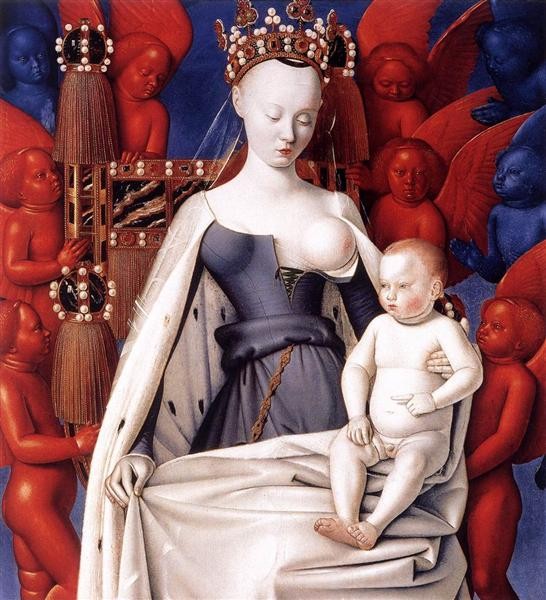
The colour is what startles first. Fouquet paints the Madonna and Child almost white and surrounds them with the seraphim and cherubim of the title in fierce blue and red, so that the central bodies look paler still. Then there is the child, who points away from his mother. It is one small movement, but it is enough to unsettle what would otherwise be an entirely still devotional image.
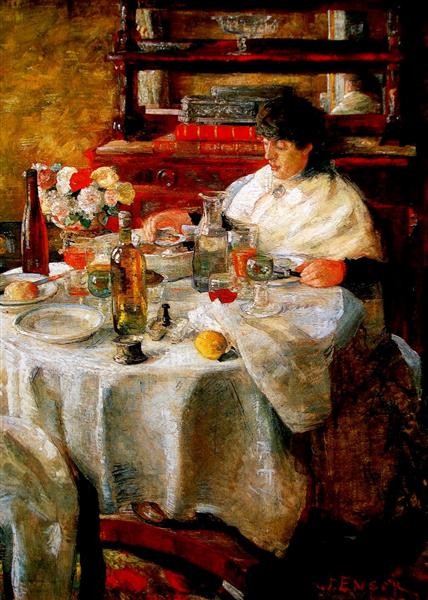
The woman is named only by what she is eating, and the painting treats her in much the same spirit. Glasses, flowers, dishes and reflected colour spread the meal across the whole picture. She is painted as part of that abundance, and no clean edge divides her from the laden table.
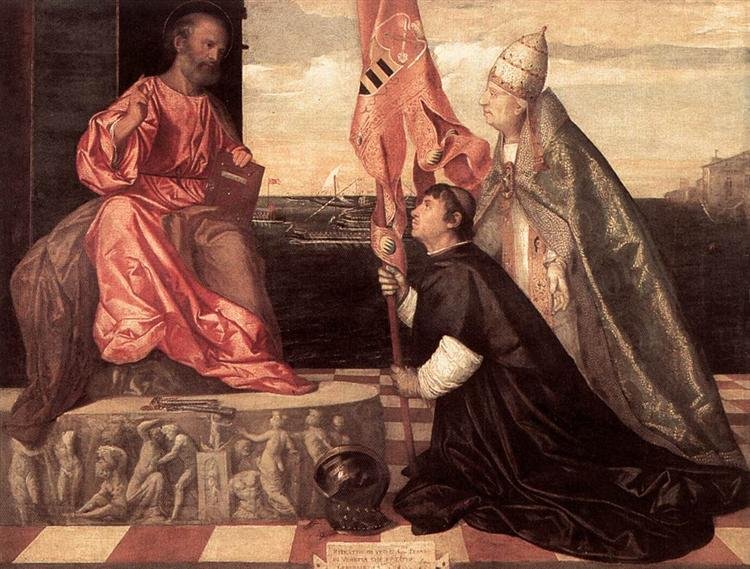
1503 · Oil on canvas · Royal Museum of Fine Arts Antwerp
Jacopo Pesaro kneels below Saint Peter, and Pope Alexander VI stands behind him to present him. Had Titian left it there, this would be a purely religious exchange between a kneeling man, a pope and a saint. But a military standard rises nearby, and with it comes martial, worldly power. With the pope as go-between, religious approval and secular authority are brought together in a single arrangement. Beyond the figures a distant sea carries the setting well past the presentation itself.
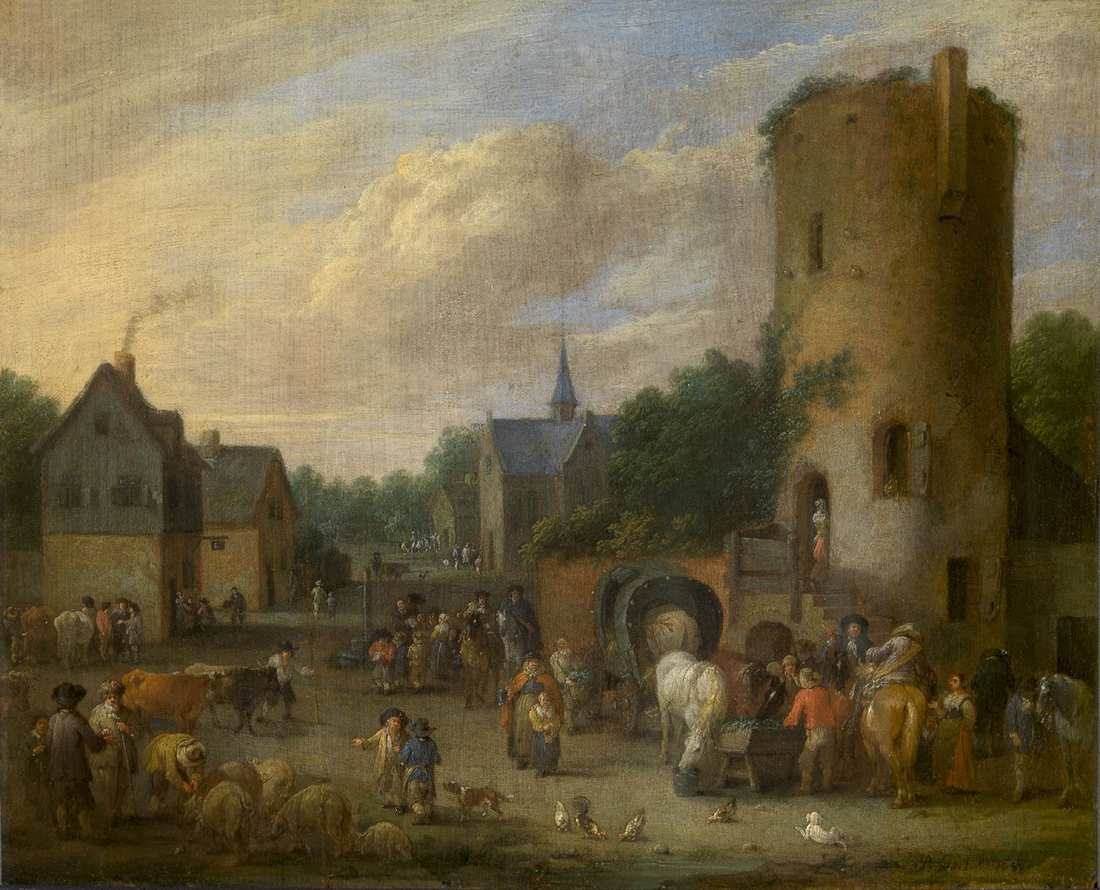
1680 · Oil on panel · Royal Museum of Fine Arts Antwerp
Nothing in Bout's village street is the main event. Horses and people gather in separate clusters, small enough for several things to go on at once without any one taking priority, and a gap between the buildings opens onto a view further off.
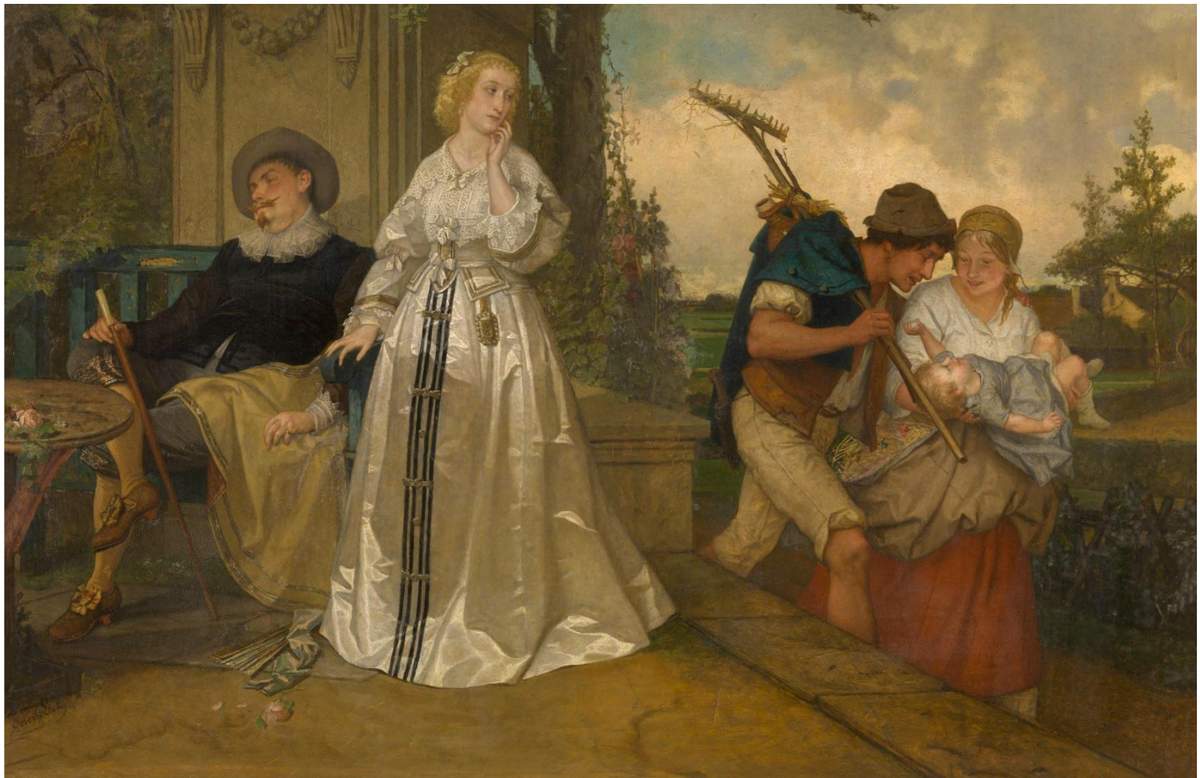
The title gives the game away before the picture does. A finely dressed woman shares a terrace with working people whose circumstances are visibly different, and clothing, placing and tools supply the comparison the title promises. They are close together, but they are not presented as equals. Social distinction is the subject, and Lies states it so bluntly that the viewer has little left to work out.
1620 · Oil on panel · Royal Museum of Fine Arts Antwerp
The finery is not quite what it seems. The metal plates on Grapheus's chest belong to the Antwerp guild's chamber of rhetoric, and the splendid vessels are guild property too, not a display of private means. De Vos gives him an individual face, but the trappings speak for the institution he served. A first-time viewer is unlikely to catch the distinction.
1528-1530 · Oil on panel · Royal Museum of Fine Arts Antwerp
Cranach tells the Fall with very little: two pale figures, clearly separated against a dark ground, the fruit tree, the offer of the fruit and a few turns of the body. Small gestures are all that connect Adam and Eve, and nothing crowds the space around them.
A keyboard, dishes and the remains of food occupy a room with nobody in it. The title places the scene after mourning, not during it, and explains nothing further. The leftovers might suggest a gathering that has broken up, but nothing in the room shows who has died or who has gone away.
Lies stands Albrecht Dürer upright in a boat on the Rhine among figures in period costume, and arranges the whole as a historical tableau. This is a later painter's imagining, not an eyewitness record, and it probably says more about how Lies's own time pictured an earlier artist than about the journey itself.
Aline's folded arms make a firm horizontal below the turn of her head, and the orange blouse keeps them prominent against a muted background. There is no setting to explain her, so the portrait rests largely on that posture and on a glance directed off to the side.
Larock shows the old woman in profile, which gives less of the face and makes its outline count for more, and he lets that outline carry the likeness. The bolder choice is the colour. Her head covering is painted in warm browns very close to those of the background, and only slight shifts of tone keep her from merging into it.
A long handle identifies the man's trade. The title adds his city but leaves out his name. Van Havermaet shows him pausing, his hand at rest, and paints him with the steady attention of a portrait, not as an illustration of sweeping. In Lies's A Contrast, working people make up one side of an argument. Here a working man has the picture to himself.
The wide format lets the wedding unfold as a procession, with participants and onlookers in their different places, so that the occasion becomes larger than the couple. The figures wear historical dress, and no actual event is documented behind the scene. The picture is better taken as a costume piece than as the record of a particular wedding.
Van Leemputten puts a single bent figure in the near foreground, close to the picture plane, while the carriage and the crowd fill the street behind as the procession arrives. The cobbles run through the whole depth of the scene, so figure and crowd share one street. Is that solitary figure part of the occasion or apart from it? The picture keeps it well away from the crowd and does not say.
Not every threat here has a solid outline. Ensor builds faces and bodies from light marks and leaves bare paper between them, so that parts of the sheet look unfinished. Creatures emerge and are lost again among the suggestions around them, which suits a scene of temptation, where it is never quite certain what is there. Long before, in The Oyster Eater, Ensor had let a figure merge into her surroundings. There it was the abundance of a meal that absorbed her.
1873 · Pencil on paper · Royal Museum of Fine Arts Antwerp
The window is the lightest part of the sheet and its strongest contrast, and it gives the man somewhere to stand. Around that opening, dense pencil work builds up the enclosed room. Little happens. The drawing is divided between the dim interior and whatever lies beyond it.
1475 · Oil on panel · Royal Museum of Fine Arts Antwerp
The supports tell the three bodies apart before their poses do. Christ hangs on a straight cross, while the two thieves are held up by rough tree trunks. Behind the execution a wide landscape recedes calmly into the distance, and the violence takes place in open country.
1600 · Oil on canvas · Royal Museum of Fine Arts Antwerp
The mourners crowd close beneath the cross, and one reaches round its base, but Christ's body is set too high for the gesture to reach him. Antonello opened his Calvary onto a wide landscape. De Vos keeps attention on the group below and on the gap between their grief and the body above them.
1873 · Graphite pencil on paper · Royal Museum of Fine Arts Antwerp
Pictures, easels, furniture and the standing figure of the painter fill the studio. De Braekeleer varies the density of the graphite so that the accumulation stays legible without every object claiming equal weight. Man at the Window, from the same year, is organised around a single light opening. This sheet is a room full of things, gathered around the making and viewing of images.
The blue-violet dress forms a broad mass that registers before the smaller features of the face. Camilla sits with her head turned slightly away, so the pose stops short of frontal. Set beside Aline, the change is one of colour and posture, not of setting: orange gives way to blue-violet, and the shape that holds the picture together is no longer a pair of folded arms but the dress itself.
Explore this selection in Artline
See the selected works alongside books and events from their period, or compare when the artists lived. The books and events provide context, not evidence of direct influence. Works without confirmed dates remain in this guide.
Occasions and ordinary days
Several of these pictures are built around an occasion, and an occasion hands out parts. Linnig's wedding sorts its crowd into participants and onlookers. Titian's presentation needs a kneeling man, a pope to present him and a saint to receive him. If the leftovers in Thevenet's room do mark a gathering, they show an occasion after the cast has left and only the props remain. The pictures without an event give their figures no parts to play. Bout's villagers keep to their own clusters, and Van Havermaet's sweeper is shown resting from his work, not performing it. Van Leemputten's street holds both conditions at once: the procession arrives with its carriage and crowd, while the bent figure at the front seems to belong to an ordinary day.
Harold Speed's general manual of draughtsmanship explains how edges, masses and lines organise a drawn figure. It offers useful terms for the two De Braekeleer drawings, where so much depends on how densely the pencil is laid, and for portraits such as de Smedt's, which are built from a few large shapes.
 Art, literature & history