The Phillips Collection in Washington grew out of Duncan Phillips's own collecting and opened to the public in 1921. People still link it with seeing modern painting in fairly intimate rooms, and its holdings cover both European and American artists. Renoir's Luncheon of the Boating Party is among its best-known pictures.
This selection leans towards painters Phillips admired and collected. Renoir, Manet, Corot, Daumier and Bonnard are here, along with Rousseau, Soutine and an early self-portrait by Mondrian. Ernest Lawson, Jerome Myers and Robert Spencer each contribute a pair, and each pair is worth reading side by side. Lawson has a winter river full of ice and hills under storm clouds. Myers has children at play in a street and women and children on a pier. Spencer has a street evangelist and an auction in the doorway of a house. There are single pictures by John Sloan, Albert Pinkham Ryder, Walter Griffin, Julian Alden Weir and Kenzo Okada, and the opening panel of Jacob Lawrence's Migration Series.
Artline chose these works independently from the Phillips Collection's documented holdings, and a picture's inclusion here does not mean it is on view. Dates and attributions keep the qualifications given in the linked records.
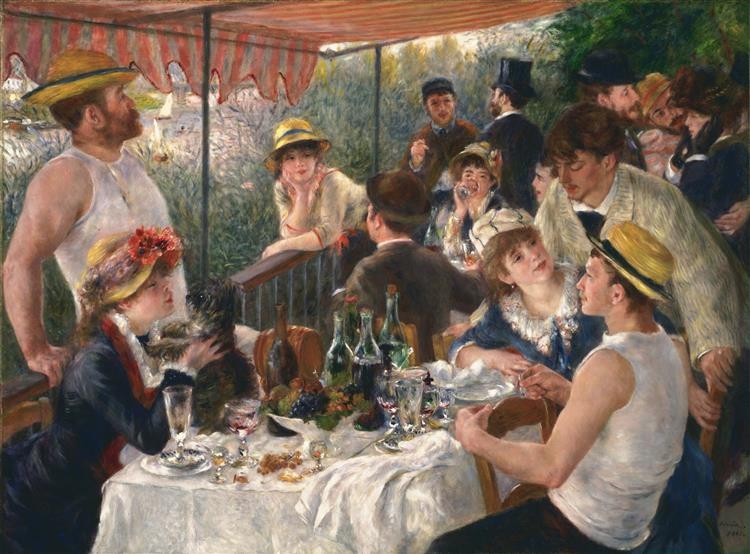
Renoir's friends crowd round a table laid with fruit, bottles and glasses, and there is no single conversation to follow. Some turn to their companions while others sit apart. The ease is deceptive. Renoir arranged the company with care, and the relaxed sociability on show belongs to a particular world of Parisian leisure.
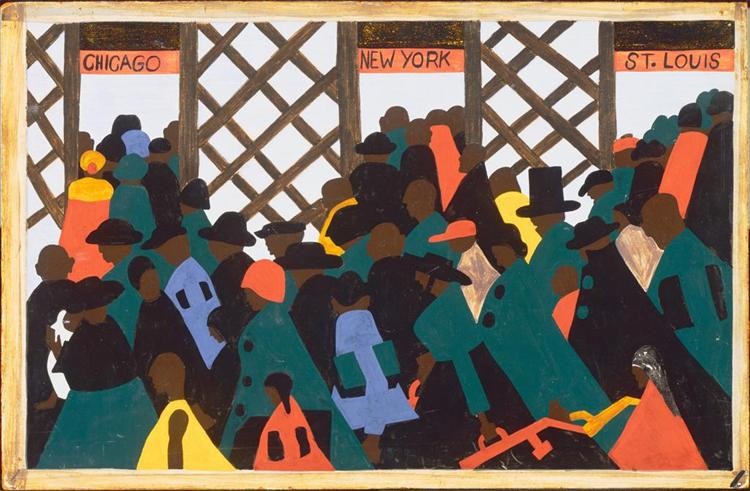
Signs above the crowd name Chicago, New York and St. Louis. Beneath them, people press towards departure. Lawrence reduces the travellers to dark, anonymous shapes and patches of bright clothing, so the destinations are easier to read than any face. This is the first of his sixty panels on African American migration from the South, and the story begins with a crowd rather than with one traveller.
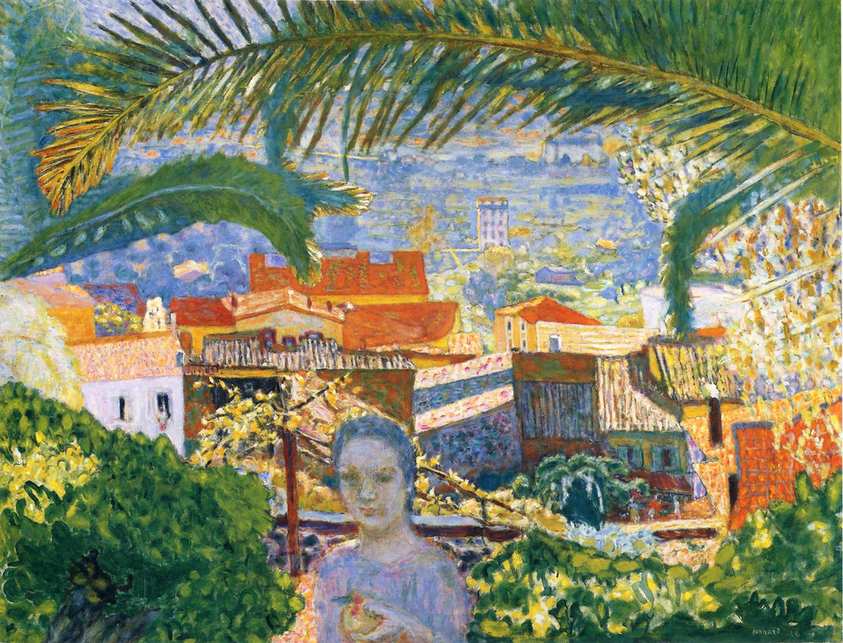
The palm gets in the way. Its spreading fronds cut across a view of buildings and vegetation, filling space that a more orderly landscape would leave open. Bonnard's colours overlap instead of stepping back in separate planes, so what lies beyond the palm never quite settles into background. A small figure in the foreground gives some measure of scale, though only a partial one.
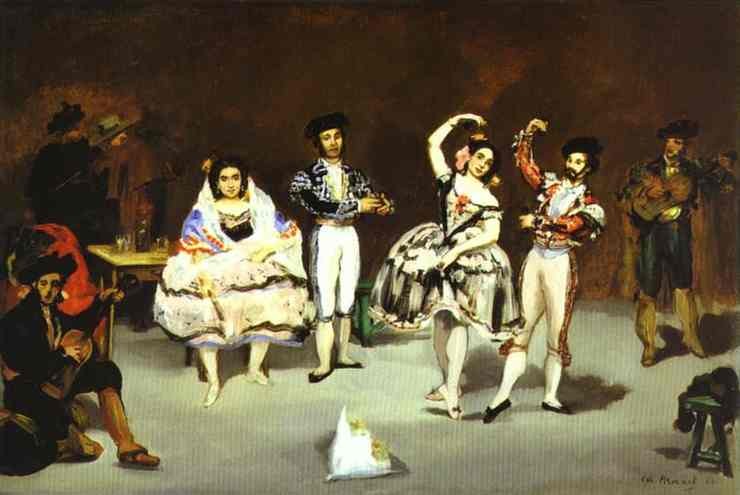
In a dim setting, light catches the pale skirts of Manet's costumed performers. Each holds a distinct pose, as if stopped mid-gesture, yet the poses never combine into a single dance step. For a ballet it is a curiously suspended scene. The company seems to be waiting between one action and the next.
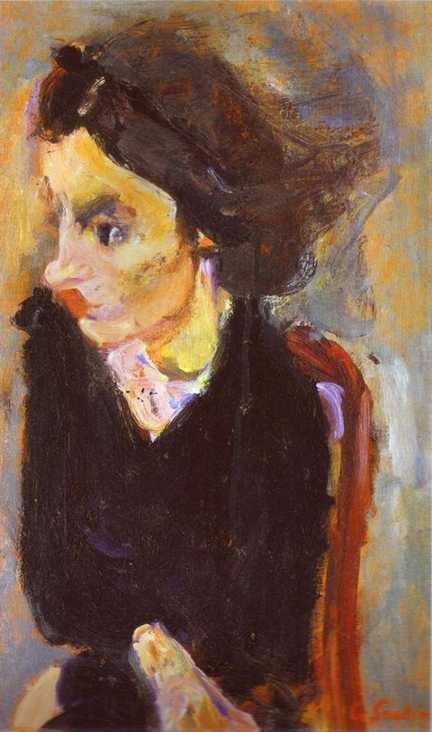
The head turns sharply into profile, and that turn gives the portrait its direction. Warm patches of paint build the face against dark clothes and a roughly handled background. Soutine leaves no part of the surface smooth, yet Madame Tennent's profile comes through clear and particular.
Candle, bottle, plate, fruit: Rousseau gives each a firm outline, and each is easy to name. Saying where they stand is harder. The setting is shallow and the background plain, and the objects never settle into a consistent space, so their differences of height, colour and edge become the main event.
A goatherd and animals move along a path below a town's distant buildings, and nothing else happens. Trees and rough ground frame the opening between path and town, and Corot's light carries across the whole distance. The small figures mainly give the view an inhabited scale.
The title calls them sculptors, yet neither man is visibly working with tools. They lean towards a small sculpture set between them, and their faces and the object emerge from a dark interior. The sculpture is there to be examined and judged, and their converging poses suggest they are weighing it up together.
How far should a title be allowed to lead? Okada sets scattered marks and muted geometric areas on a pale field. With the title in mind, it is easy to link the marks across the gaps between them, as if following someone's passage through a place. The picture goes along with the idea only so far. There is no continuous path and no walking figure, the marks never form a complete landscape, and not every shape fits the notion of footsteps.
Anyone who knows Mondrian only from the abstraction for which he is better known may take a moment to place this picture. He paints himself bearded and open-collared, looking straight out, his face modelled by warm light against a dark reddish ground. The subject is one particular face and the shifts of tone across it.
Sloan's clown sits at a small table beside curtains, and the costume and make-up are still unfinished. The light gathers on the face and on the preparations. This is the time before the public appearance, when making up is a practical job and nothing is yet being played as a joke.
Most of the picture is dark mass. The moon shows between long clouds and its reflection lays a narrow path across the water, and the light stays confined to those few small areas. Ryder leaves out the detailed coastline that might identify the cove.
c. 1907 · Oil on canvas mounted on wood panel · The Phillips Collection
Broken ice, water and winter banks share a narrow range of pale colours, so Lawson has to tell them apart by other means. He uses varied strokes instead of sharp outlines. Buildings stand beyond the river, and dark accents and scattered trees show how far the unstable, partly frozen water extends.
Ice in the River keeps to a narrow range of pale colour, but this picture depends on contrast. Dark clouds gather above hills, a house and water, but the storm has not yet broken, and light still reaches parts of the ground. Lawson keeps those bright passages in view against the clouds, so the change in the title is caught while it is still happening.
Carcassonne's fortified buildings rise beyond a tree-lined wall. Griffin paints them in the same broken colour as the foliage and the open ground, and the stone gets no more polished a treatment than the trees. The town's outline is still recognisable, and it stands in the same light as the vegetation around it.
Buildings and shopfronts tower over the children, and the darker walls pick out their pale dresses and small gestures. Myers keeps the group loose, with each child moving differently, and for a while the street is given over to play.
Here Myers moves from the street to the waterside. Women and children sit or stand close together on the pier, distant structures stretch along the horizon, and warm evening light falls across the whole group. No single event seems to have brought them there. Some look more at rest than others, and not everyone is part of the same conversation.
The evangelist speaks from a raised position where the street crowd can see him. Below him, faces, hats and postures vary, and the listeners never merge into a uniform mass. Is anyone convinced? Spencer does not say, and he does not show whether they are all listening in the same way.
Spencer uses an arrangement similar to the one in The Evangelist, with a raised figure above a crowd, but sets it at the open doorway of a house. People cluster there, looking towards the objects on offer, and pale walls and shutters frame them firmly. The evangelist's listeners vary in posture, but this crowd all faces one way, looking and waiting. The doorway of a home has become a place where goods are valued in public.
A woman in a pale dress stands under trees beside a saddled horse, and its darker body sets off her dress. Weir spreads dappled light over figure and ground alike, so the portrait stays part of its outdoor setting. The horse is still saddled, so the ride in the title probably ended only a short time ago.
Explore this selection in Artline
See the selected works alongside books and events from their period, or compare when the artists lived. The books and events provide context, not evidence of direct influence. Works without confirmed dates remain in this guide.
Different kinds of gathering
Many of these pictures show people in company, and each one raises the question of what brought that company together. Renoir's lunch and Myers's evening on the pier are loose, sociable groups with no single focus. Daumier's pair and Spencer's auction crowd each have something to judge: a small sculpture in one case, goods for sale in the other. Spencer's street listeners share a speaker, though perhaps not an opinion. Manet's performers share a setting while each keeps to a separate pose. Lawrence's crowd is held by neither talk nor spectacle, only by the places named above its head.
Further reading
Anne Dayez, Michel Hoog and Charles S. Moffett · Read online or download · English
This Metropolitan Museum catalogue by Anne Dayez, Michel Hoog and Charles S. Moffett gives historical background on Renoir and Manet. That makes it a useful companion to Luncheon of the Boating Party and The Spanish Ballet, two pictures with different social settings and very different painted surfaces. You can read it online or download it. Because it covers Impressionism, it has little on most of the other artists here.
 Art, literature & history