The Palais des Beaux-Arts de Lille holds a large collection of European paintings, drawings and sculpture. It is especially strong in art from France and the Low Countries, which is hardly surprising in a city so close to the Belgian border, and its galleries cover large religious subjects as well as portraits and scenes of ordinary life.
None of the twenty paintings chosen here is religious. Several take their subjects from ancient legend and myth, but the story matters much more in some than in others. You can follow David's Belisarius with little help from the legend. Delacroix's Medea reads quite differently once you know the myth. The name Erigone does surprisingly little to unlock Moreau's dense panel. Other pictures need no background at all, among them Jordaens's cows and Oudry's pug. Boilly appears twice, with two public men, Robespierre and Marat, and he treats them in strikingly different ways.
Artline chose these works from the museum's documented holdings. The selection is independent of the museum, and dates and attributions keep the qualifications given in the source records.
1781 · Oil on canvas · Palais des Beaux-Arts de Lille
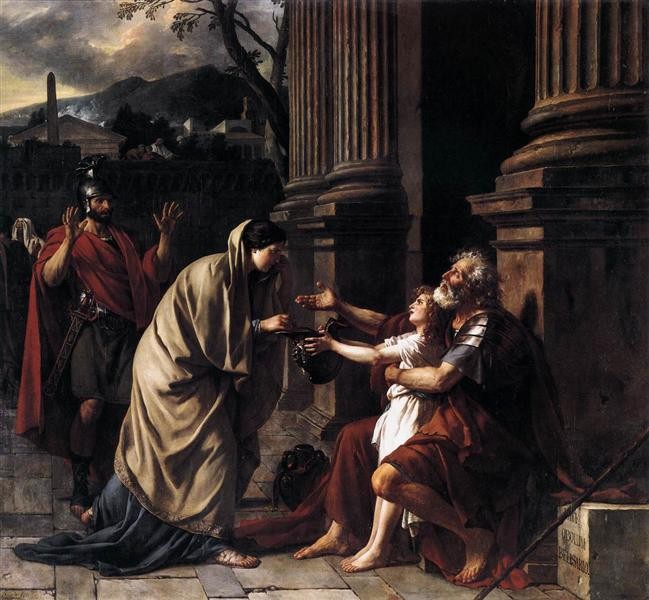
Belisarius, the fallen general of legend, has been reduced to begging. David hangs the whole reversal on one object: the helmet that once signalled military authority is now used to collect alms. The onlookers do the rest. Their gestures of surprise, recognition and pity each show the old man's fall from a different side.
1624 · Oil on canvas · Palais des Beaux-Arts de Lille
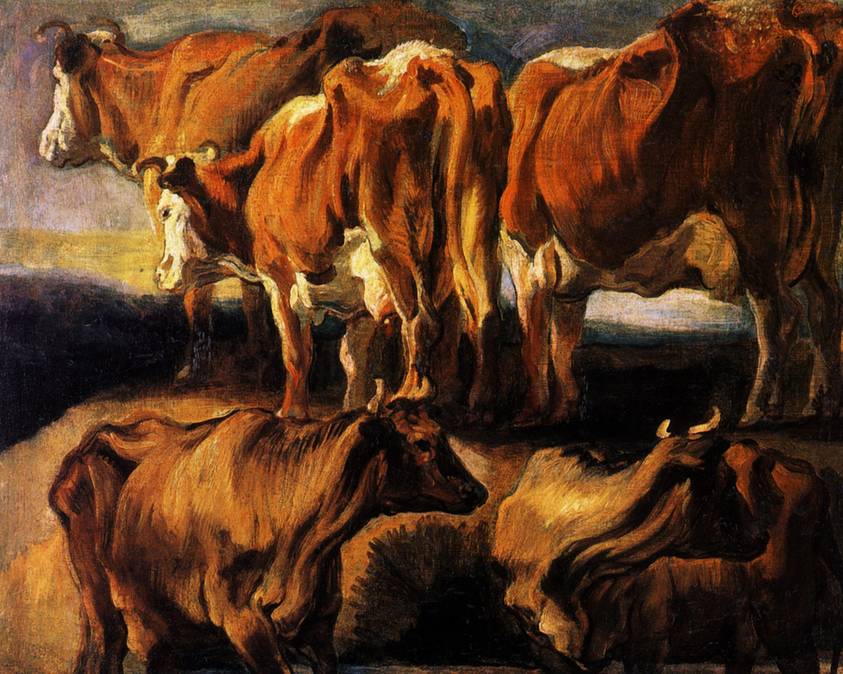
Five studies, but no herd. Jordaens put the cows on one canvas without joining them into a scene. Some stand and some lie down, and each pose brought its own problems of weight, overlap and the turn of a head. The repetition is what gives the canvas away as a working study rather than a composed picture.
c. 1794 · Oil on white paper mounted on canvas · Palais des Beaux-Arts de Lille
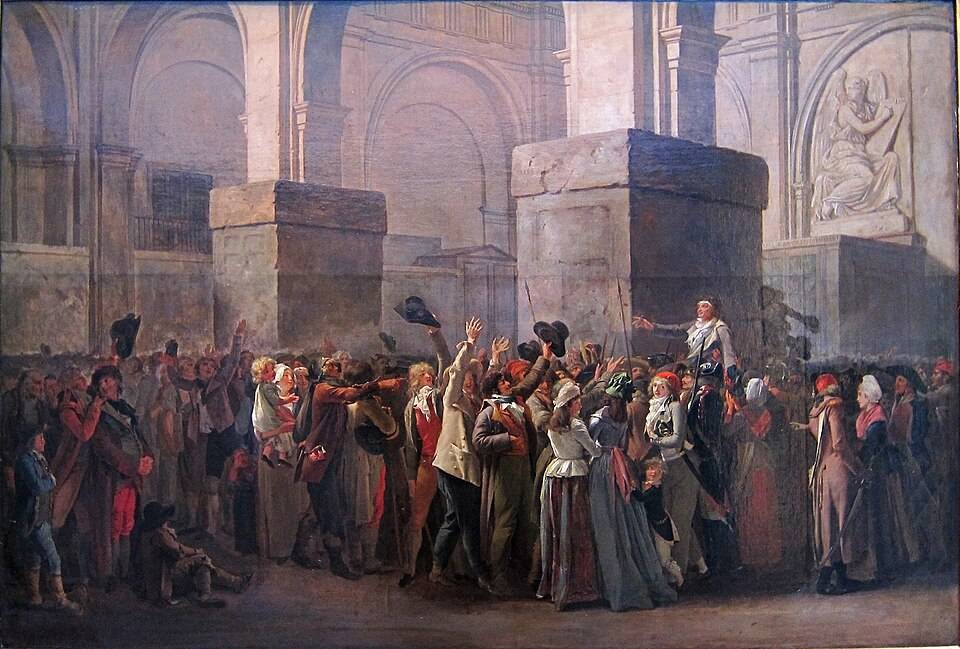
Marat is lifted up and carried, yet he hardly owns the picture. Boilly gives much of it to the bearers, whose raised arms and clustered heads make his importance look like something they hand up to him. If this is a triumph, the crowd is the one staging it. It is also the only painting on paper in this selection: oil on white paper, mounted on canvas.
1838 · Oil on canvas · Palais des Beaux-Arts de Lille
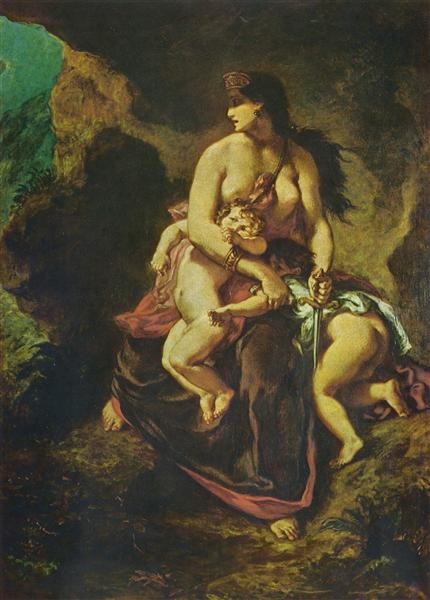
Medea holds two children in a rocky shelter. At a glance the close grouping might pass for protection, but her turned head and tense grip say otherwise. Delacroix puts the danger in the embrace itself. For anyone who knows how her story goes, the children's dependence on her is hard to look at.
c. 1791 · Oil on canvas · Palais des Beaux-Arts de Lille
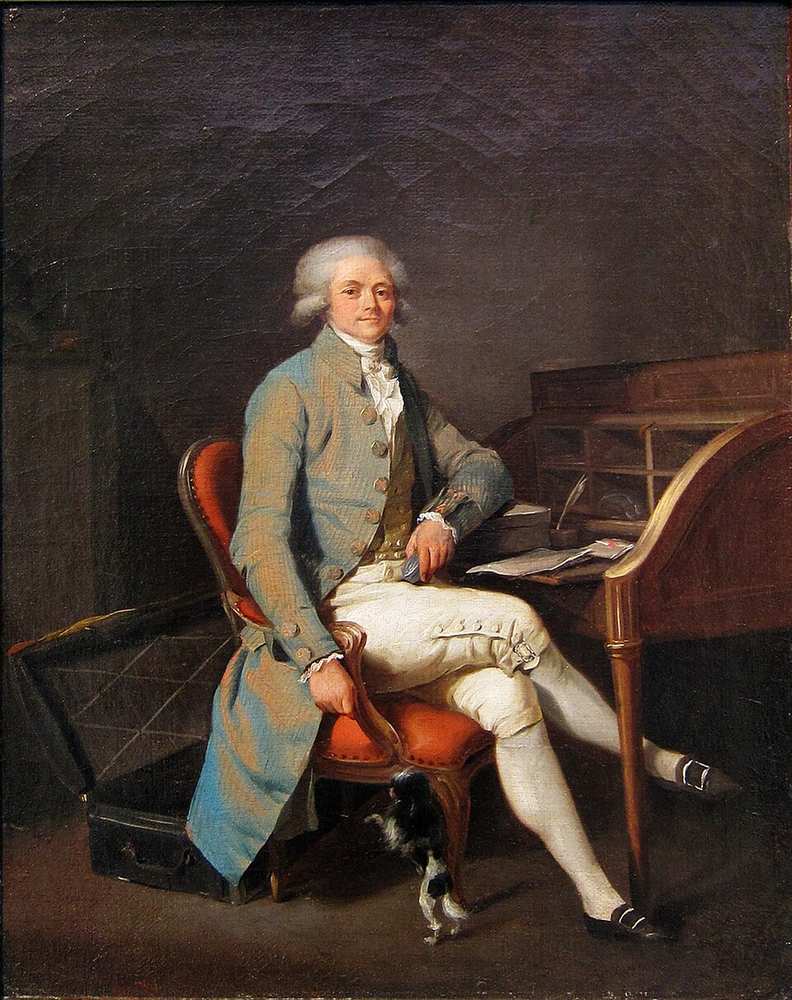
Papers, a desk, orderly clothing: these are the restrained props of a particular kind of formal portrait, and Boilly uses them to present Robespierre as a composed civilian sitter. In the same painter's Triumph of Marat the crowd hands a public man his importance. Here Robespierre's standing seems to rest on furniture and paperwork.
1817 · Oil on canvas · Palais des Beaux-Arts de Lille
Nobody is racing yet. Géricault paints the moment before the start, when the horse has to be held back, and he makes the holding look like hard labour. Human limbs and the animal's neck pull in different directions, and the bodies are packed so tightly that no single action stands out from the struggle. Like Jordaens's cows, this is a study, but of another kind. There are no separate poses set side by side here; people and horse are already tied into a single knot.
1880 · Oil on canvas · Palais des Beaux-Arts de Lille
The thaw of the title is already over, and Sisley paints what it has left behind. The swollen Seine has spread into an unusually broad, pale expanse beside the wet bank, and water lies where there might otherwise be firm ground. The weather has changed the proportions of the place.
c. 1814 · Oil on wood · Palais des Beaux-Arts de Lille
The ancient story turns on three figures: Apelles the painter, Campaspe his model, and Alexander, the ruler who watches the work. David separates them with the easel and keeps its canvas in view between them, so the picture being made stays visible inside the one we see. Campaspe is the one being looked at. Of those doing the looking, Alexander is the most powerful.
Second half of the 17th century · Oil on canvas · Palais des Beaux-Arts de Lille
Beside the small travellers the rocks look formidable, and at first they seem to block the way. The route gets through all the same, and beyond the enclosed passage the view opens out onto distant country.
c. 1620 · Oil on wood · Palais des Beaux-Arts de Lille
The centre of the bouquet is crowded, yet no flower is lost in it. Savery sets each stem and delicate edge against the dark background with enough contrast to keep it clear, and a few fallen blossoms carry the arrangement beyond the vase.
c. 1873 · Oil on canvas · Palais des Beaux-Arts de Lille
River, houses and sky lie in broad horizontal bands, and then the water loosens that order. Reflections blur the boundaries between the bands and give the inhabited bank a second, less solid presence. Little else happens, so the reflections repay a closer look: no building in the water quite matches the shape of its counterpart on the bank.
Second half of the 19th century · Oil on canvas · Palais des Beaux-Arts de Lille
Bonheur brings the shepherd so close that his rough outer garment counts for as much as his face, and his dark cap against the blue sky makes the turn of his head easy to read. The tight cropping leaves out any wider view of rural work. Instead he gets the close attention of a portrait, and his occupation has to be read from his clothing and bearing.
1730 · Oil on canvas · Palais des Beaux-Arts de Lille
The red ribbon gives the picture its title and a bright accent at the neck, but the dog's stance is what holds it together. Compact and pale against darker surroundings, the pug registers at once: open mouth, alert pose.
c. 1660 · Oil on canvas · Palais des Beaux-Arts de Lille
Ruisdael runs a curving path through the farmland and puts a few small figures on it, so the fields look continuous and easy to cross. The sky works on another scale entirely. Its great banks of cloud stop the land from looking fully under human control.
1864 · Oil on canvas mounted on wood · Palais des Beaux-Arts de Lille
A confidence is meant for one listener, and Breton does not let the viewer become a second. One young woman leans towards the other so that both bodies turn the same way. Their relationship is plain, though what they are saying is not, and together they make a private enclosure within the wider setting.
1888 · Oil on glass · Palais des Beaux-Arts de Lille
Bernard painted this on glass, not canvas. He built the scene from areas of colour edged with dark outlines rather than modelling it with naturalistic shadow. The pickers and trees are still recognisable, but the depth is compressed, so each patch of colour does two jobs at once: it describes part of the scene and takes its place in a flat pattern.
c. 1810 · Oil on canvas · Palais des Beaux-Arts de Lille
The old women are elegantly dressed and study themselves in a small mirror, but nothing in the picture flatters them. Behind them, a winged figure and a raised broom bring in a larger threat, presumably the Time of the alternative title. Against that, their business with the mirror, trying to control how they look, seems very small.
1865 · Oil on canvas · Palais des Beaux-Arts de Lille
A girl has fallen asleep in the woods. Her head rests on her hand, and the wooded ground closes round her body. Cut branches show that she is near some kind of work, but what Anker paints is an unposed break from it. As with Bonheur's shepherd, the work itself stays outside the picture and only its signs remain.
c. 1865 · Oil on wood · Palais des Beaux-Arts de Lille
A pale body emerges from a setting that will not sort itself into distinct parts. Moreau picks out the skin with small areas of light against the dense growth and shadow around it. Beyond that, the panel gives little away.
1876 · Oil on canvas · Palais des Beaux-Arts de Lille
Snow mutes the colour, and grey and violet shadows break up the white, but the road keeps its structure. Its converging edges lead carriages and walkers between the houses and trees. In Sisley's view of the Seine after the thaw, water spills over what should be firm ground. Here the snow softens almost everything, but not the line of the road.
Explore this selection in Artline
See the selected works alongside books and events from their period, or compare when the artists lived. The books and events provide context, not evidence of direct influence. Works without confirmed dates remain in this guide.
Bystanders and travellers
The secondary figures in this selection do very different jobs. In the figure paintings they tell you how to read the central figure: Belisarius's fall and Marat's elevation both reach us largely through the people around them. In the landscapes, people shrink to something closer to a measuring device. The walkers beside Sisley's swollen Seine show how wide the river has become without taking over the scene. Ruisdael's figures and Teniers's travellers mark out a route, easy going across the fields in one picture and harder won among the rocks in the other. None of these landscape figures is the subject. That role belongs to cloud, rock and water, and the people mostly tell us how big those are.
Reynolds sets out an influential eighteenth-century argument about what painting should aim to do. These pictures are not among his subjects, but his argument gives you a yardstick from the period for judging the ambitions of the large figure compositions by David and Delacroix.
 Art, literature & history