The National Gallery of Victoria in Melbourne was founded in 1861 and has built up a broad collection of Australian and international art. Australian painting makes up the largest part of this selection of twenty works, and most of it is landscape: Louis Buvelot's views near Heidelberg and at Templestowe, Arthur Streeton's river, harbour and spring pictures, Clara Southern's bee farm and evening valley, and Jane Sutherland's naturalists and mushroom gatherers. Each of these painters appears more than once, so their pictures can be set against one another: Buvelot's winter against his summer, for instance, or Sutherland's outdoor scenes against her portrait of Dorothy Sutherland.
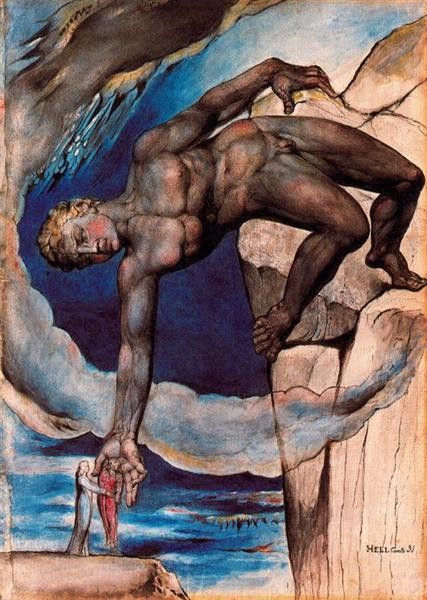
The international pictures range more widely. George Stubbs's lion and horse, William Blake's giant Antaeus with Dante and Virgil, and Elizabeth Thompson's regiment under fire are scenes of force and danger. Manet's house at Rueil, Pissarro's Paris boulevard in grey weather and Gwen John's dim interior are quieter. Modigliani's portrait of the painter Manuel Humbert and Mark Gertler's apple woman and her husband complete the European group. The most recent works, Albert Tucker's Judas and Mark Rothko's Untitled (Red), close the selection at opposite extremes: a crouching figure bent under a burden, and areas of red and orange with no figure at all.
Artline chose these works from the NGV's documented holdings, independently of the museum. Inclusion here does not mean a work is on view, since some may be on loan or off display. Dates and attributions follow the linked records, with their qualifications kept.
1896 · Oil on canvas · National Gallery of Victoria
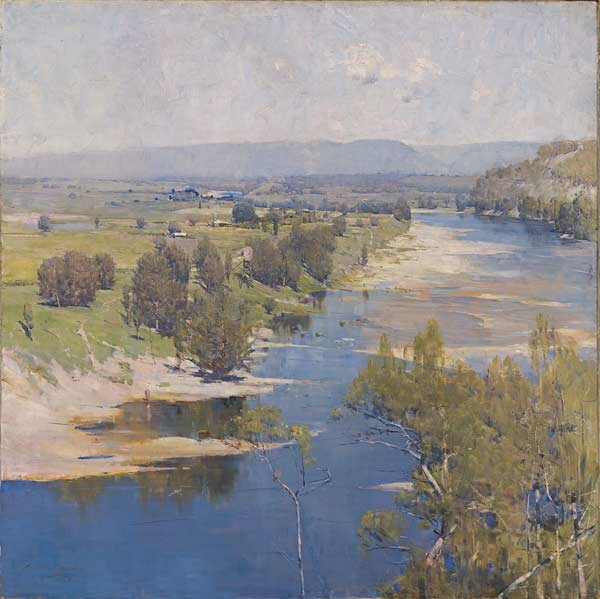
The title claims a great deal for one hour of the day: purple, transparency, might. What Streeton paints is a river curving across a broad stretch of country and leading the eye out into it. Strong blues in the foreground give way to paler hills, which lose definition the further off they are. Transparent is an odd word for distances that blur, unless the air itself is meant. Streeton makes the heat visible through exactly that gradual loss of clarity.
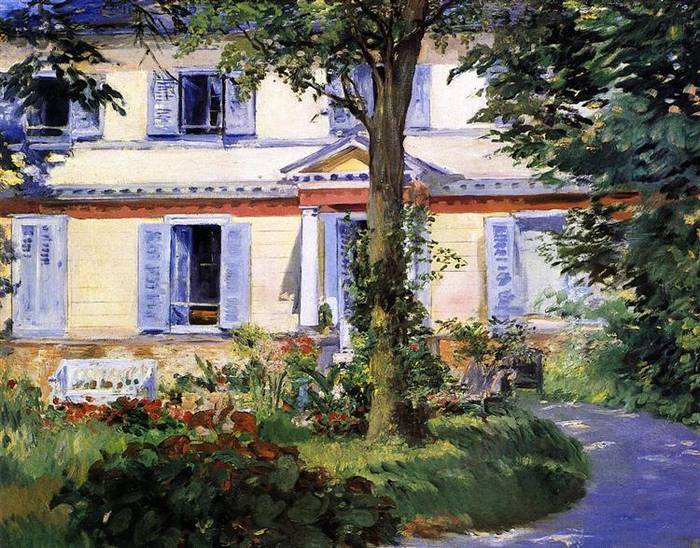
A tree trunk stands in front of the house, near the centre of the picture, so the pale walls and blue shutters show only in patches between the trunk, the leaves and the garden plants. For a picture named after a house, a surprising amount of the house is hidden. The view belongs to one particular spot in the garden, and Manet leaves the trunk where it stands.
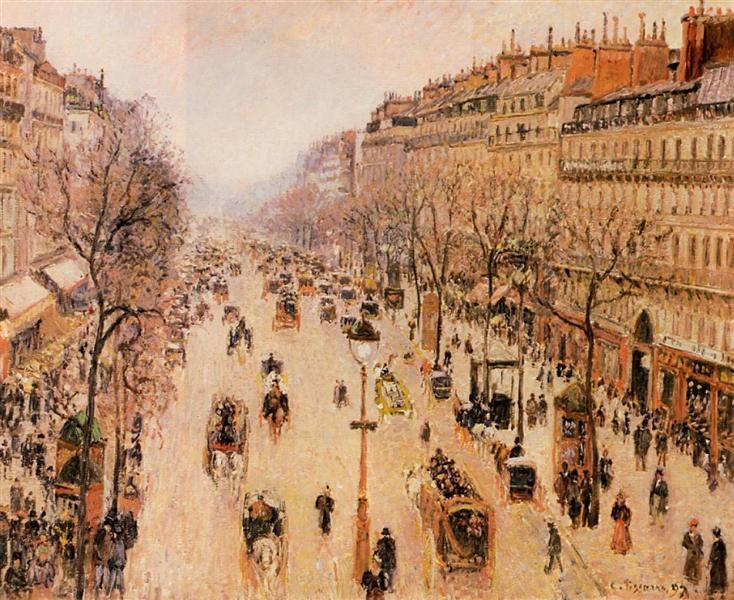
The title reads like a note of conditions: a place, a time of day, a kind of weather. Pissarro builds the pedestrians and carriages out of repeated marks, so they read as a single stream of traffic moving along the boulevard as it narrows. Buildings and bare trees recede with the street, and further off individual forms lose their definition in the grey morning.
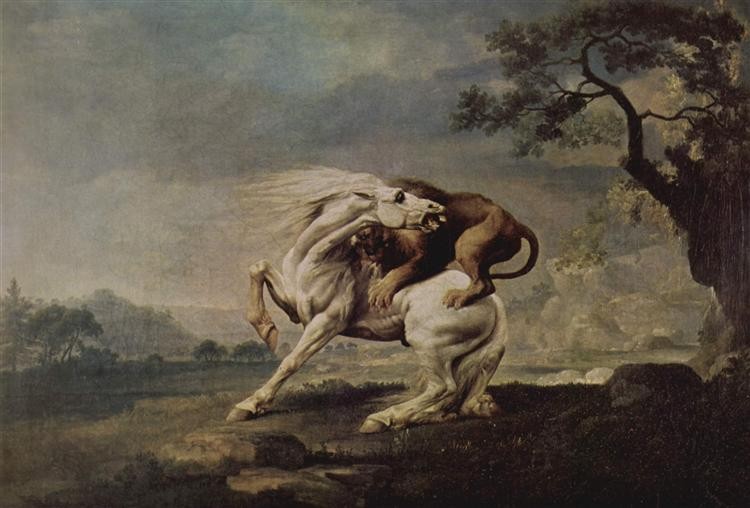
The title gives the action to the lion, but Stubbs gives his attention to the horse. The two animals are locked together above a low landscape, and the attack is told through the horse's anatomy: its neck stretches and its whole body twists against the lion's grip. Pale and dark masses keep the two animals distinct even where their bodies overlap, so the struggle never turns into a tangle.
Blake tells the episode through scale. The giant Antaeus bends to set down the poets Dante and Virgil, who are dwarfed by him. In another picture a path or a stair might carry the travellers across this distance. Here his body does the job, and its curve leads the eye down towards the depths below.
1916 · Oil on canvas · National Gallery of Victoria
Manuel Humbert, a painter himself, sits facing the viewer in a dark suit. Modigliani lengthens the head and neck but keeps the warm-toned hands small, so the figure is compact below and drawn out above. In a portrait of a painter, it is hard to overlook how little room the hands are given.
The hives make this grassy clearing a place of work, and the weathered objects and small building earn the "old" of the title. A single figure is busy at some task but takes up only part of the scene. The title, after all, names the farm, not whoever works it. Southern paints the grass, the building and the objects around it with the same care as the figure, in cool light.
Evening arrives here without a spectacular sun. Houses, sloping ground and valley are painted in a narrow range of violet and grey, and the evening is spread across the whole view, not gathered into a sky. Every part of the landscape can still be made out, but the tones are drawing closer together as the light fades.
Naturalists go out to examine plants, and here the plants rather have the upper hand. Sutherland's figures are small, and the growth around their feet takes up a large share of the picture. She places the observers among the grasses and trees, inside the landscape they have come to study, and gives it more room than she gives them.
One gatherer bends while another stands upright, two moments in the same search. Their attention is fixed on the grassy ground close by, and the picture's interest stays there with them. Like Sutherland's field naturalists, they are absorbed in what lies at their feet, but this ground carries the marks of earlier labour: it is broken up by cut stumps where trees have been felled.
The title puts colour before sitter, and the colours are easy to find: a blue garment, and copper-coloured hair standing in for gold. The face is more closely defined than the clothing, though even there not every feature has a hard outline. Lower down the handling loosens, and the clothing seems to count chiefly as an expanse of blue answering the copper above.
1890 · Oil on canvas on plywood · National Gallery of Victoria
A narrow track leads from the foreground into a field where flowering trees have room to stand out. Fresh green and a blue sky mark the season, and little else happens. With so little incident, the small changes of colour and vegetation across the open view become the substance of the picture.
1907 · Oil on canvas on plywood · National Gallery of Victoria
Branches close at hand fix the viewpoint on the shore, and beyond them vessels, buildings and headlands spread out across the water. Manet's tree at Rueil hides much of what its title promises. Streeton's screen of branches does the opposite and makes the harbour look broader still.
Trees and their reflections in a pool form a dense, dark mass at the centre, and beyond it the land opens out, brighter in the morning light. The reflections do more than mirror the bank. They extend its dark forms and add to the weight of the mass. The picture's depth comes as much from the gap between that mass and the brighter land as from the distant horizon.
Painted in the same year as the winter morning near Heidelberg, this is almost its reverse. There is no dark central mass. Sky and dry ground share warm colours, with little contrast between them, and a track, a fence and thin trees give the view just enough structure. Otherwise the afternoon light spreads across the scene with few interruptions.
The title names her by her apples and him only as her husband, and the arrangement follows suit: she sits in front of him, the two packed into a cramped space with apples gathered at its edge. Firm outlines make their bodies solid and heavy. Against all that weight, a red spotted scarf adds a quicker, decorative pattern.
The title is exact: a named regiment, a named action, a year. Thompson painted the scene decades after the battle, so it is necessarily a reconstruction. The infantry hold their formation while horses and figures press through the foreground in disorder, and further off smoke hides parts of the action. What Thompson shows is a line held under visible strain, its steadiness tested both by the danger each soldier faces and by the confusion pressing around it.
Two women stand close together in a dim, furnished room, one in paler clothing, the other in warmer colours. Patterned walls and furniture leave little spare space around them. Whatever passes between them depends on small differences in how each one turns, and Gwen John does not spell out any dramatic exchange. The title is just as reticent, naming only a room and the figures in it.
With no horizon and no recognisable object, nothing fixes the scale of these red and orange areas. Where they meet, the edges are soft and uneven, not ruled, and each colour varies slightly within itself. The bracketed red of the title says nothing of the orange.
A crouched figure, pressed tightly into the picture space, grips a broad wooden form above pale coins. Tucker reduces the biblical subject to a few heavy, forceful elements. With the head lowered and the hands and feet cramped, the burden reads first as physical strain. The money is in plain view.
Explore this selection in Artline
See the selected works alongside books and events from their period, or compare when the artists lived. The books and events provide context, not evidence of direct influence. Works without confirmed dates remain in this guide.
Across two sites
Comparisons in this guide sometimes cross from one of the NGV's collections to the other, as with Streeton's harbour and Manet's view at Rueil, and the NGV shows those collections at separate sites. Pictures that sit side by side on these pages may therefore belong to different sites, and inclusion here does not mean a work is currently on display. Check access with the NGV before planning a visit around a particular picture.
Ruskin's The Elements of Drawing is a practical book that asks readers to work out for themselves how trees, clouds and shadows are structured. Those questions are worth taking to the landscapes here: Buvelot's reflected trees, Southern's fading valley, Sutherland's grasses and Streeton's distances.
 Art, literature & history