The National Gallery Prague's collections run from medieval European painting to modern and contemporary art, and Czech artists are especially well represented. Many people know Mucha only by name. Here his work takes its place in a wider history of painting in the region, beside artists who may be little known outside the Czech lands, among them Karel Špillar, Pepa Mařáková, Otakar Lebeda and Joža Uprka. Václav Špála has more pictures in this selection than anyone else. That is enough to follow his colour across his own face, the body of Eve, a road and a group of washerwomen.
Among the rest are Repin's portrait of his mother, a Pissarro landscape at Pontoise and Henri Rousseau's self-portrait in front of Paris. The twenty pictures mix older and more recent painting and do not tell a single story. A few threads do run through them, though: painters picturing themselves at work, real sitters cast as Slavia or in the borrowed story of Roman Charity, and people gathered in public places, from a Paris exhibition to a Sunday on the edge of town.
Artline chose these works from the gallery's documented holdings, independently of the museum. Dates and attributions keep the qualifications given in the linked records.
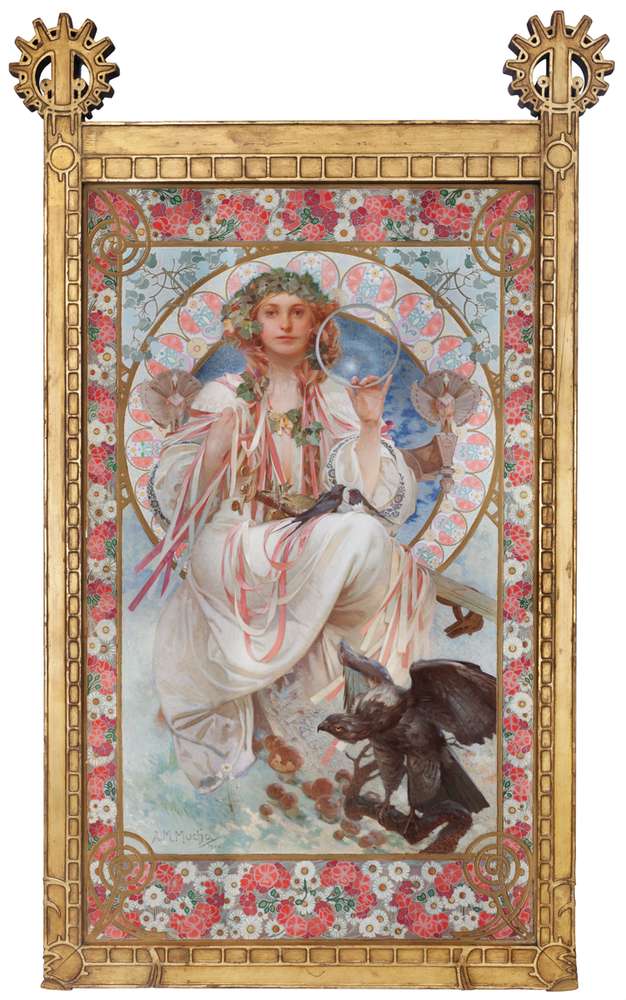
Josephine Crane-Bradley is a particular woman, and she can still be recognised as one here. But Mucha also dresses her in the ceremonial clothing and emblems of Slavia, a personification with political and cultural associations. The costume and the composition lift her into a public, symbolic role larger than herself.
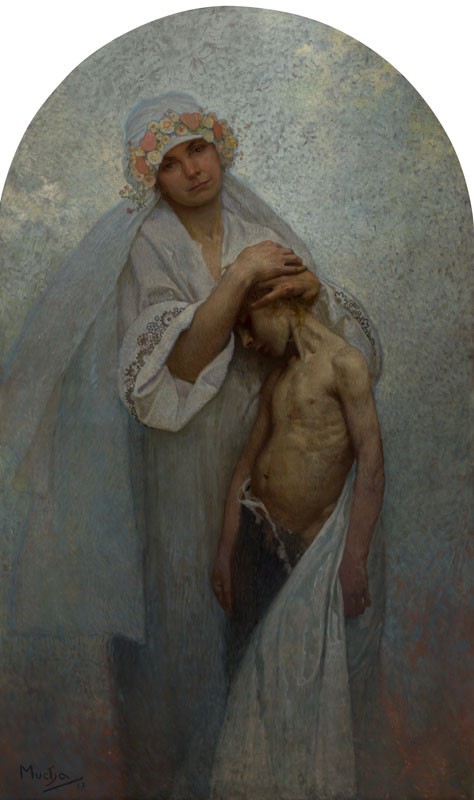
The Slavia portrait relies on costume and emblems. Czech Heart does without them. A woman's lowered hand and a child's slight body set up a plain, unequal relationship of care, with the stronger figure attending to the weaker. The title claims a great deal, and Mucha rests all of it on two figures and a gesture.
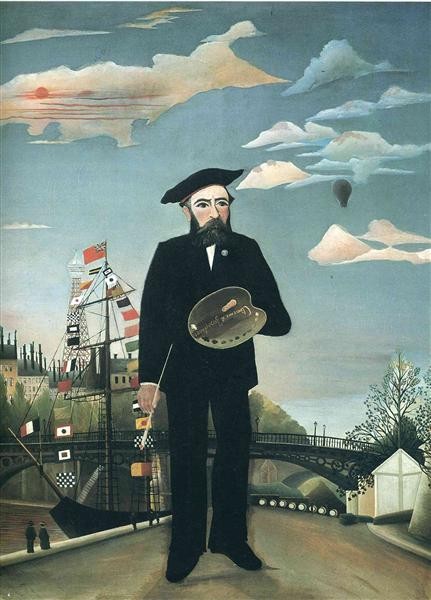
It is listed here as a self-portrait from the Île Saint-Louis, but the museum's own title is 'Myself: Portrait–Landscape'. The picture is both, though not in equal measure. Rousseau stands in the foreground, large and dark, with palette and brush in hand. Paris is easy to recognise behind him, but the city does not set his scale. The painter looms over it. The title puts Portrait before Landscape, and so does the picture.
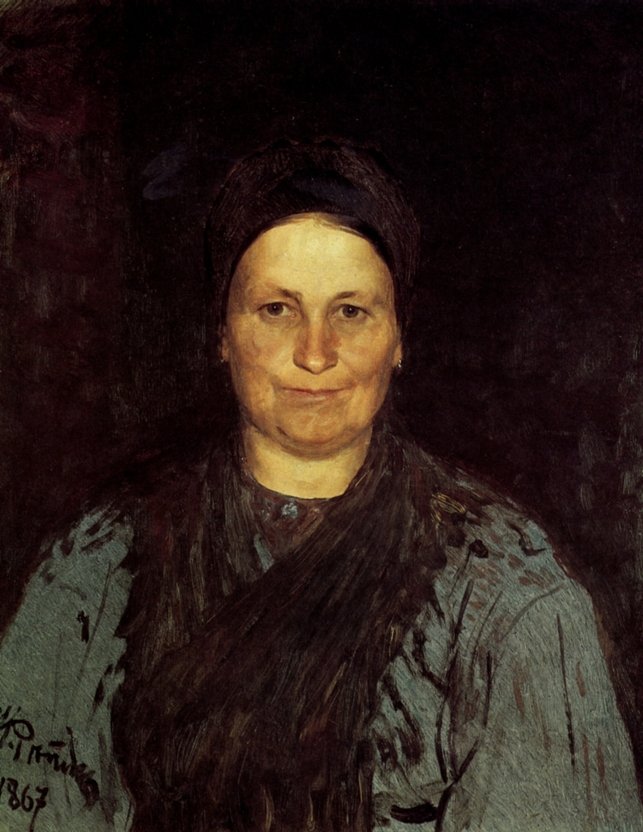
Repin comes in close to his mother. A shawl encloses her face, and the crop leaves out her hands and most of her body. The portrait is made from very little: a few features and the fabric that frames them.
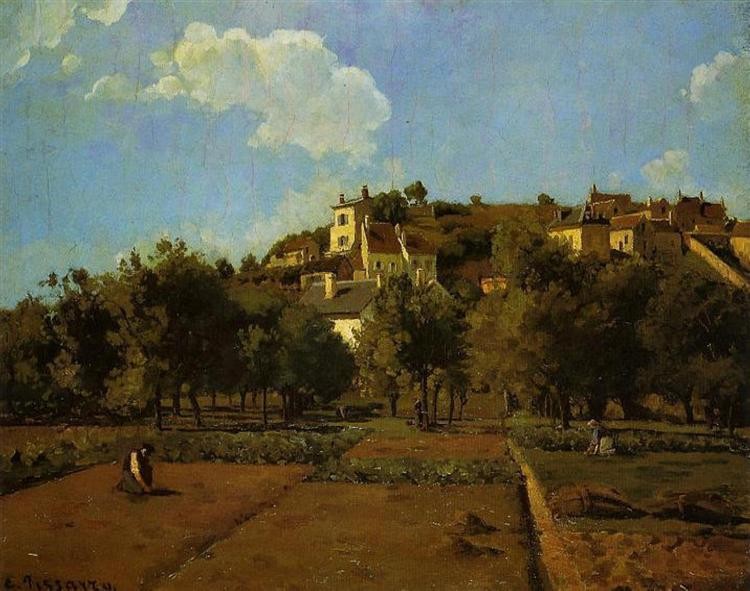
The gardens of the title are worked land. Walls, paths and planted plots divide the hillside at l'Hermitage, and you notice that order before you find the small figures of the workers. Trees, houses and sky fill most of the view, yet the gardens and the settlement never get lost in it. Pissarro keeps them legible.
The only reproduction available here is in black and white, so Stevenson's colour is left to anyone standing in front of the picture itself. The design comes through all the same. Trees and their reflections make matching dark shapes around the water. Within the narrow range of tones a small bright area stands out, and patches of light are held in place by the darker areas around them. It is a fitting economy for a picture called Nocturne.
You might expect a road to lead you into a landscape. Špála's road keeps getting interrupted. Angular trees and planes of pink, blue and green cut across it, so it never opens into a continuous corridor. The scene is built frankly from colour, and yet the place stays recognisable.
Špála's Eve is a large red-pink body held within dark outlines, and she carries as much weight as the green slopes and blue sky around her. Broad areas of colour bind her into the landscape across the surface. The outlines pull the other way, keeping her distinct and easy to read.
This is the earliest of Špála's pictures in the selection, and the freedom with colour that shapes A Road on Lopud is already at work here, on his own face. Blue and green divisions run across it, no longer tied to the usual way of painting skin. The palette resting in his lap names his trade, and the face is where he puts it into practice.
Bent backs and arms lock into a shared pattern of angles, and the three washerwomen become hard to tell apart. The pattern comes from the repeated movements of the work itself. Špála pares the setting down, so we recognise the washing from the women's postures, not from household objects. Arguably it is the labour, more than any individual woman, that he portrays.
The exhibition is hardly the subject. Špillar paints the visitors as they walk, stand and look, with one figure close in the foreground, and the pictures and display stands become the setting for a social scene. Anyone reading this guide in a gallery is, by Špillar's reckoning, part of the subject.
Špillar's subject is again people sharing a public place, but he handles them differently. In the exhibition picture a visitor stands close in the foreground. Here hats, flowers and cups give the café its character, some faces are partly hidden, and light clothing loosens into the warmer marks around it, so the figures blend into the room. They share a table, but the picture offers no particular conversation to overhear.
A doorway splits the scene into a bright outdoors and a dark interior. The children stand at different points between the two, some in clear view and others harder to make out. Food passes among them. Some have received theirs and others are still waiting. The boy by the outer wall stands more clearly apart. Is he next in line, or outside the group altogether?
Barbara Krafft casts the Count and Countess von Hartig in the subject of Roman Charity, so the picture is a double portrait and a borrowed story at once. The story dictates the pose. The pair sit closer together than they would in an ordinary portrait of a couple, and that closeness comes from the subject, not from any event in their own lives. Mucha also gives Josephine Crane-Bradley a ready-made role, but Slavia is a personification she can carry alone. Roman Charity is a story, and it takes both sitters to play it.
Pirner divides the picture into two realms. Below, the elderly philosopher bends near his barrel on rough ground beside a simple shelter: an old man with bodily needs, fixed to one place. Above him, airborne figures seem free to move. The painting is built on that contrast, and it leaves open whether the figures overhead are a dream, an allegory or a visitation.
A woman faces the valley, so her expression stays out of sight. She is part of the landscape and looks out over it at the same time, while a curving path leads from the foreground into the distance. Nothing happens. The silence of the title has to come from the arrangement alone.
Mařáková's father taught her to paint. Women could not enrol at the Prague Academy at the time, and he made informal access to it possible for her. That history gives weight to both figures. Their painting equipment makes this a shared working scene as well as a family portrait, and the way they are placed is suggestive: he turns towards his daughter, while she faces outwards as the author of the picture.
Lebeda's lake lies low, shut in by steep slopes. Broken rocks in the foreground set a nearer, rougher scale before the eye reaches the water, and distance is measured by the terrain, not by any open panorama. In Hudeček's Evening Silence a path leads out into the view. Here the ground keeps closing it off.
Uprka's title insists on place, and the picture backs it up. The title also pairs a Madonna with a song, and the triptych format makes room for both. Across the three panels a central devotional figure and many people in regional dress receive different degrees of attention, so the picture holds a shared religious focus and also a crowd taking part in a communal ceremony. Clothing and repeated gestures tie the gathering to a particular place and practice.
Kars draws his Sunday crowd in the same angular forms as the trees and ground, whether the figures are resting or on the move. The shared angles recall Špála's Three Washerwomen, though Kars carries them beyond the figures into the whole setting. The public landscape is compressed, with no distant backdrop for anyone to stand out against, so the people are drawn as part of the place.
Explore this selection in Artline
See the selected works alongside books and events from their period, or compare when the artists lived. The books and events provide context, not evidence of direct influence. Works without confirmed dates remain in this guide.
Three painters at work
Rousseau, Mařáková and Špála each paint themselves as painters, and in each picture the equipment names the profession. The claims they make differ. Rousseau relies on scale, setting his own figure against a whole city and outweighing it. Mařáková makes her claim within a relationship, sharing the tools with the father who taught her, so her picture is about an apprenticeship as well as a trade. Špála makes his through method, letting the colour on his own face show what his trade involves.
Further reading
Wassily Kandinsky; translated by Michael Sadleir · Read free · English
Kandinsky's book, in Michael Sadleir's English translation, makes a case from the period for freeing colour from literal description. It is good context for the Špála pictures in this selection, such as the pink planes of A Road on Lopud or the blue and green divisions across his face in the Self-Portrait. It gives background, not a key to them.
 Art, literature & history