The National Gallery of Canada in Ottawa holds Canadian art alongside European, American and other international collections, and its holdings include important works by Indigenous artists. These twenty works give a sample of that range, from a Lorenzo Lotto portrait to an abstract painting by Jean-Paul Riopelle. The Canadian landscapes form a group of their own: Tom Thomson's pine, J. E. H. MacDonald's garden, and the lakes and mountains of John Arthur Fraser, which were painted well before Thomson's and MacDonald's pictures. Edward Wadsworth and Wyndham Lewis show people at work around a camouflaged ship and a gun. The portraits run from Lotto and Bronzino to Élisabeth Vigée Le Brun and George Horne Russell, while Benjamin West's Death of General Wolfe and Jean-François Millet's Oedipus bring in history and myth. Sisley, Klimt, Braque, Beckmann, Nash and Redon complete the selection. Some of the most useful comparisons cut across these groups: a single pine set against a whole orchard, a dying general against a child lifted from a tree.
Artline chose these works from the gallery's documented holdings, independently of the museum. A work in the collection is not necessarily on view, because some may be on loan or off display. Where the records qualify a date or attribution, the qualification is kept here.
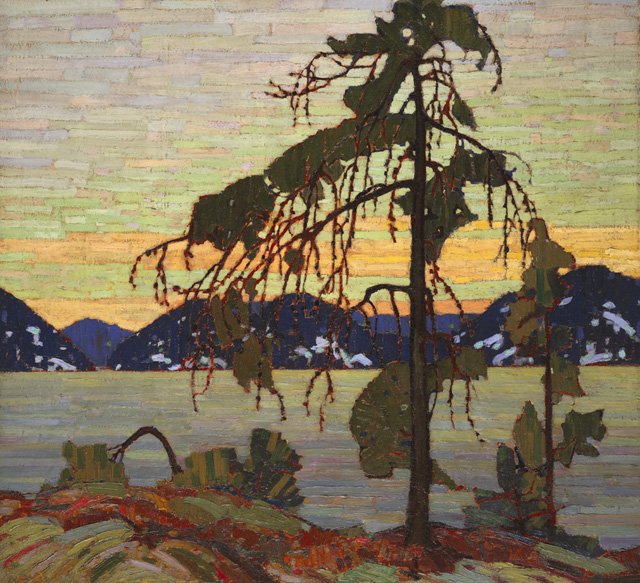
Thomson paints one particular tree. The pine is irregular and stands close to the front of the picture, against bands of lake, distant shore and evening sky. Everything behind it is reduced to broad horizontal divisions, while the tree keeps its uneven shape, and that contrast lets a single pine supply the main upright structure of the whole view. Its branches look almost like drawing laid over the colour.
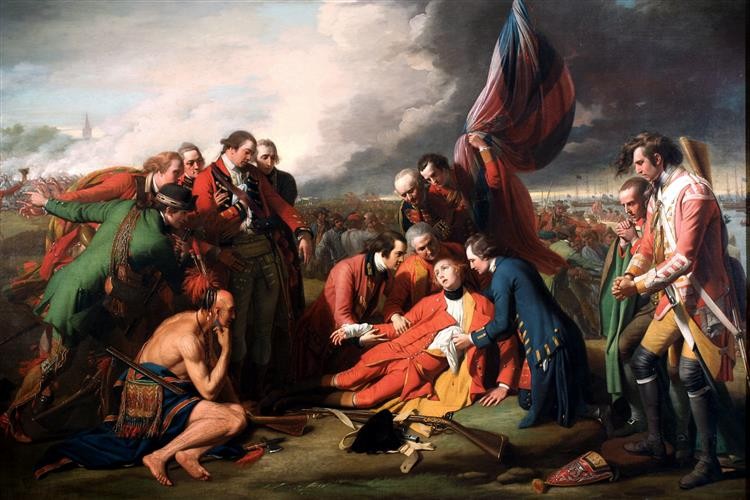
West painted Wolfe's death after the event, and the result is a composition, not a record of who was present at any single moment. Wolfe lies pale at the centre, and the men around him turn their gestures and attention towards his body. Their uniforms and faces are convincing enough to suggest reportage, but the arrangement is theatrical. The group is organised to frame and honour the dying general, and a death on the battlefield becomes a scene of formal witness.
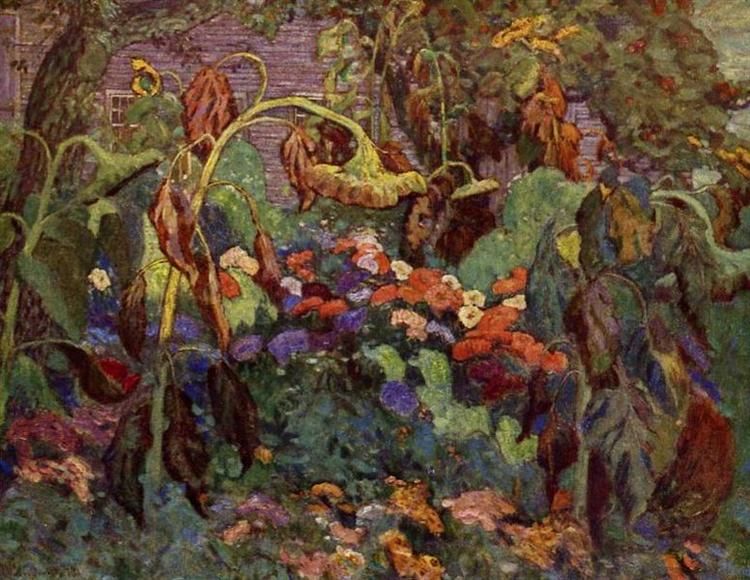
MacDonald's garden was painted around the same time as Thomson's pine, and it works in almost the opposite way. Thomson sets a clear form against a simplified distance. Here, drooping plants crowd the foreground and press right up to the viewer, their leaves and flowers overlapping in a thick tangle scattered with bright patches. There is no path through, and neighbouring shapes have to be picked apart one at a time. The garden is cultivated but far from tidy, and MacDonald does not neaten it into a decorative pattern either. The abundance comes close to excess.
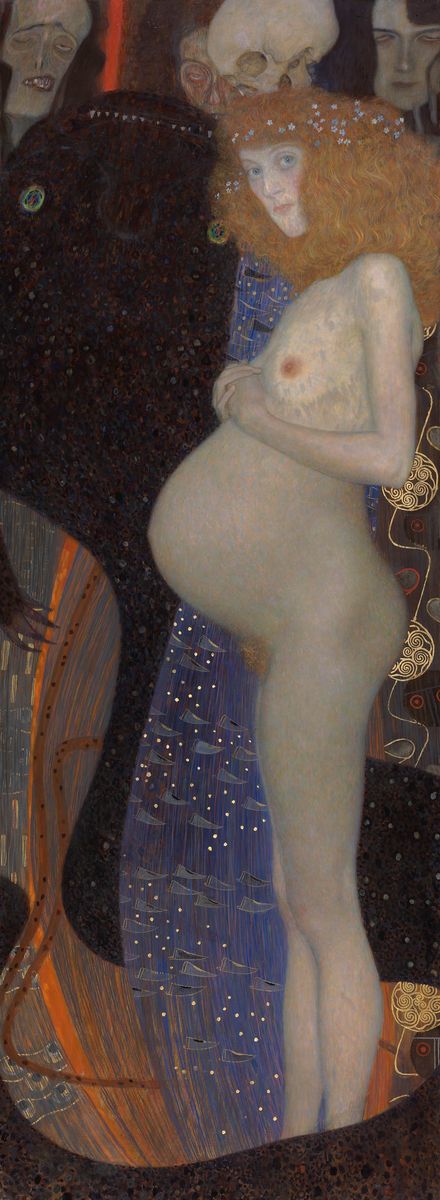
Klimt's title is Hope and his subject a pregnant woman. That sounds straightforward until you notice the dark forms behind her, which are unsettling and sit awkwardly with the title. The woman herself is firmly drawn and kept distinct from them, but they share the same surface, and the picture does not explain how the two belong together. Do the forms threaten the hope, or only surround it? The painting never settles into a fixed prophecy either way.
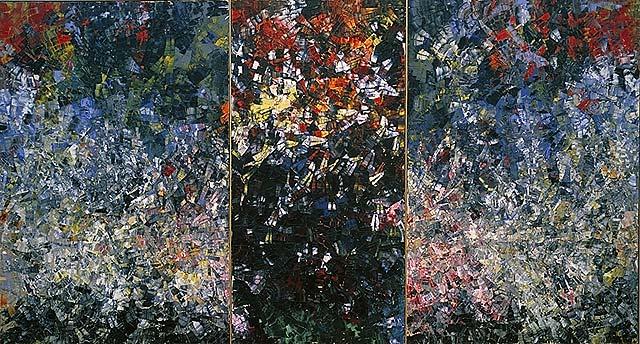
Riopelle gives the eye no object and no horizon to settle on. The wide field is divided into three sections, and across all of them the individual marks stay distinct, repeating without hardening into a uniform pattern. Colour gathers thickly in some areas. The paint builds up in places and thins out in others, so the density of the surface keeps changing from one part of the field to the next.
A striped hull towers over the small figures finishing its paintwork in the dry dock. Dazzle camouflage was designed to confuse estimates of a ship's course rather than simply to hide the vessel. There is a dry irony, then, in Wadsworth's handling of it. The deliberate optical disruption sits inside a clearly organised composition, where the pattern meant to mislead and the enormous ship carrying it are both perfectly legible.
Lewis draws his soldiers into the same visual language as their gun. Angular forms run through bodies, equipment and ground alike, and each man's task and posture tie him to the weapon and its supports. Wadsworth's workers stay small and separate beside their ship. Lewis's men can still be read as individuals at work, but the machinery determines the space they occupy and the shapes that define them.
A curved railing in the foreground marks the near edge of the harbour. Beyond it, boats and distant buildings sit in strong fields of colour that have little to do with ordinary daylight. Braque splits the work between space and colour. The spatial relations stay clear enough for the port to read as a port, while the colour is frankly invented and pushed well beyond description into something more declarative and strange.
Beckmann leaves only a narrow strip of horizon, so the heavy sky presses down on the broken water. Yellowish strokes descend through the dark clouds and cut across the rolling movement of the sea below. Given the title, they may be lightning. For all the turbulence, the divisions are emphatic, and the storm keeps a firm structure rather than dissolving into haze.
Nash enlarges the sunflower until its head rhymes with the sun, repeating the same circular form in different parts of the landscape and at two scales that could never meet in an ordinary view. That invented relationship organises the picture, and botanical accuracy alone would not have produced it. The title does the same thing in words by giving the flower a solstice of its own.
The title identifies Lotto's sitter only by his felt hat, and the picture offers little else to go on. In this oil on paper he looks straight out, his face framed by broad dark clothing, and nothing in the setting indicates his rank or profession. So the hat, held in one hand, has a good deal to do. It occupies the hand and gives the pose something specific. Without it, the body would present itself quite differently.
c. 1552 · Oil on wood · National Gallery of Canada
Lotto's man has only his hat. Bronzino's gentleman is given a companion: a small sculpture, a second figure standing beside the living one. The object shares the work of social presentation with the face. It ties the sitter to the world of collected things and suggests cultivation and taste, though on its own it cannot tell us everything the man knew or valued.
Rocks and trees take the place of an official interior. Anna Ivanovna Tolstaya rests her head, her drapery hangs loosely, and the pose looks informal. It is no less arranged for that. Her apparent ease is built from dress, gesture and setting, and Vigée Le Brun controls each of them.
In Sisley's orchard no tree is singled out, which makes it almost the reverse of Thomson's pine. Trunks recur at regular intervals, and pale blossom breaks up their outlines. Depth comes from the gaps between the trees and from small shifts of colour and tone as the eye moves back into the space. Nothing happens at the centre, and the orchard needs nothing to.
Sheep rest on the near shore, small and calm. Beyond them, water and mountains recede into paler distances under a broad sky. The flock never takes over the picture, but it gives the foreground a lived-in scale and a measure for the much larger terrain behind.
This time the title promises an event, yet Fraser's figure and dog are tiny beside the wide water and the changing dawn sky. Light and space fill almost the whole surface. Is the shot the subject, or only the occasion for painting the dawn? The proportions of the picture suggest the latter.
In Fraser's other pictures here, a flock of sheep or a figure with a dog gives the distance a measure. At the Rogers Pass has no large figure in the foreground to do that job. Dark conifers fill the nearer valley and bare, sunlit peaks rise beyond. The distance comes instead from the successive bands of ground between the peaks and the viewer, and from the change from dark woodland to bright, open heights.
Dark clothing and a restrained background leave Dyonnet's face and the white of his collar as the main areas of light. Bronzino gave his sitter a sculpture, but Russell includes few objects that tell us anything about Dyonnet. The likeness depends on small adjustments of tone that model the head and distinguish the features.
A dark bird perches in a confined interior, close to an open window. Redon defines its head and beak sharply and keeps attention on this small, watchful presence. The title carries a literary association, but the image does not retell a story. It stays with the bird, its position and the enclosed room.
The subject comes from the ancient Oedipus story: the exposed infant Oedipus is being taken down from the tree. Millet gathers the figures round the small, vulnerable body and encloses the group with dark branches, and the light falls where the child is being lifted and supported. As in West's Death of General Wolfe, a group converges on a single body. Here, though, the figures are taking a child's weight rather than witnessing a death, and they handle it with care.
Explore this selection in Artline
See the selected works alongside books and events from their period, or compare when the artists lived. The books and events provide context, not evidence of direct influence. Works without confirmed dates remain in this guide.
Size on screen
Keep the recorded dimensions in mind when comparing these works on screen, where a small portrait and a large painting can look the same size.
Ruskin's book is built around exercises in observing natural forms, and they apply directly to the landscapes here. It also works as a foil. Ruskin asks for continuous, accurate description, while Thomson, MacDonald and later painters simplify, rearrange and invent. Reading him beside their pictures makes those choices easier to see.
 Art, literature & history