Twenty-five paintings from the National Gallery of Armenia in Yerevan, chiefly by Armenian artists, from the late nineteenth century to the first half of the twentieth.
The National Gallery of Armenia, in central Yerevan, collects European art and work from other traditions as well as Armenian painting. This selection of twenty-five pictures concentrates on the Armenian painters, and it keeps coming back to a few subjects: churches, the mountains Ararat and Aragats, and Lake Sevan. The churches alone appear in very different states. They are violated, ruined, crowded with a procession or glimpsed in shadow around a monastery courtyard.
Vardges Sureniants has more pictures here than anyone else, and they range widely: church interiors after violence, scenes from Armenian history and legend, a procession and a portrait of a cleric. Gevorg Bashinjaghian, the next best represented, went back to Lake Sevan in different weather. Martiros Saryan and Georgy Yakulov simplify far more boldly than either of them. Pictures by Nicholas Roerich and Victor Borisov-Musatov widen the selection further: Roerich with a siege and a legendary landscape, Borisov-Musatov with a woman who half merges into the decoration around her.
Artline chose these works from documented museum holdings, independently of the museum. Being in the collection does not mean a picture is on view, and individual works may be on loan or off display. Dates and attributions keep the qualifications given in the linked records. Where the National Gallery's date for After the Massacre differs from the one in some older records, for instance, the entry gives both.
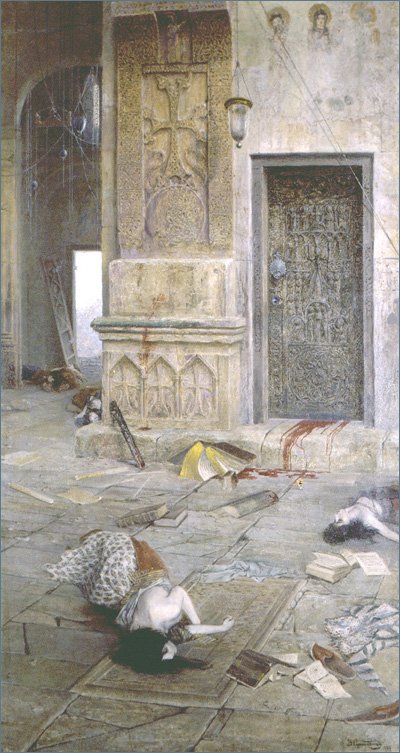
The attack itself is not shown. Sureniants paints the church once it is over: bodies and displaced objects lie beneath the carved stonework, and empty space rises above them. The architecture is closely observed, though the title does not say which church this is. Much of the picture's force seems to come from that imbalance between the carefully described stone and the dead lying under it. The National Gallery dates the work to 1898; some older records give 1899.
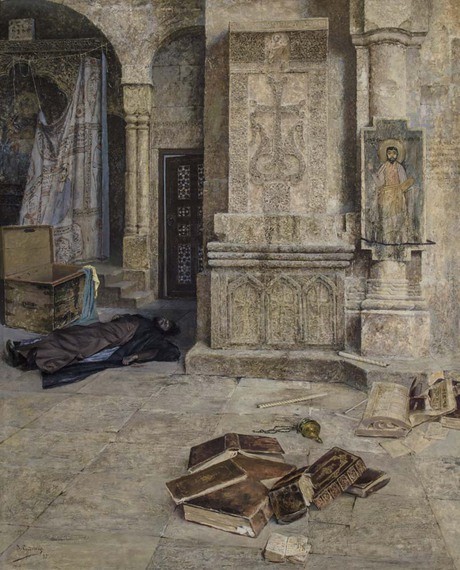
This is the earlier of Sureniants's violated churches, painted a few years before After the Massacre. The piers and decorated walls still stand, but the objects inside have been overturned, and a shadowed doorway leads into a space that is hard to make out. No figure at the centre explains what has happened, so the title has to do much of the telling.
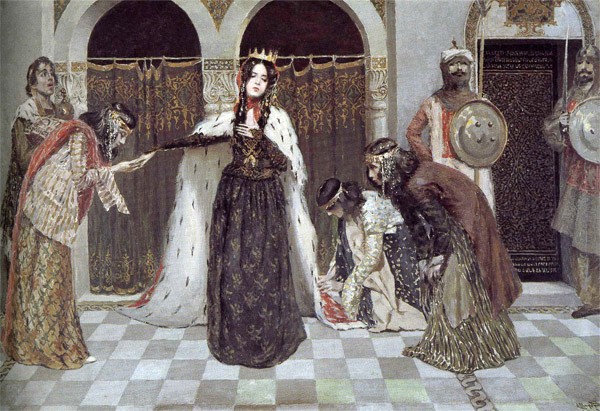
Sureniants stages the return as a crowd scene. Attendants and armed figures in historical costume press in from either side and gesture towards the queen, who stands on a relatively clear patch of floor. That small clearing carries the picture. It puts her at the centre of the occasion and also leaves her alone there, the focus of everyone's attention and perhaps of their demands.
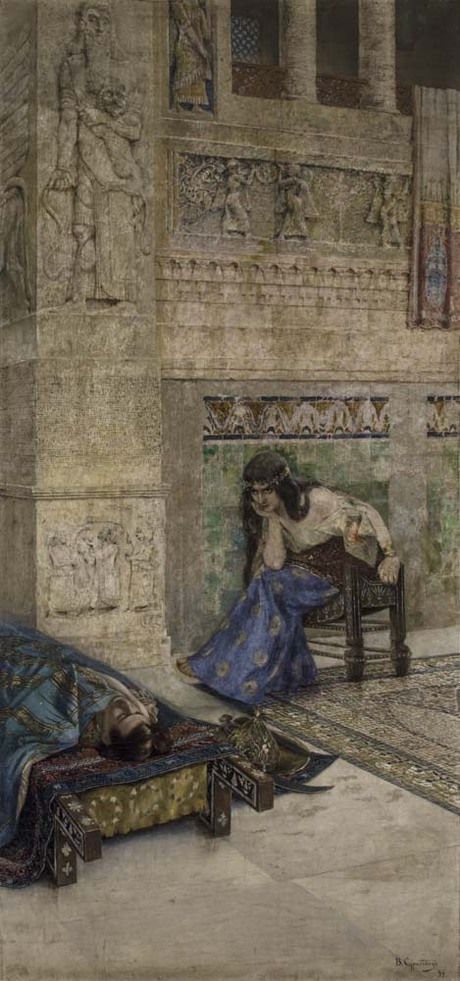
For a scene from legend, this is an odd composition. Semiramis bends towards Ara's body low down in the room, and the two figures at the heart of the story take up only a small part of the picture, beneath a decorated wall that rises far above them. The arrangement is close to that of After the Massacre, painted in the same year or the year before: a body low in the room, with ornament towering overhead.
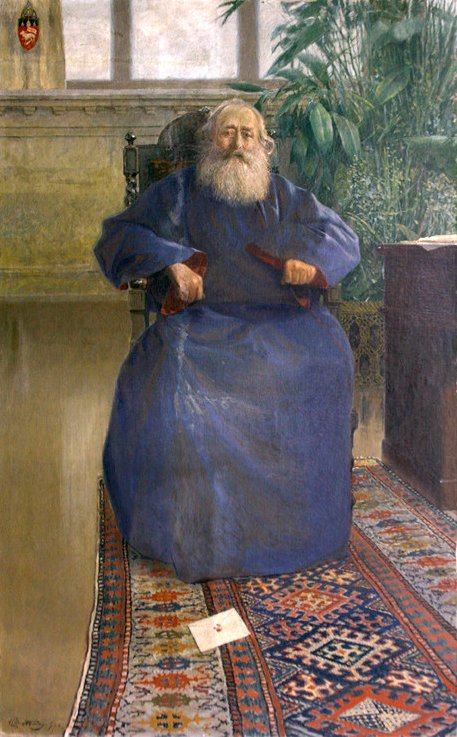
Mkrtich Khrimian, a cleric, sits among plants, carpet and furniture. His blue clothing makes a broad shape at the centre, and his face and hands emerge from it. The chair gives him a formal place, but the things around him suggest a room that is lived in.
Faces, banners and vestments are massed beneath a portal far taller than the people passing through it, and the doorway sets the scale for everything else. Sureniants painted Desecrated Shrine in the same year, and the two make a sharp pair. There the contents of a church lie overturned. Here the church is crowded, ceremonial and in use.
Here the damage is to the building itself. Sureniants's violated churches keep their walls and are seen from inside. Fetvadjian's cathedral is a ruin, its roofline open to the sky. He describes the warm stone and repeated arches of what remains closely enough to identify a particular building, and sets it on sparse ground with no figures at all.
In the same year that Sureniants painted the crowd at the door of Etchmiadzin Cathedral, Tadevosyan used Etchmiadzin as a place to look out from. The settlement shrinks to a low strip along the bottom of the picture, while Ararat's blue mass fills far more of it, its outline set against a greenish sky. The foreground is kept spare, so nothing competes with the peak.
Aragats never quite becomes a single shape. Cloud and light break it up, so that some snowy slopes stand out while others fall back into shade, and the peaks never join into one continuous silhouette as Tadevosyan's Ararat does. In this, the latest of Bashinjaghian's pictures here, the weather does as much as the drawing to describe the mountain.
A dark shore marks the near edge, and still water stretches out to the island. A small boat gives a measure of the distance, and the island's reflection softens its outline. Bashinjaghian needs little more than that. The rest of the view is made from small changes of tone.
The same lake three years on, in the rain. The low island is still there and a small sail can still be made out, but mist has closed off the distance that lies open in the morning view, and the sky is much heavier.
This is the earliest picture in the selection, and the only Bashinjaghian here without a mountain or a lake to organise it. The depth comes instead from the repeated trunks. The nearest birch stands apart from the smaller trees behind it, and dark marks on the bark break up the pale verticals. Sunlight falls in patches among the leaves, so the grove never settles into a flat pattern.
The loads of hay almost hide the mules carrying them. Only small dark legs show beneath the large, rounded bundles, so the hay seems to be walking by itself. Saryan sets these bright forms clearly apart against a yellow ground, and the clarity only makes the sight odder.
The title points to Egypt in general rather than to identifiable objects, and the picture seems to treat its masks less as particular artefacts than as variations on a face. They overlap in a shallow space, with eyes and mouths repeated at different sizes and a large yellow face anchoring one side. In so shallow a space, it is colour that keeps neighbouring forms apart.
Lettering shares the ochre field with a standing figure and a small animal. It belongs to the composition rather than sitting beneath it as a caption. Yakulov offers no conventional view of the café's interior. The flat treatment and prominent text suggest a different kind of picture-making, closer to a poster or a sign than to the landscapes and interiors elsewhere in this selection.
The latest painting in the selection shows Komitas as a tall standing figure in white, his head turned and one hand raised, with the greens around him setting off his clothes. Smaller figures appear in the landscape behind him. Tadevosyan had already set a lone figure in front of many in Talent and the Crowd, but there the faces press close behind. Here they stand back in the landscape. The raised hand and the difference in scale make this feel closer to a public image than a private likeness.
A single darker figure advances at the front, with faces packed densely behind. The title names a conflict, and the gap between the figure and the mass makes it visible. Beyond that, the picture is less definite than its title. Does the figure stand for talent? Is the crowd hostile, or simply there? In Sureniants's Queen Zabel, from the same year, the many at least gesture towards the one.
Light falls in separate patches and catches just enough stone to suggest the vaults and columns around the courtyard. Much of the space stays in shadow, so the monastery is known only in fragments and never seen as a complete outline.
Terlemezyan gives a working man from Lori the space usually reserved for formal portraiture. The fur hat, belt and layered clothes are all closely described. The hands are held low, leaving the face and upper body to carry the picture, and nothing in the dark interior behind competes with them.
The vegetables are packed tightly against a dark ground, yet each stays distinct because each catches the light differently. Hakobyan separates rounded skins from cut surfaces and green stalks, and lets one vegetable rest against another so that its edge cuts across its neighbour.
Zakarian painted his plums a year before Hakobyan's vegetables, and they are much harder to read. Only part of each object is sharp. A glint marks a curve, then an edge disappears into the brown surroundings, and the fruit and vessels have to be pieced together from such glimpses.
Among the named lakes, mountains and monasteries of this selection, this is an unusually placeless picture, and even its title is generic. Mahokian keeps to water, light and movement. The horizon is level, but nearer in the water breaks in different directions, and pale foam picks out the crests against the darker green beneath. No ship or coastal landmark fixes the view or suggests a story.
Roerich compresses people and fortifications into overlapping bands, patterned so strongly that the scene looks more like a stage set than a battle plan. Above them, large red and pink clouds carry as much visual weight as the history below.
The giants of the title never appear, and the landscape stands in for them. Interlocking blue rocks with firm, emphatic outlines lie beneath a curling sky whose forms flow, and between them they convey the scale of the legend. As in The Siege of Kazan, the sky is as active as anything beneath it.
The patterns on the dress continue the leaves and flowers around the woman, so that she partly merges with the decorative setting, though her face and hands remain clearer. Across the lower part of the picture, the spreading skirt makes the broadest link between figure and design.
Explore this selection in Artline
See the selected works alongside books and events from their period, or compare when the artists lived. The books and events provide context, not evidence of direct influence. Works without confirmed dates remain in this guide.
The size of a person
One question runs through many of these pictures: how much room does a person get? Sureniants often allows very little. His dead, his figures from legend and his procession are all measured against stonework and doorways that dwarf them. Yet the same painter gives Queen Zabel a patch of floor of her own and puts Khrimian squarely at the centre of his portrait, so the smallness elsewhere looks more like choice than habit. Tadevosyan swings between extremes. He reduces a whole settlement to a sliver at the foot of a mountain, then makes Komitas the one large figure in his landscape. Borisov-Musatov changes the terms of the question. Nothing dwarfs his woman in blue, and the difficulty there is to say where she ends. Khrimian, whose portrait is also built around a broad shape of blue clothing, makes the telling comparison. He stays distinct from the furniture and plants around him. Her dress runs on into the ornament.
Further reading
Helen C. Evans, editor; The Metropolitan Museum of Art · Read free · English PDF
An illustrated study of medieval Armenian art that, as its title promises, takes in religion and trade as well, with churches and religious objects among its subjects. It deals with the Middle Ages rather than modern painting, but it gives useful background to the church buildings and religious settings that recur in these pictures.
Wassily Kandinsky; translated by M. T. H. Sadler · Read free · English
Kandinsky's own account of colour and form, in M. T. H. Sadler's English translation. It is a first-hand statement of one strand of early twentieth-century thinking, by an artist working at the same time as several of the painters in this guide, and it makes a useful point of comparison for the bolder simplifications of Saryan and Yakulov.
 Art, literature & history