The Museu Nacional d'Art de Catalunya, or MNAC, occupies the Palau Nacional above Barcelona. Its collections run from medieval art, including Romanesque mural paintings brought from churches in the Pyrenees, to later Catalan painting. Modernisme and the years around 1900 are central to the city's artistic history, and many of the pictures chosen here belong to that period.
All twenty come from the later collections. The earliest is Torrescassana's Landscape and the latest is Mir's Waterwheel at Onclet. Santiago Rusiñol and Darío de Regoyos have several pictures each. The other painters include Ramon Casas, Isidre Nonell, Joaquín Mir, Joan Brull and Joaquim Sunyer. One picture was made to decorate a café, and another shows a café. Elsewhere there are gardens and courtyards, a domestic interior, a woman at a keyboard, a Basque celebration, a Good Friday procession, a passing train, the coast and the mountains.
Some of the pictures are best read in pairs. Nonell's portraits of two women, Consuelo and Flores, are one pair. Mir's loosely touched landscape and Torrescassana's hard-edged one are another.
Artline chose these works from the museum's documented holdings, independently of the museum. Where the linked records qualify a date or an attribution, this guide keeps the qualification.
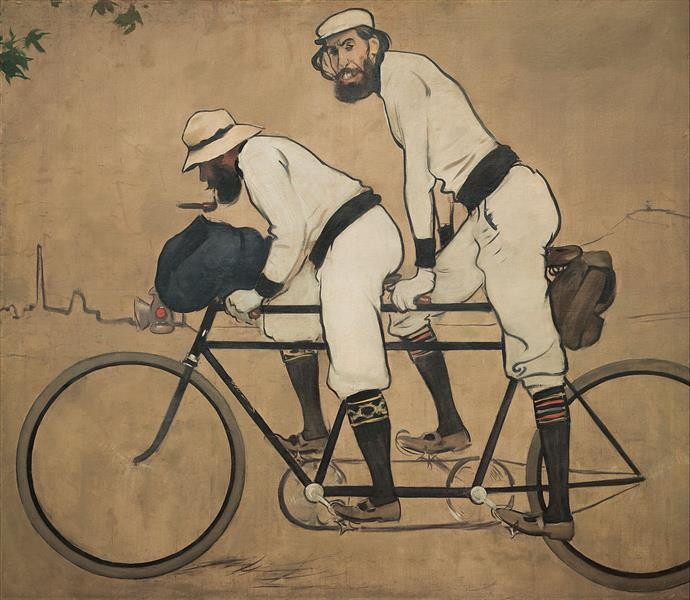
Casas painted himself and Pere Romeu on a tandem as part of the decoration of Els Quatre Gats, the Barcelona café where both men were familiar figures. The joke was aimed at the café's own customers, who would know the riders by sight. The tandem was also a fashionable machine, and it puts the pair firmly in the world of modern transport and city life.
1889 · Oil on canvas · Museu Nacional d’Art de Catalunya
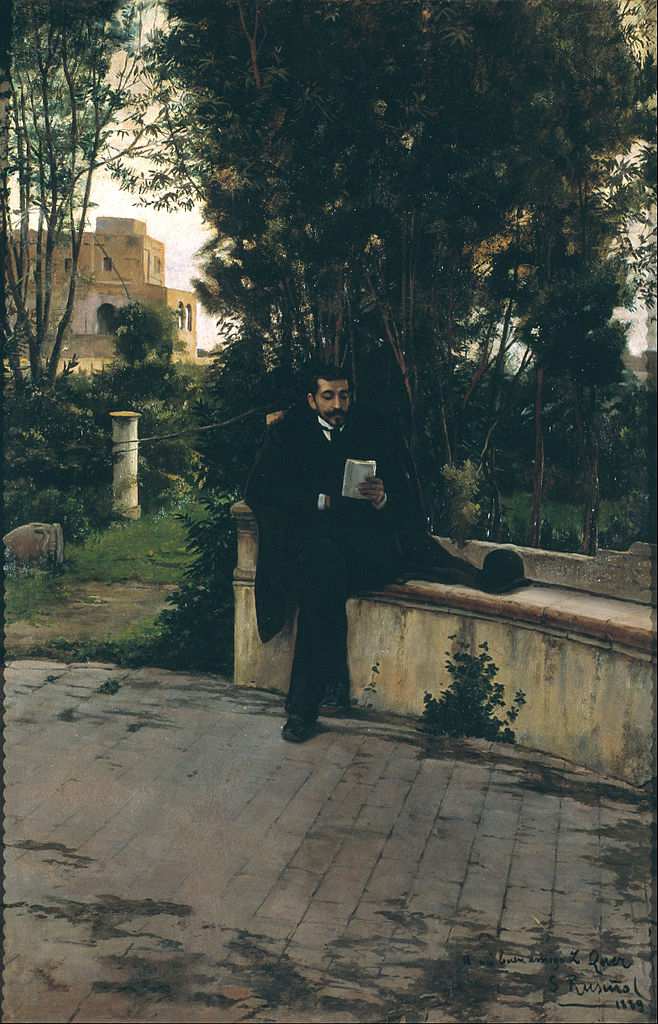
The title names a garden, and most of the canvas belongs to it. Its paths and shade are too substantial to be a neutral backdrop for a portrait. Instead they give the small, dark figure of the man somewhere to belong, and his face is kept secondary.
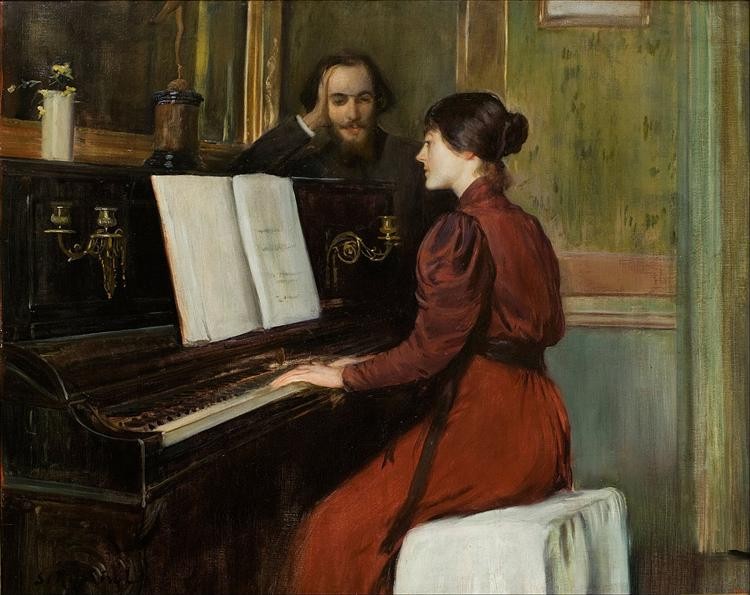
The woman in red sits at the keyboard and the standing man is near the music, so each has a part in the performance. The instrument gives them something in common, and it also fills the space between them. Music is plainly being made. The romance of the title is less plain, because the picture says nothing directly about their private relationship. Whatever romance there is has to be read from the way Rusiñol has placed them.
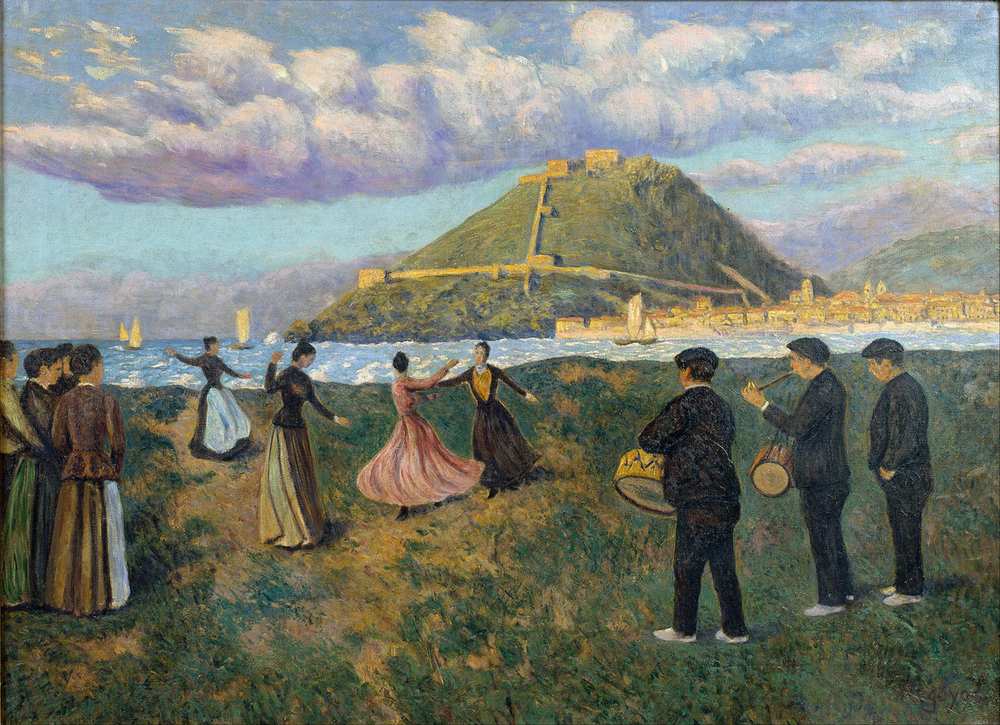
The dancers form a curved chain across the ground, a boundary that holds only while the dance lasts. Regoyos sets the whole celebration inside a much wider view of the bay and hills. He keeps the musicians and onlookers at the edges, so they do not crowd into one centre. The festivity has room to spread, and it is easy to tell who is dancing and who is watching.
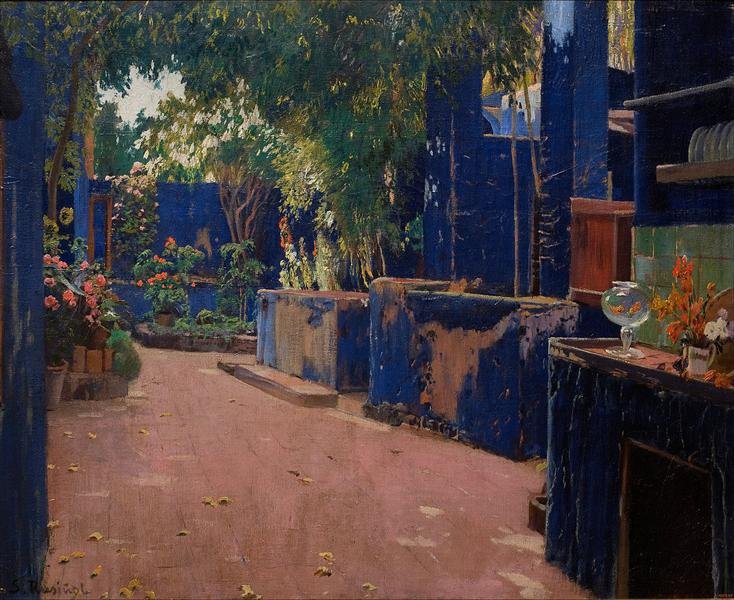
Blue is the strongest colour here. It belongs to the walls, and the pots and plants are set out against it. Rusiñol keeps most of the space shallow and close to the picture surface. That is why the one narrow passage through to a different, brighter space counts for more than its size.
Sunyer's women, children and baskets are rounded and solid, and the forms of the coast behind them repeat that solidity. The subject is an everyday one, but nothing about the grouping looks casual. Each body is placed in relation to the tree, the village and the bay as well as to the figure beside it.
Chlorosis is a historical diagnosis, and the title records how such a subject was named at the time. A label like that can easily swamp a picture. The title makes the diagnosis. The paint itself shows a woman reclining with her head lowered and her weight against the sofa, and an open book that has been put aside.
For a picture of a café, this one is short of company. The pale tables take up more room than any visible social life, and what stands out is the empty space around the seated woman. Casas paints a setting for leisure and leaves much of it unused. Any conversation the place might hold is left unstated.
Consuelo's face is mostly hidden. Nonell divides the picture into broad areas: her red skirt, her bent body and dark hair, and the cloth around her. Without the face, her posture has to tell us what a face usually would. What it conveys is weight: a seated figure folding in on herself. It is tempting to call that sadness, but the picture does not say so.
Brull separates the pale figure only loosely from the bank and the water. Hanging branches and softened distances make the setting hard to divide into distinct planes. There are trees and there is water, but their edges stay uncertain, and the figure is hardly firmer. Is the figure dreaming, or part of the dream?
Flores is the sitter's name; this is not a picture of flowers. Broad, visible brushmarks describe her yellow-green blouse and striped shawl without breaking the figure apart. Nonell treats her face with the same economy and simplifies it through the handling of the paint. In Consuelo he hid the face through posture. Here the face can be seen, but in simplified form.
Regoyos gives the hour as much weight as the ritual. Warm, lit windows stand out against cool buildings and dark clothes. The procession is not cut off from its surroundings. It shares the picture with the town in the early light.
Without the title, this would be a group of women and children: a nursing child, bodies set close together, a plain show of care. There is none of the elaborate setting of a ceremonial religious painting. It is chiefly the title that makes them a Holy Family.
Rusiñol paints the way in to the Moulin de la Galette, not the entertainment itself. The red wall and open gate promise entry, but most of what lies beyond is kept out of reach. A few distant figures further along the path give the only hint of it. The Blue Courtyard, painted much later, also turns on a single way through.
Torrescassana builds the foreground from broken stones, a run of hard edges before the larger slopes begin. Plants fill the gaps but never soften the ground into one green surface. Close at hand the rock is solid and sharply described. The land beyond is less distinct, and the sky is handled differently again.
Chairs, a fireplace and a patterned cloth are easy to recognise, though none of their surfaces is described in detail. Tornè Esquius builds the room from broad areas of colour placed side by side in a shallow space. The gaps between the furniture and the red accent of the cloth do most of the describing. Rusiñol's The Blue Courtyard also dates from 1913 and also keeps its space close to the picture surface.
The first thing to see is the light spread across the fields and trees. No figure dominates, but the land is in use. The wheel and its structures, pale built surfaces among the vegetation, are quieter evidence of work. Regoyos's train at Pancorbo interrupts its valley, but these structures belong to the scene.
Strokes of blue, green and yellow build up into vegetation, yet each can still be seen as a separate touch. Warmer marks keep the foreground from merging into one undifferentiated mass. Torrescassana's Landscape sets out its rocky ground with hard edges. Here the terrain appears gradually, through repeated touches and shifts of colour.
The train occupies only part of the valley, but its steam makes a shape that will not last. Around it the village buildings, cliffs and slopes look settled. Regoyos's other pictures here work in a similar way: the dancers at El Antiguo and the Good Friday procession at Orduña are also passing events set within a larger, more lasting place. This time the event is a machine. It is large enough to interrupt the view, yet small beside the terrain it has to pass through.
Small figures give the slopes their scale, but the foreground deserves as much attention. Between the viewer and the heights lies rough ground. The eye crosses the distant view with ease, but this ground would be far harder going.
Explore this selection in Artline
See the selected works alongside books and events from their period, or compare when the artists lived. The books and events provide context, not evidence of direct influence. Works without confirmed dates remain in this guide.
A shorter reading
For a shorter reading, begin with the two Casas pictures, the tandem and the thinly peopled café of Plein Air. Then read Rusiñol's garden and his blue courtyard, and put Nonell's Consuelo and Flores side by side. Finish with Regoyos's train at Pancorbo. A sequence that opens on a fashionable bicycle then ends with a railway. This is an order for reading, not a route through the galleries.
Further reading
Anne Dayez, Michel Hoog and Charles S. Moffett · Read online or download · English
This is the catalogue of a centenary exhibition of French Impressionism, a kind of painting that artists across Europe debated and adapted in the later nineteenth century. Its French pictures offer a point of comparison for the outdoor subjects and the handling of light in several paintings here, such as Mir's separate touches of colour or the steam of Regoyos's train. The book is about French painting, so those comparisons are left to the reader.
 Art, literature & history