Museum Rietberg in Zurich is devoted to art from Asia, Africa, the Americas and Oceania. This selection keeps to its Chinese paintings. All are on paper and most are landscapes, but the formats vary more than the subjects do. Some are album leaves, a few with a page of calligraphy opposite. Others are fans painted on gold-ground paper, where the shape can matter as much as the subject. Among all the mountains and rivers stands one tall figure painting: Ding Yunpeng's Bodhidharma crossing the Yangzi on a reed.
Mei Qing, Hongren and Gu Shanyou are each represented by a small group of works from a single year, and Shen Hao and Zhang Zongcang also appear more than once. So you can follow one painter from picture to picture as well as compare different hands. Hongren's group, for instance, runs from bamboo and rocks to a fisherman on open water. Subjects also pass from one painter to another: a fisherman alone in his boat, a figure viewing a waterfall, a boat drawn in under trees.
Artline made this selection independently of the museum, drawing on its documented holdings. Dates and attributions follow the museum's records and keep their qualifications. Among them are an attributed work, approximate dates, a dynasty left open between Ming and Qing, and an unidentified painter.
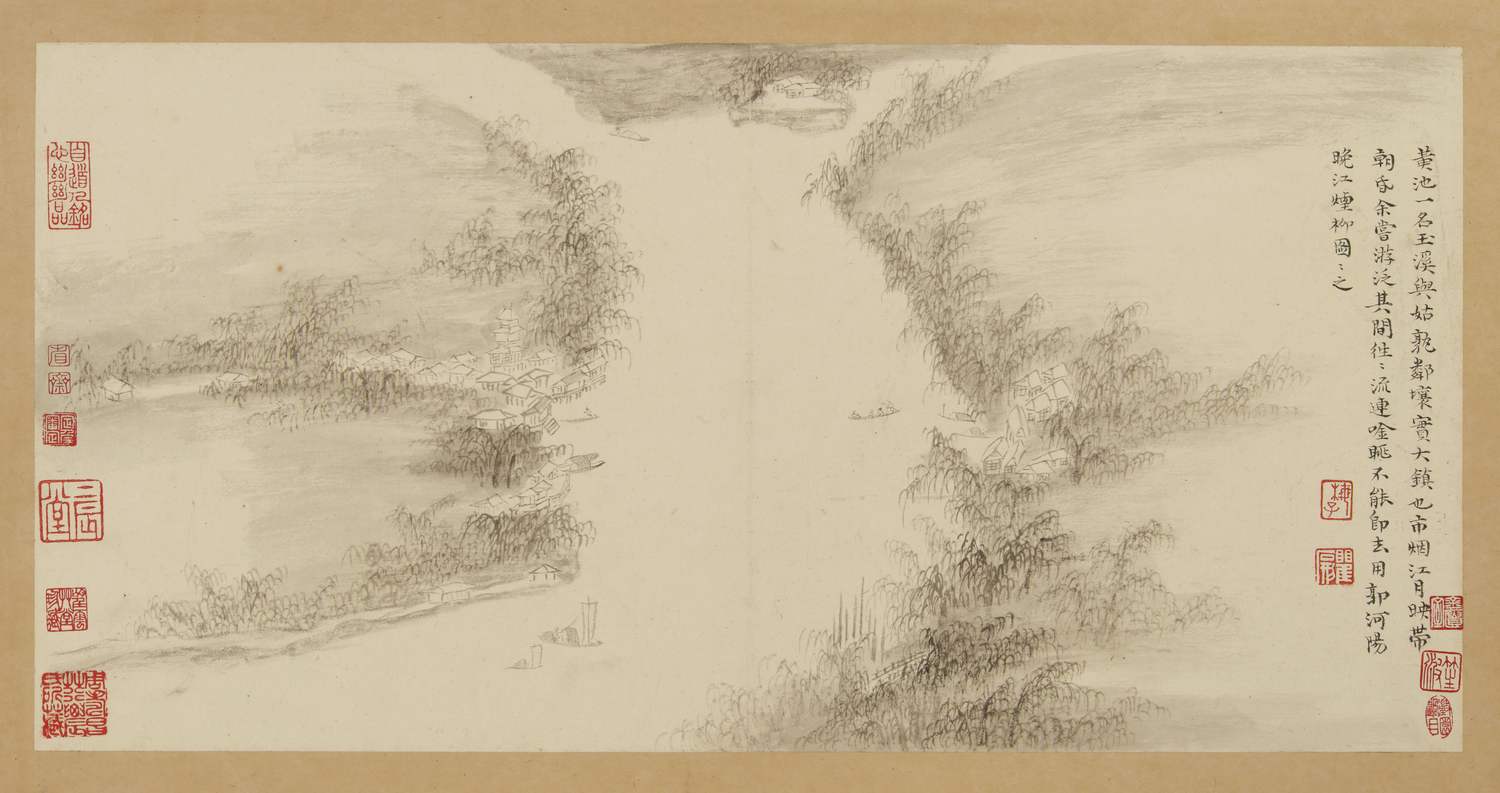
Qing dynasty, dated 1680 · Ink and colour on paper · Museum Rietberg
Evening here comes down to what can still be made out: some parts of the landscape read clearly, others only faintly. The river is paler than the banks that hold it and is the surest guide, with buildings and distant hills turning up along it at intervals. The space is not organised around a single vanishing point, as a European landscape might be. The easiest way through it is to follow the water.
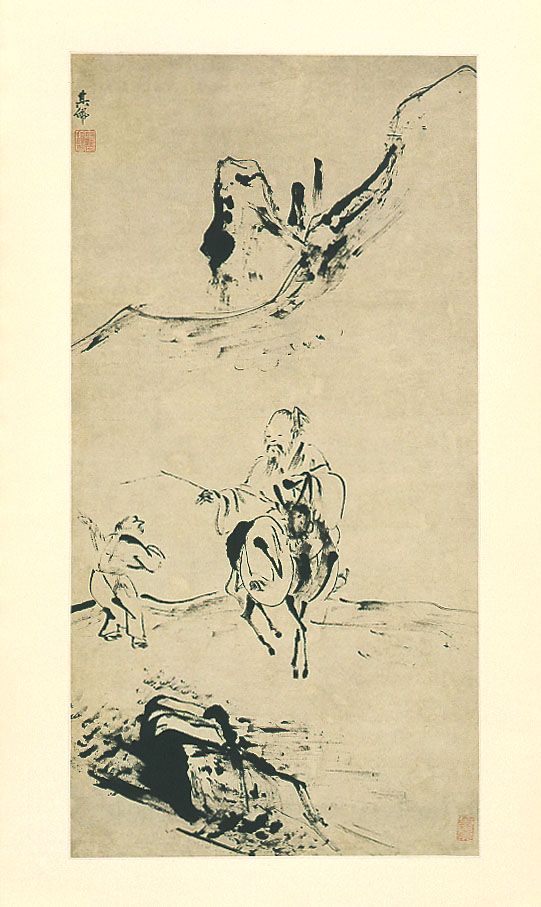
An old man and his attendant travel through a tall, sparsely marked space. A branch and a few dark accents are almost all that lies along their way, yet they are enough to give the journey a direction. The museum's record is nearly as spare. It lists the painting as attributed to Gao Qipei and places it only within the Qing dynasty, without a year, so neither the painter nor the date is settled. No other picture in the selection is so loosely dated.
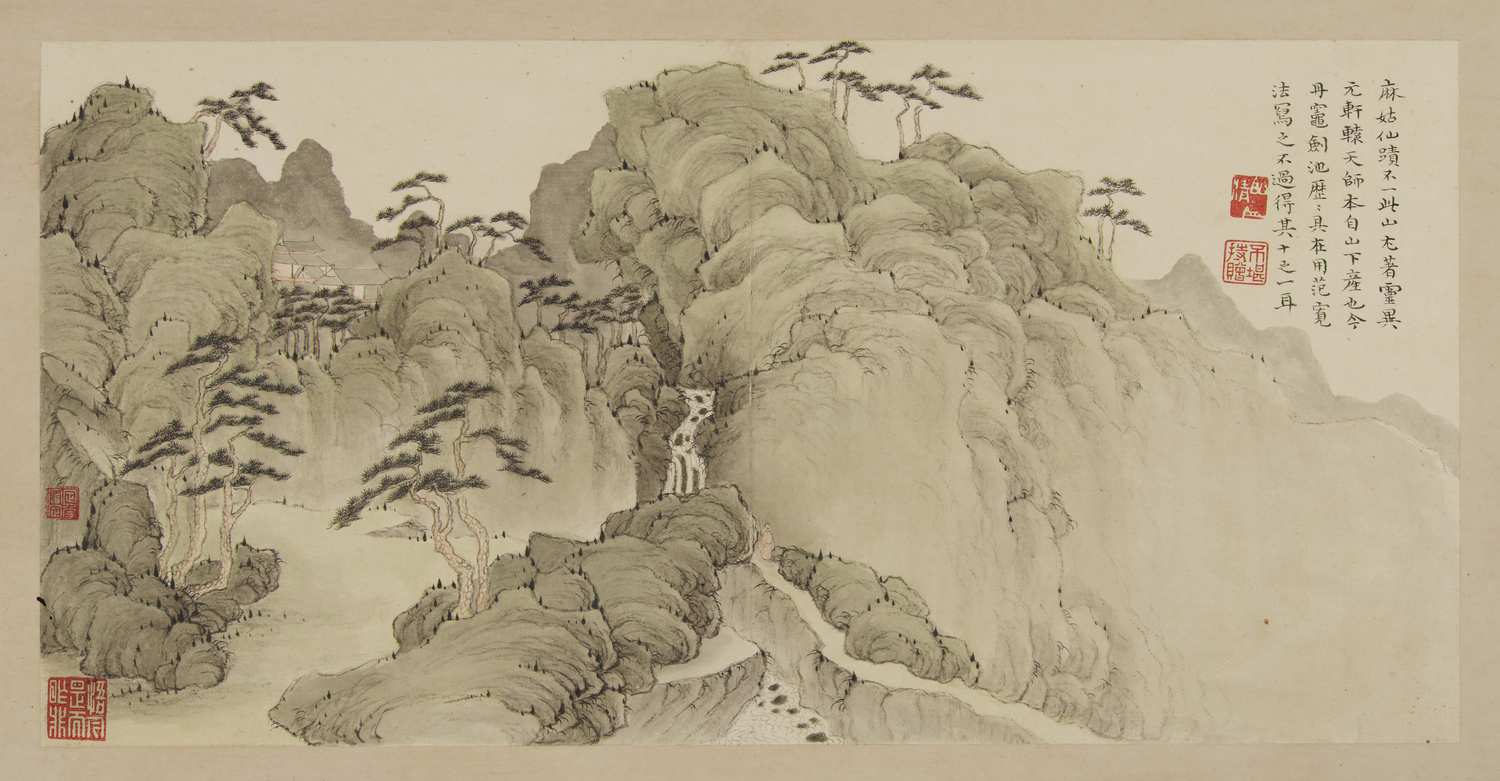
Qing dynasty, dated 1680 · Ink and colour on paper · Museum Rietberg
A winding route shows among the overlapping ridges and small buildings of this compact leaf, but it never runs unbroken through the terrain. It breaks off at one mass and has to be picked up again at the next, so the search named in the title goes on in stages. Evening by the Jade River had its river to follow. Nothing here is so obliging.
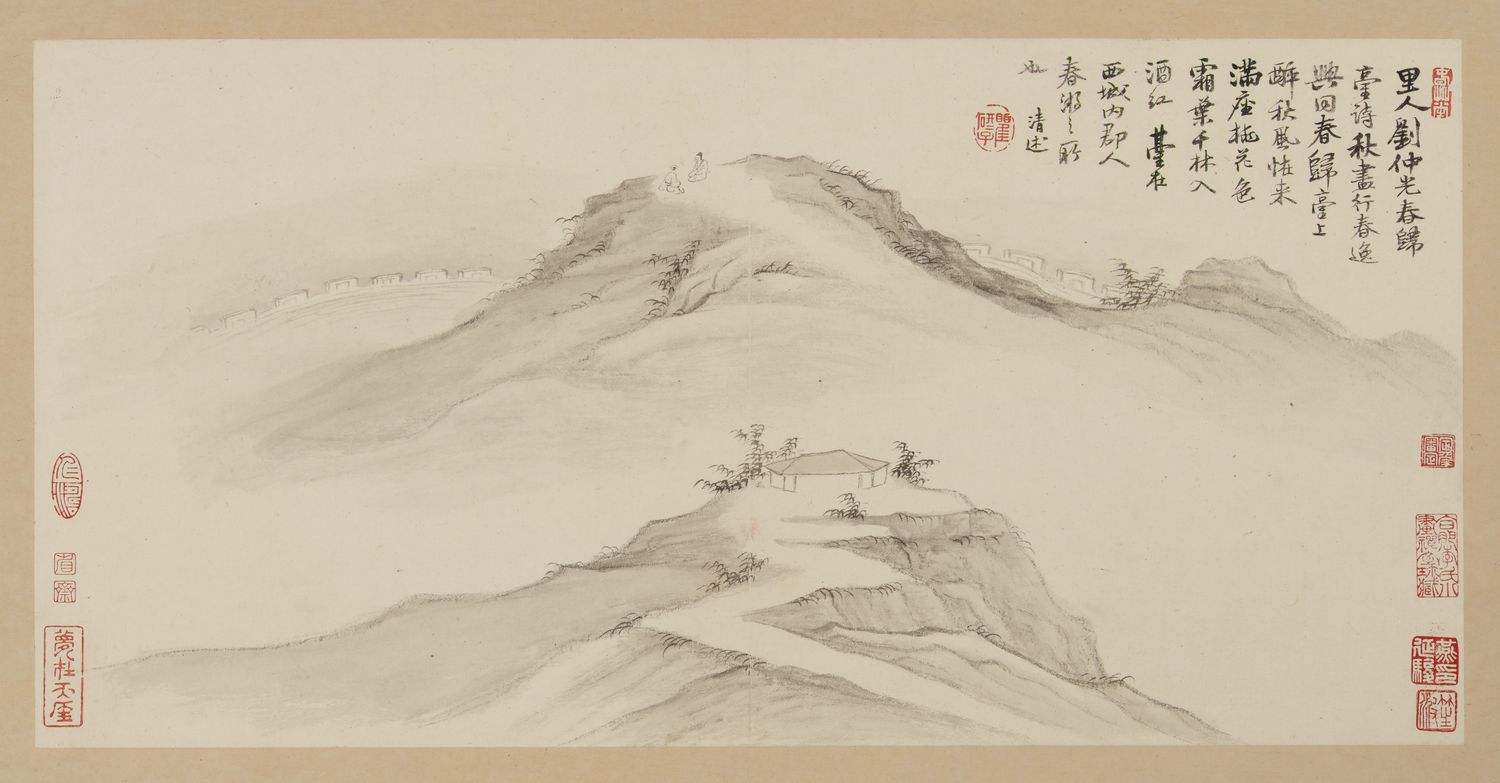
Qing dynasty, dated 1680 · Ink and colour on paper · Museum Rietberg
The last of the Mei Qing paintings deals with distance by leaving most of it out. The terrace and its tree stand close at hand and the mountain far off. The wide stretch between them carries little detail, and much of it is not marked at all. Anyone standing on that terrace would be looking out across what is mostly bare paper.
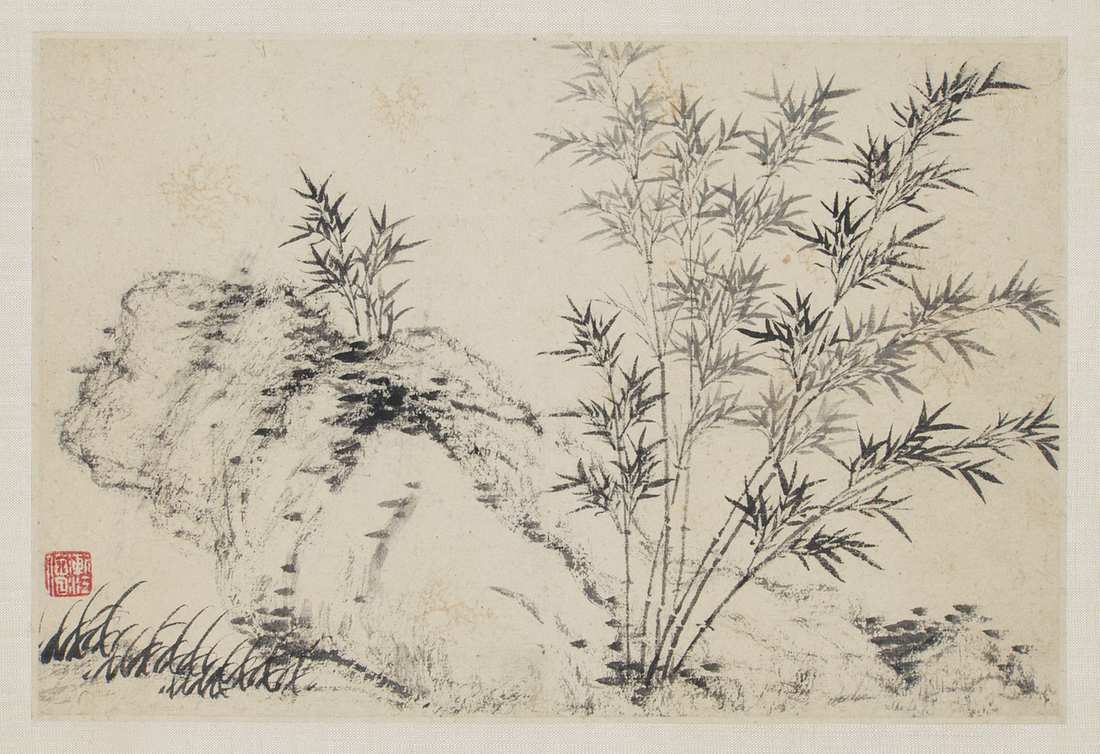
Qing dynasty, 1656 · Ink on paper · Museum Rietberg
Hongren has nothing but the brush to tell bamboo from stone. There is no colour and no detailed background, only open paper around the two subjects. Pointed leaves cluster on slender stems, while the rock's broken surfaces make it read as hard. With nothing else to separate them, you can watch the brush change its movement as it passes from one to the other.
Qing dynasty, 1656 · Ink on paper · Museum Rietberg
The rock from Bamboo and Rocks has grown here into a sharply edged cliff. It lifts the bamboo above the lower ground, and now a small building as well, which gives the cliff its height without taking over the scene. Edges are hard and surface detail is spare. Once the main divisions of the ground are settled, Hongren leaves much of the rest undescribed.
Ming or Qing dynasty, c. 1640 · Ink and light colour on paper · Museum Rietberg
A small figure on a ledge watches the falling water, and because the figure is so small, the fall looks tall. Blue-grey rocks and a pine mark out the spaces around it. The date is approximate, as it is for Shen Hao's other painting here, Composing Poetry in a Boat beneath a Pine. The museum's record does not place either work firmly on one side of the line between Ming and Qing.
Ming dynasty, dated 1639 · Ink and colour on paper · Museum Rietberg
Other titles in this selection name places, such as Mount Lingyan or the Magu Mountains. This one names a model: the mountain is painted in the manner of the earlier painter Huang Gongwang. He is not represented in the selection, so the comparison the title invites has to be made elsewhere. Buildings and layered slopes fill the album leaf. The facing page holds calligraphy, which sits beside the painting but does not serve as its caption.
Qing dynasty, dated 1748 · Ink and light colour on paper · Museum Rietberg
The title promises mountains and peaks, and the leaf offers little else. Small trees and buildings sit among the larger masses, and an inscription takes up part of the open space at the top. The handling keeps the range from monotony. The ridges repeat, but each has its own outline and density of ink, so they never become a row of identical mountains.
1574 · Ink and colour on paper with silk mounting · Museum Rietberg
Here the subject is a legend rather than a view. The robed Bodhidharma crosses lightly drawn water on a reed, a support far too slight for ordinary balance to explain. Ding Yunpeng does not crowd the scene with narrative, and the tall format gives the figure plenty of room and almost nothing to stand on. The painting carries the earliest date in the selection. Its museum record is also the only one here to list the silk mounting as well as the painted paper.
Ming dynasty, dated 1643 · Ink and light colour on paper · Museum Rietberg
Most of the snow is paper left pale, in the areas between the dark trees and the worked outlines of the mountain. Together those areas turn the whole landscape to snow. This is also the one painting in the selection whose painter is not identified. The record supplies a year and the title names a particular mountain. Only the painter's name is missing.
Ming or Qing dynasty, c. 1640 · Ink and light colour on paper · Museum Rietberg
Whatever poem is being composed, the painting does not illustrate it. It shows the place where the writing happens. Figures sit in a boat beneath a pine whose branch reaches out to shelter them without filling the view, and light marks and touches of colour keep the water distinct from the rock.
Ming dynasty, dated 1617 · Ink on gold-ground paper · Museum Rietberg
Viewing a waterfall is Shen Hao's subject too, but the fan changes it. The field widens outwards and narrows towards the bottom, so the landscape has more room in some places than in others, and Li Liufang has to fit his small figures, trees and waterfall into that shape. He works in ink alone. That leaves the gold ground as the picture's only colour and makes it part of the setting.
Qing dynasty, dated 1759 · Ink on paper · Museum Rietberg
The fisherman gives the picture its title, but Wang Jiu gives him very little of the picture. Densely marked banks fill most of the surface, and between them the river turns and narrows into the distance. The small boat ends up as a measure of how much land surrounds it.
Qing dynasty, 1656 · Ink on paper · Museum Rietberg
Hongren's fisherman was painted much earlier than Wang Jiu's, also in ink on paper, but its arrangement is close to the reverse. Hongren lays the scene out in low, lightly marked stages, with no crowded wall of mountains, and the boat stays in clear view on broad water between the banks and a pavilion. Perhaps this is the same restraint that left open paper around his bamboo and rocks, here spread across a whole river view.
Ming dynasty, dated 1639 · Ink and colour on paper · Museum Rietberg
Gu Shanyou does not set this temple above its mountain as a commanding landmark. Instead he tucks it in among the mountain's overlapping forms. Trees and faint shifts of colour mark off the ground around it, so the small building keeps a little room of its own inside a much larger landscape.
Qing dynasty, dated 1748 · Ink and light colour on paper · Museum Rietberg
In Mountains and Peaks, Zhang Zongcang kept his ridges apart by outline. Here mist does much of the dividing. Patches of it break up densely drawn ground among buildings, trees and distant ridges, separating near from far without hard boundaries. The traveller is placed within this mixture of clear and hidden ground, and the route is never fully in view.
Qing dynasty, 17th century · Fan leaf, ink and colour on gold-ground paper · Museum Rietberg
Li Liufang left the gold as his only colour, but Kuncan adds colour of his own to this gold-ground fan leaf. He fits the landscape to the curve largely by varying the density of his ink. Concentrated marks fix the buildings in place, and thinner passages let the river open out. The fan's lower edge cuts the space off, which limits how far its distances can reach.
Ming dynasty, dated 1624 · Ink on paper · Museum Rietberg
Angular mountains rise above a broad, pale river, with nearer banks and trees below. Here the river is less a route to follow than an open expanse, and the gaps between the groups hold the picture together as much as any continuous line does. An inscription is written into part of the upper area.
Explore this selection in Artline
See the selected works alongside books and events from their period, or compare when the artists lived. The books and events provide context, not evidence of direct influence. Works without confirmed dates remain in this guide.
Solitary, in several ways
Towards the end of the selection the word solitary turns up in one title after another, on Ming and Qing paintings alike, attached in turn to fishermen, a temple, a traveller and a house. In none of these pictures does it mean that nothing else is there. Hongren's fisherman shares his river with a pavilion. Zhang Zongcang's traveller moves through ground with buildings in it. Kuncan's fan is named for a single house, yet it shows buildings in the plural. The word seems rather to pick out one small thing within a larger scene, and the paintings differ in what they let the surroundings do to it. Wang Jiu's banks close in on his boat. Gu Shanyou's mountain holds its temple but leaves it some room. Zhang Zongcang's mist hides part of what surrounds the traveller, so his solitude may have as much to do with what cannot be seen as with empty space.
Further reading
Maxwell K. Hearn and Wen C. Fong (1999) · Free PDF and online reading from the Metropolitan Museum of Art.
Hearn and Fong work through paintings from the C. C. Wang family collection at the Metropolitan Museum, discussing landscape traditions, brushwork, attribution and the history of collecting. The catalogue gives background on older painters, such as those named in some of the album titles here. Its treatment of attribution is useful for a selection that includes an attributed work and an unidentified painter.
Maxwell K. Hearn (2008) · Sample available through the publisher; full book in print.
A shorter introduction that looks closely at individual paintings and works of calligraphy and compares them in detail. Because it treats writing alongside painting, it suits the album leaves here that face a page of calligraphy, and the landscapes that carry inscriptions.
 Art, literature & history