The Musée de l'Orangerie stands in the Tuileries Garden in Paris. Its best-known rooms were designed for Monet's Water Lilies, enormous panels that surround the visitor with views of the pond at Giverny. The museum also holds the Walter-Guillaume collection, with paintings by Renoir, Cézanne, Matisse, Modigliani and others.
Three of the Water Lilies panels are included here. Almost everything else is far smaller, and much of it is portraiture. The Guillaume name turns up twice among the sitters: Modigliani painted the young dealer Paul Guillaume, and Derain painted Madame Guillaume in a wide-brimmed hat. The other recurring thread is distortion, which takes several forms. Modigliani lengthens necks and draws them into smooth curves. Soutine roughens faces and, in one landscape, tips the whole view off balance. Henri Rousseau departs from appearances more quietly, setting down a chair factory, a coast and a child with the same careful formality. Renoir appears three times, with a nude, two sisters at the piano and a child dressed as a clown. The rest are landscapes by Sisley and Utrillo, an odalisque by Matisse and Marie Laurencin's Deer.
These works were chosen from the museum's documented holdings, independently of the museum itself. A work in the collection is not necessarily on view, and any of them may be on loan or off display. Dates and attributions keep the qualifications given in the linked records.
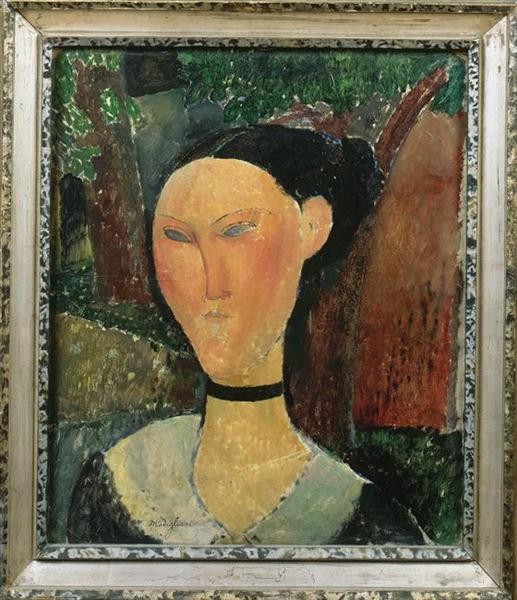
The title identifies the woman only by her ribbon, and the ribbon deserves the attention. Where the black velvet crosses her neck, it works almost as a measuring mark, showing just how far Modigliani has stretched it. The face keeps no closer to ordinary anatomy, yet it holds together, because neck, head and shoulders are drawn as long curves made to answer one another rather than to measure correctly.
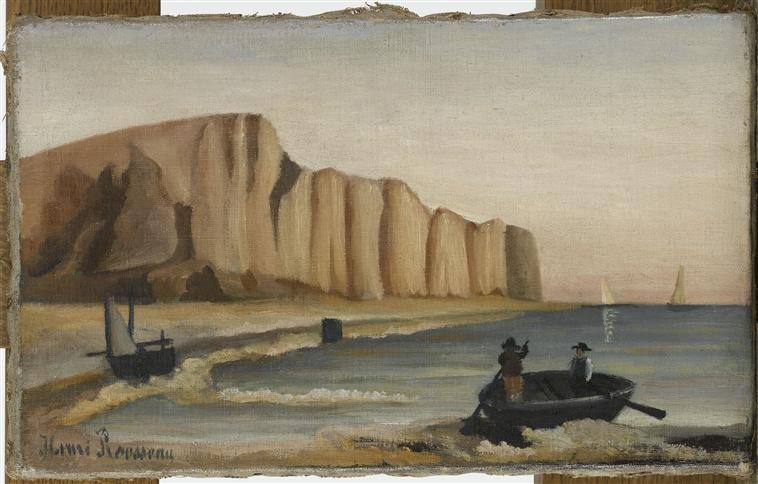
A coast made from very few parts: a cliff face scored with vertical ridges, long horizontal bands of sea and shore, and small boats fitted into the scheme. The uprights of the cliff set against the level bands do nearly all the work, and the picture hardly needs more detail than it has. The date is approximate. If it is right, Cliffs was painted at about the same time as The Chair Factory at Alfortville, another picture that depends on firm edges.
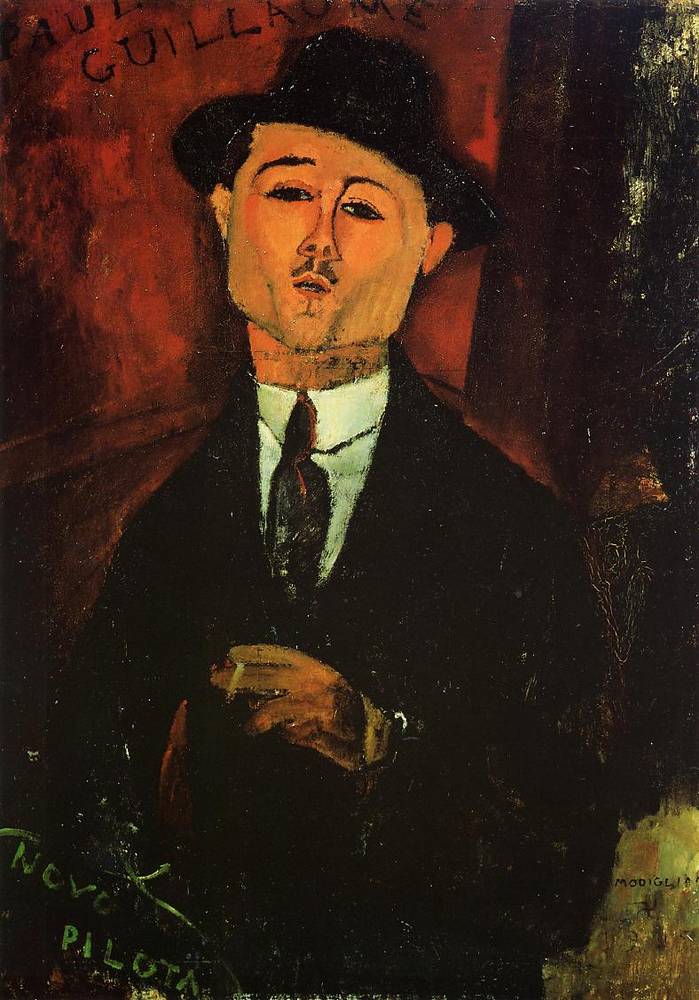
This portrait was painted in the same year as Woman with a Velvet Ribbon, and it goes almost the other way. Instead of drawing the figure out into long curves, Modigliani presses Guillaume into a compact silhouette, dark suit and hat against a red ground, with one isolated hand near the chest making the only gesture. For a portrait of a dealer, remarkably little is on show: no elaborate interior, no display of possessions. Whatever authority he carries comes from the pose and the force of the contrast.
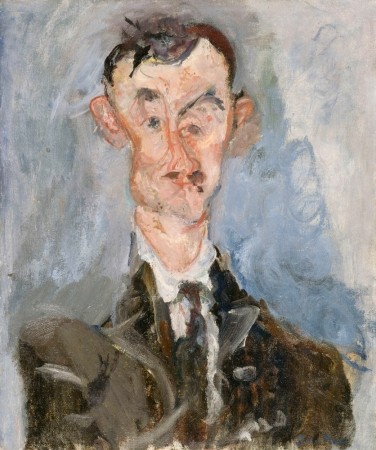
Soutine builds Émile Lejeune's face from uneven angles and carries them on into the background, where the paint is left visibly worked. He smooths neither face nor ground to a finish. The likeness is no weaker for it. If anything, the irregularities keep it lively.
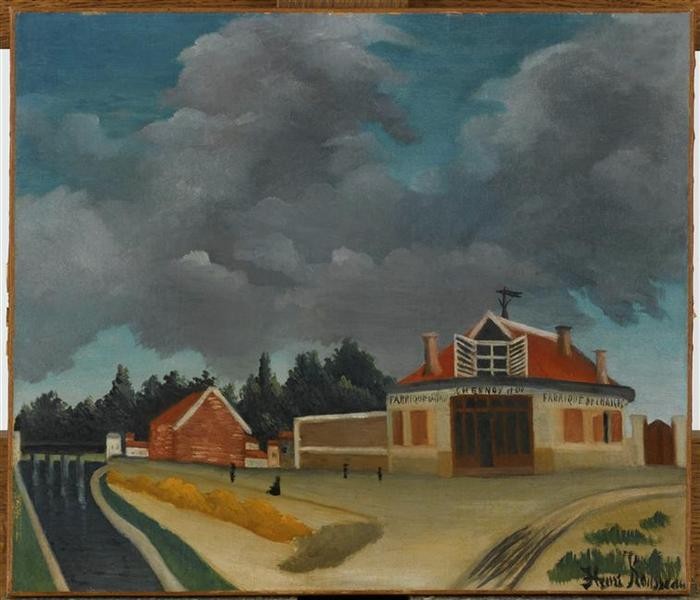
Rousseau paints a chair factory with the formal stillness of a landscape view. The low building keeps firm edges beneath clouds that swell and soften overhead, and a branching road and small figures bring the industrial site down to human scale.
c.1904 - 1905 · Oil on canvas · Musée de l’Orangerie
The child faces the viewer squarely, and her doll is presented almost as a second sitter. Her enlarged head and red dress outweigh the narrow strip of ground and the open sky behind her. Nothing here suggests a moment of play. Girl and doll are equally direct and equally still, and the picture is closer to a formal portrait than to a scene of childhood.
The house has to be found. Utrillo puts a screen of bare branches between the viewer and the small building, and their dark mesh blocks any direct route to it, while pale water and sky show through the gaps.
Patterned textiles fill the room and compete with the red trousers, and with the reclining woman who wears them. Her pale blouse gives a quieter interval without detaching her from the decoration. Pattern keeps undercutting the sense of depth, so the picture reads both as a room with a figure in it and as a set of adjoining fields of colour. Neither reading quite wins out.
Modigliani's dealer makes do with a dark suit and very little else. Derain, by contrast, builds his portrait of Madame Guillaume out of clothes. The broad hat closes the top of the composition, and gloves and gathered fabric answer it below. Her face stays individual within this stable arrangement, but the fashionable costume gives the picture much of its weight and structure.
The sunset itself is never seen. It appears only as warm reflections, which are spread across six metres of painted pond and share the surface of the water with the plants. That is more than the eye can hold from one spot, so the panel has to be followed along its length. There is no conventional foreground, so shifts of colour do much of the work of telling you where you are.
The earliest painting in the selection is also one of the plainest in subject: an ordinary route, painted without dressing it up. The pale road gives the open fields a direction without filling them, and small walkers show how it recedes. A broad sky keeps the road from taking over the picture.
Willow branches hang where a horizon might be expected, and their fall repeats across the wide surface in a rhythm of its own. They cross both the pale water and their own reflections, and it takes a while to tell the tree from its image.
Of the three panels, this one gives you the least to hold on to. There is no visible bank and no clear horizon, and unlike Clear Morning with Willows it has no branches hanging into view. There is only water. Distance has to be judged from clusters of lily pads and the lighter intervals between them. You cross the picture by comparing denser patches with thinner ones, and no single path leads back into depth.
The subject comes with its own expectation of order: a boy with a formal role, in red and white vestments, his hands joined. Soutine lets neither the fabric nor the body beneath it settle into symmetry. The joined hands gather the pose together, and a twisting area of white cloth pulls it apart again.
The date of 1915 is unverified. If it holds, Antonia belongs to the same year as Woman with a Velvet Ribbon and Paul Guillaume, and she is plainly closer to the first of them. She has the same long neck and pale face, here set above the restrained base of a black dress. At first the seated, forward-facing pose looks symmetrical, until slight tilts of the head and shoulders unsettle it. Modigliani keeps the interior shallow, so little competes with these small shifts of weight and angle.
Only the deer make it into the title, but Laurencin paints the human figures no differently. People and animals share soft tones of blue-grey broken by pink and white, and their curved outlines overlap without hard divisions. Each form can still be made out, but it emerges from its neighbours rather than standing clear of them.
Everything leans. Road, houses and trees tilt with the view, and even the solid buildings look ready to slide. A small figure supplies a familiar sense of scale without steadying anything around it. Sisley's road to Louveciennes is built from similar ingredients, a road and small walkers, and nothing in it tilts.
Yvonne and Christine Lerolle share the music but not the task: one sister plays while the other follows from nearby. Renoir draws their heads and shoulders into a shared area of attention. The dark mass of the piano holds the white and red of their clothes together and still keeps the two poses distinct.
A clown's costume promises entertainment, and the child inside this one does not supply it. The red costume enlarges Claude Renoir's outline, but his small shoes and straight legs leave the body clear beneath the theatrical shape, and his face stays serious.
Renoir sharpens the seated woman's outline in some places and lets it soften into the foliage in others, without losing the weight and structure of the body. Warm skin meets cooler vegetation through related rounded forms. Her backward turn draws her into the landscape's wider arrangement of colour rather than setting her apart from it.
Explore this selection in Artline
See the selected works alongside books and events from their period, or compare when the artists lived. The books and events provide context, not evidence of direct influence. Works without confirmed dates remain in this guide.
Scale on screen
On a screen, one of Monet's long Water Lilies panels and Modigliani's portrait of Paul Guillaume on cardboard can come up at the same width. The recorded dimensions are a better guide. They matter most for the panels, because their size is much of the point.
Further reading
Anne Dayez, Michel Hoog and Charles S. Moffett · Read online or download · English
This Met publication, which you can read online or download, gives background on Monet, Renoir and Sisley, mainly on their earlier work. It suits the Impressionist roots of this selection, especially Sisley's road. It is less help with anything from the twentieth century, and that includes Monet's own Water Lilies.
 Art, literature & history