The Musée Marmottan Monet occupies a former private residence in western Paris. It is known above all for its paintings by Claude Monet, Impression, Sunrise among them. It also holds works by Berthe Morisot and by other artists associated with Impressionism, and in this selection Morisot has almost as large a place as Monet.
Monet's pictures here take in the harbours at Le Havre and Honfleur, the Gare Saint-Lazare, the Seine near Giverny and his water-lily pond. Morisot paints boats being built, a father and daughter at a garden table, a woman at a ball and a resting shepherdess. Pissarro shows the outer boulevards under snow. Sisley paints apple trees in blossom and autumn trees near Moret-sur-Loing, and Gauguin contributes the only still life among the twenty, a bouquet. The portraits are by Morisot, Manet and Renoir. Harbours and sunrises come round more than once, sometimes by different painters, sometimes by the same painter years apart.
Three works are older than Impressionism itself: Louis Gauffier's view over the Arno valley, Auguste Antoine Massé's interior of Gros's studio and Corot's road descending from Volterra.
The works were chosen independently of the museum, from its documented holdings. Approximate dates and any qualified attributions are given as recorded.
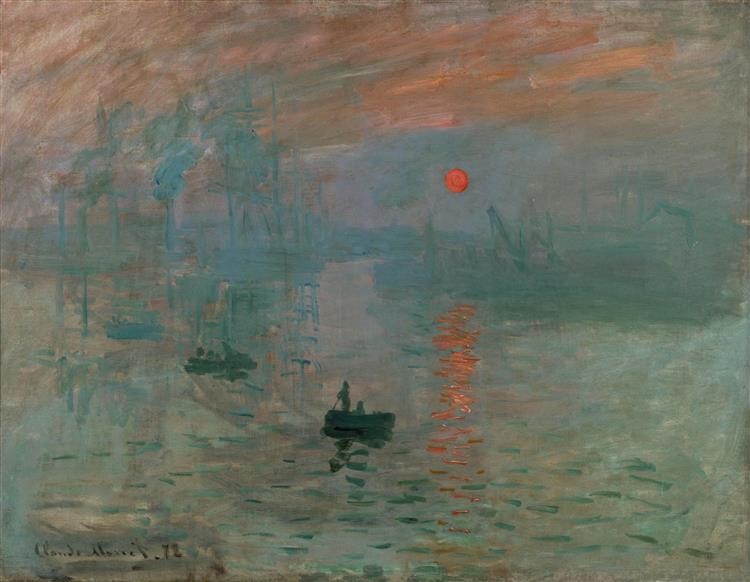
When this view of the harbour at Le Havre was exhibited in 1874, its title helped give Impressionism its name. The picture is mostly mist. Beneath an orange sun the boats are reduced to dark silhouettes, and the cranes and buildings behind them have nearly vanished. It is a working port, but very little of its business can be made out.
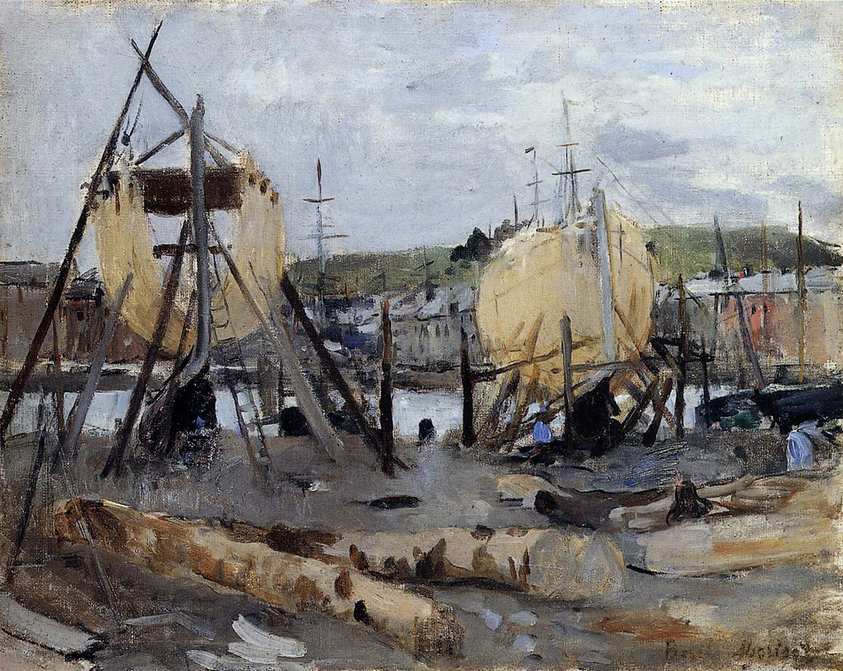
Set beside Impression, Sunrise, Morisot's picture shows the kind of work that Monet's mist conceals. Her boats are still being built. Their unfinished hulls expose the structure that a completed vessel would hide, and rigging and supports cut diagonally across the shoreline.
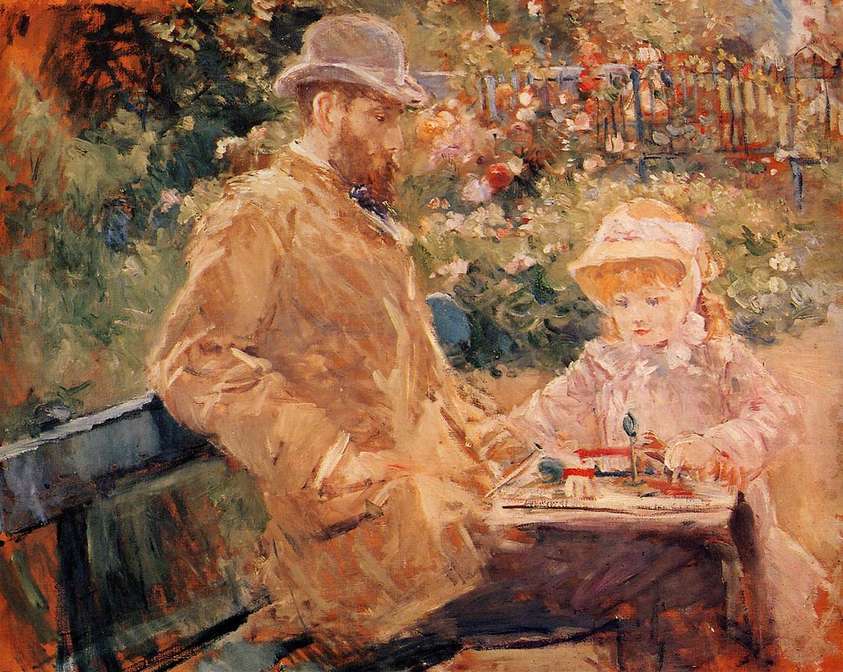
Neither father nor daughter turns outward to pose. They are close together at a garden table, with bright foliage continuing behind them. Morisot's closely spaced brushwork runs through their clothes and the plants alike, so the two figures seem made of the same stuff as the garden and lit by the same light.
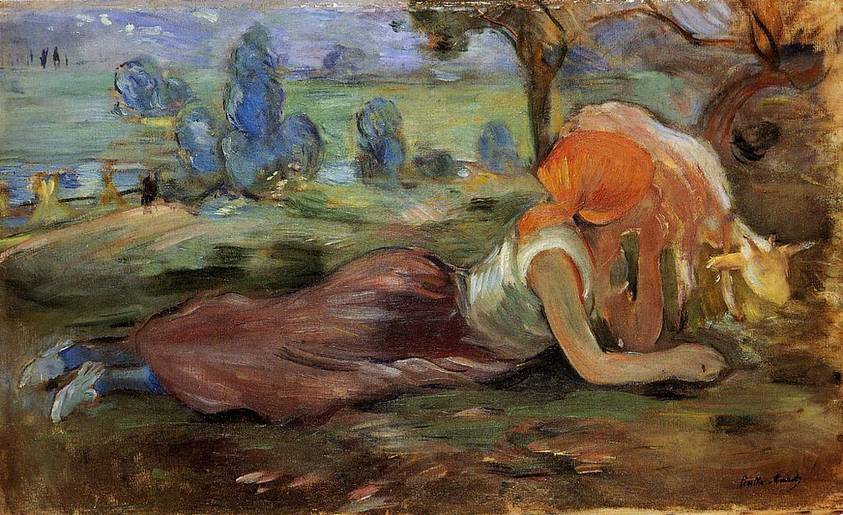
A shepherdess lies on the ground with her head propped on one arm, and the handling seems to suit the title. Her long skirt runs into the greens and browns beneath her, as though she were settling into the ground, and in places the marks for cloth and grass are hard to tell apart. Her form stays distinct all the same.
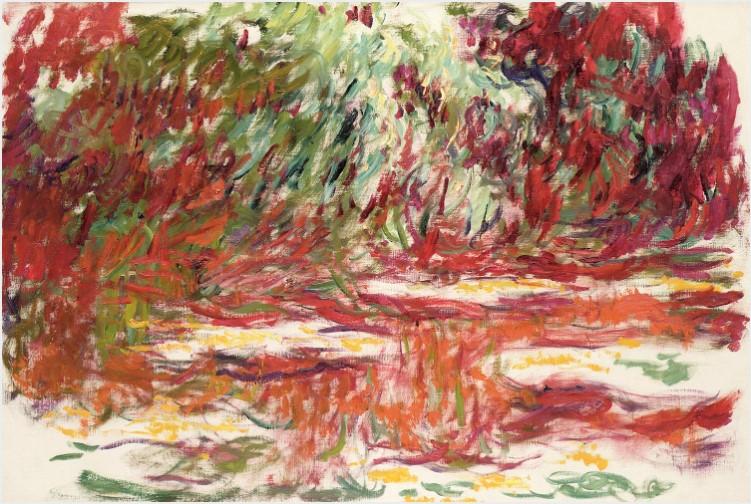
Red, green and pale strokes share one busy surface, and reflections keep breaking down any clear line between bank and water. The pond is still recognisable, but with no firm horizon or outline the picture gives you no fixed point from which to take it in.
Masts and a church spire rise above the waterfront houses and moored boats. They break up a low sky in a view otherwise laid out in broad horizontal bands.
The museum dates the painting to 1917, which may seem late for a Monet harbour scene. It places the picture close in time to the Water-Lily Pond, and the two could hardly hold the eye more differently. The spire and masts here are just the kind of fixed points that the pond withholds.
The bouquet is packed into a compact, crowded mass in the upper part of the canvas, above a looser arrangement of vase, cloth and fruit, so the picture's weight sits near the top. The red and blue flowers count as colour rather than as specimens, and Gauguin picks out little botanical detail flower by flower.
Renoir shows Monet absorbed in reading, his eyes on the page rather than on the viewer. Light catches the paper near his hands, and his hat partly frames his face. There is no palette or brush to mark him out as a painter. In a museum that bears his name, he appears simply as a man reading.
Gros's studio is shown as a place of teaching. Students fill a high room, with their easels and raised hands spread across the space. Every one of them faces the same seated model, who is set apart from the rest, and each sees that model from a different position. The whole room is organised around one posed figure.
The oldest painting in this selection takes its title from its vantage point, the Paradisino at Vallombrosa. A terrace wall separates a small group of figures in the foreground from the broad sweep of the Arno valley beyond, where gardens and wooded slopes recede on a scale quite unlike theirs.
Snow mutes the buildings and the traffic but has not brought the boulevard to a halt. People and carriages keep moving among the bare trees, their darker touches held within a narrow range of pale winter tones.
Morisot's pale face is held within a large dark mass of clothes, hair and hat, set against red. Manet gives almost nothing of a setting. With so few elements in play, small inflections around the eyes and mouth carry a great deal.
Renoir adds no props or emblems and keeps the background soft, so the sitter has the picture to herself. Her long hair and dark dress give weight to the lower part of the portrait, and a slight turn of the head keeps the pose from being strictly frontal.
Renoir painted this portrait shortly before his Julie Manet, and it works quite differently. Julie is anchored by a dark dress, whereas Mademoiselle de Bellio is set off by a red blouse, the largest area of warm colour in the picture. Her face is built from smaller, softer transitions and reads clearly without a hard edge all round. The pale background gives the red room without letting it overwhelm her.
Pale tones dominate here, as they do in Pissarro's snowy boulevards of the same year, but in Sisley's spring they belong to blossom. Apple trees recur across grass and worked ground, their structure partly lost under the flowers. A darker hill behind stops all this pale growth from running off into the distance.
Gauffier's terrace wall keeps his figures apart from the view, and Corot's road does the opposite. It curves down from the town, linking a small figure and the nearer trees with Volterra in the distance, and depth builds along its course through simple shifts of tone and overlapping planes. The figure seems to be there chiefly to give the setting its scale.
Sisley's other picture here moves from blossom to the warmth of an Indian summer. The autumn foliage stands out against cooler distances, so the season's colour also does the work of separating near from far. Tall trees beside the watercourse recur as narrow uprights and keep the view steady where the leaves shift in tone.
Everything turns on the open fan. It partly screens the sitter and changes the outline of her figure, yet it draws the eye towards her face even as it gets in the way. Her pale dress and skin stay distinct against her darker hair and the plants behind her.
Iron girders give the station a firm framework, and the diagonal of the bridge stays legible above shifting white clouds of steam that hide parts of the structure. At Le Havre the mist was weather. Here some of the air through which Monet had to paint the architecture came from the station's own machines.
This is another Monet sunrise, this time on the Seine near Giverny rather than in a port. The banks and their reflections close in from either side in blue and violet, and the clearest sign of the river itself is the pale gap they leave between them.
Explore this selection in Artline
See the selected works alongside books and events from their period, or compare when the artists lived. The books and events provide context, not evidence of direct influence. Works without confirmed dates remain in this guide.
Painters and sitters
Most of the portraits here stay within a small circle. Manet paints Morisot, Morisot paints Eugène Manet and his daughter, and Renoir paints Monet and, years later, Julie Manet. Monet and Morisot, the two painters at the centre of this selection, therefore also appear in it as sitters. At about the same time, Morisot reclines for Manet and Monet reads for Renoir. Neither is shown at work. Easels do appear in an earlier picture, Massé's view of Gros's studio, but the painters there are students and the sitter is a posed model.
Further reading
Anne Dayez, Michel Hoog and Charles S. Moffett · Read online or download · English
This Metropolitan Museum publication is available to read online or download in English. It gives historical context for Monet, Morisot, Renoir and Sisley. Its entries let you compare subjects and methods from one artist to the next without reducing Impressionism to a single style.
 Art, literature & history