Manchester Art Gallery's collection is strongest in British painting, particularly of the nineteenth century, and its Pre-Raphaelite pictures are well known. It also holds portraits, scenes of work and daily life, and art from other periods. The gallery is closely tied to the history of the city that collected and displayed these works, and two of the paintings here show Manchester itself, seen from Belle Vue and from Kersal.
This selection follows the collection's strength. Its subjects come from legend, myth, history and modern life: Arthur dying among women, Hylas drawn towards a pool, Berengaria receiving news of Richard I, a London street being dug up. Alongside them are George Stubbs's cheetah with its attendants, still lifes of thistles and of grapes, and a regatta at Chelsea. Work comes up again and again in different forms, and so do people who have stopped in the middle of a task, with a book in the lap or thread in the hand.
Artline chose these works from the museum's documented holdings, independently of the museum. Dates and attributions keep the qualifications given in the linked records.
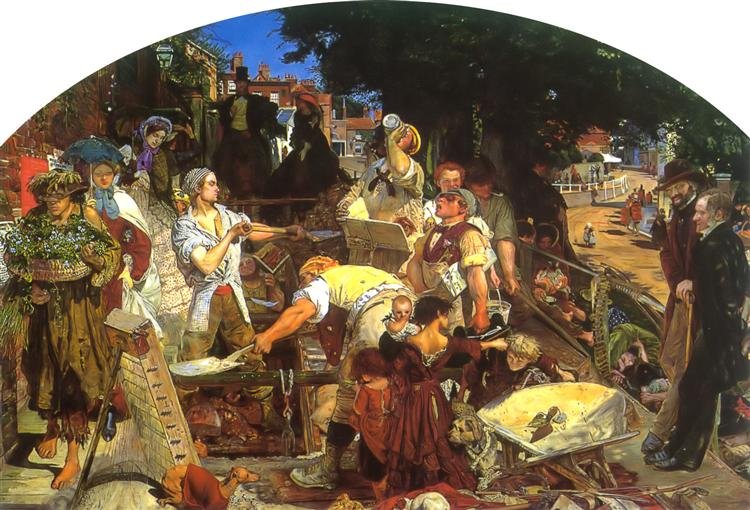
The title could hardly be plainer, and neither, at first sight, could the subject: men digging up a London street. Around them Brown arranges people from different parts of Victorian society, some passing by, others stopping to watch. He worked on the picture over many years, giving an everyday street scene the scale and care once reserved for great historical subjects.
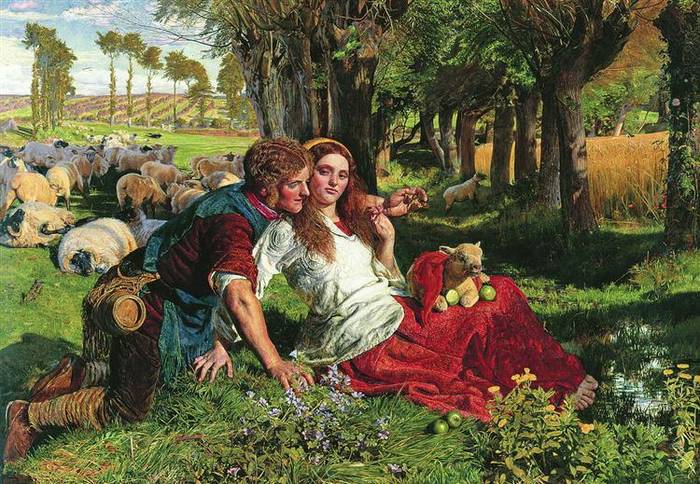
A hireling is a hired worker, so the title hints at neglect before the picture does. This shepherd is minding sheep for someone else, and not minding them well, because his attention is on the woman beside him. Hunt doesn't leave the point to the title alone. Behind the couple, the flock has spread out unwatched.
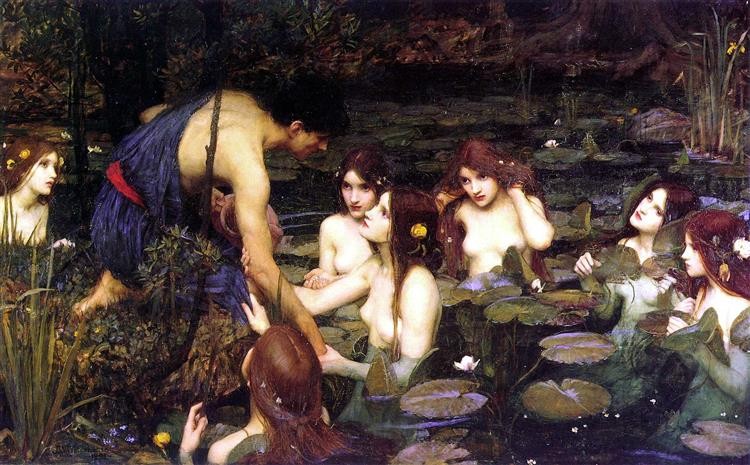
Hylas leans out from the edge of the bank, where the ground no longer gives secure footing, and the nymphs reach out from the pool to draw him in. Their pale faces and shoulders stand out against the dark water, so the invitation is plain. The painting shows that much and no more. The danger comes from the myth.
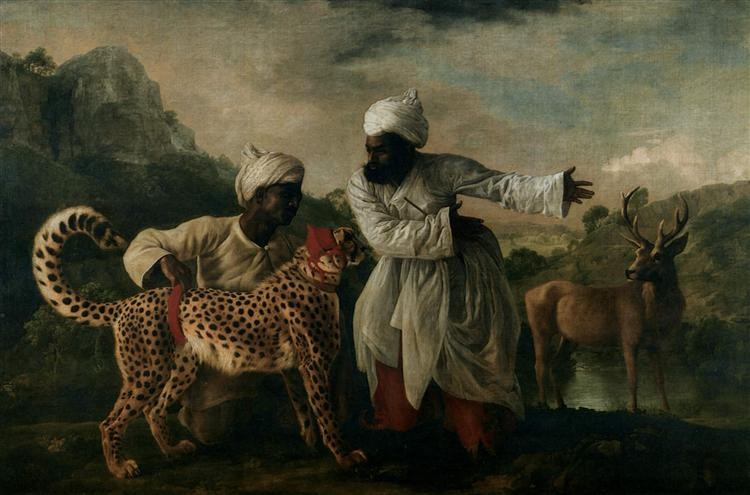
The title puts the cheetah first, and people often come to the picture mainly for Stubbs's animals. Yet the scene depends on the men. Two attendants work together to manage the cat, and one points towards a stag in the distance, as though setting up a hunt. Their handling matters to the encounter as much as the anatomy of the cheetah does.
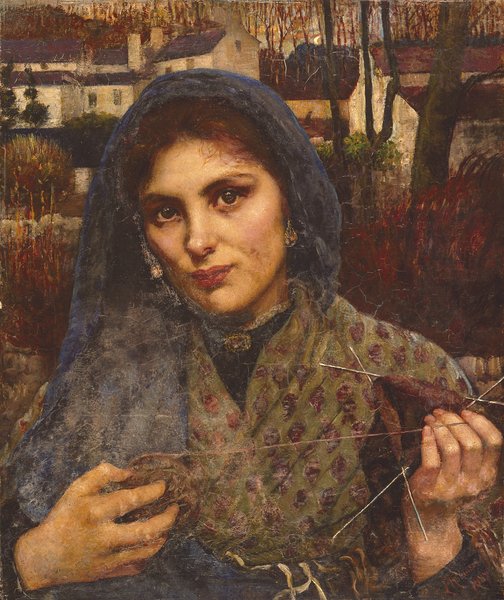
The woman holds thread and a small object, which suggest a task she has broken off. Swynnerton shows her face plainly and calls her a dreamer, but doesn't say what the dream is about. The things in her hands don't help either: they show what she was doing, not where her thoughts have gone.
The title identifies the sitter only by her nationality and her necklace, and the painting is just as economical. The red of the necklace stands out against the green surroundings and the young woman's shoulder. Leaves frame her turned head, but Dacre never develops them into a separate landscape. A face, a few nearby materials and colours strong enough to tell them apart are all she needs.
The picture is called Balaclava, but what Thompson paints is the aftermath of a charge. Her men and horses no longer move together. Some stand or sit, some are exhausted, and some are held up by others. The sky above them is comparatively quiet.
A girl looks down at a bowl as ducks come towards her. Stott arranges the water's edge, a tree and the reflections around this small exchange, and the approaching birds supply whatever action the quiet scene has.
Millais showed the familiar floating corpse. Hughes keeps Ophelia on the bank, still alive, and the drowning lies outside the moment he paints. She sits among the plants at the water's side with one hand raised, and her pale dress draws the eye to her poised position. The arched top edge of the picture closes over her there.
Archer tells the end of the legend through the women's care for Arthur. He wears his armour, the dress of a fighting king, yet he can no longer act for himself, and the women are grouped around his body. Beyond them a boat waits at the shore for his departure, the part of the story still to come.
Perugini's title says she is reading. For the moment, she isn't. The book lies open in her lap, she rests her chin on one hand, and the dark foliage sets off the pale figure without giving any clue to her thoughts. Beside Swynnerton's The Dreamer it makes a pair of interrupted occupations, a book here and thread there, though the titles take opposite sides: Swynnerton names the reverie, Perugini the activity that has been put aside.
The emigrant doesn't appear. Instead a household gathers at a table around a single sheet of paper to write a reply. Collinson shows distance through its effect on the people left at home, where answering a letter takes the effort of several people.
Magnus keeps the thistles' pointed leaves and uneven heads instead of smoothing them into an ideal bouquet. A simple vessel and a plain ground give their irregular outlines room. A prickly, common plant receives the kind of sustained attention usually given to more obliging flowers.
In the foreground one figure bends close to the ground, while another carries on with the harvest further back, beneath the trees. A basket gives the work its practical purpose. The orchard is sunlit, but La Thangue stays with the effort of picking and doesn't offer the place as a pleasant retreat.
People take part in the regatta from boats, from the shore and from buildings along the river. No single onlooker could take in the whole event, and Greaves doesn't pretend otherwise. He builds the scene from many small incidents around the water, and no one race dominates. Unlike the crowd in Ford Madox Brown's Work, which gathers around a central task, this one has no centre.
From Belle Vue the full spread of the industrial city becomes visible. Factories and smoke fill the distance, set within a wider landscape, while people and animals occupy greener ground in the foreground.
From high ground at Kersal, Waddington shows Manchester spreading along the river, its chimneys and large buildings rising through haze. The fairly open land in front makes the extent of the city easier to judge. Danson's view from Belle Vue is arranged the same way, with greener ground in front of the factories.
In a dark room, light falls on the hands and needlework of a woman in a pink dress. Alma-Tadema shows her skill through concentration and a restrained gesture, and never turns the domestic task into a performance. The industry of the title is diligence with a needle, a long way from the chimneys of the Manchester views.
Rose Magnus gives her thistles a plain ground to stand against. Muckley packs glass, grapes, fabric and a patterned dish closely together and still keeps each one distinct. Reflections and degrees of translucency separate them where gaps might otherwise have done the job, and the same light gives glass, fruit and cloth each a different surface.
A visitor holds out a small object. Berengaria rises, and the figures around her turn towards the exchange. The news about Richard I arrives in something small enough to hold in the hand, and the title says what kind of news it is: Berengaria fears for his safety. In the picture itself the meaning is carried by gesture, in her rising and in the turning of the figures around her.
Explore this selection in Artline
See the selected works alongside books and events from their period, or compare when the artists lived. The books and events provide context, not evidence of direct influence. Works without confirmed dates remain in this guide.
Kinds of work
Work takes many forms across this selection. Ford Madox Brown's Work puts labour out in a public street, while Laura Theresa Alma-Tadema's Sweet Industry keeps it indoors, as domestic skill. In James Collinson's Answering the Emigrant's Letter, keeping up a relationship across a distance is itself a task. Henry Herbert La Thangue adds labour on the land, and George Stubbs's attendants are working too, handling the cheetah while the animal takes most of the attention. William Holman Hunt's The Hireling Shepherd shows the reverse: a man paid to watch a flock who has stopped watching it.
Ruskin's book is a manual of drawing, built around exercises that train close observation. That habit of attention suits the Pre-Raphaelite pictures in this selection and the paintings of plants and ordinary materials, such as Magnus's thistles, Muckley's grapes and glass, and Alma-Tadema's needlework under light. The exercises also offer a way of examining details closely without reading every object as a symbol.
 Art, literature & history