Kunsthaus Zürich holds one of Switzerland's major art collections, including Swiss artists alongside a wide range of European painting, from older works to modern art. This selection of twenty runs from Hans Fries's late medieval Adoration to Mondrian. It includes small groups that are worth comparing. Ferdinand Hodler appears three times with views of Lake Geneva: an earlier evening view from Chexbres and two views from Caux painted in the same year. Giovanni Segantini's two paintings set a studio scene beside an unsettling pastoral. Among the works by artists from beyond Switzerland are a Rembrandt apostle, Poussin's sleeping Venus surprised by a satyr, Monet's Parliament in a sunset haze and Mondrian's grid of red, blue and yellow. The subjects range more widely than that list of names suggests. There is a caught trout, a portrait built from attributes, a crush of horses and bodies titled simply War, and a group of archaeologists at work in a church.
Artline chose these works from the museum's documented holdings, independently of the Kunsthaus. Dates and attributions keep the qualifications given in the linked records.
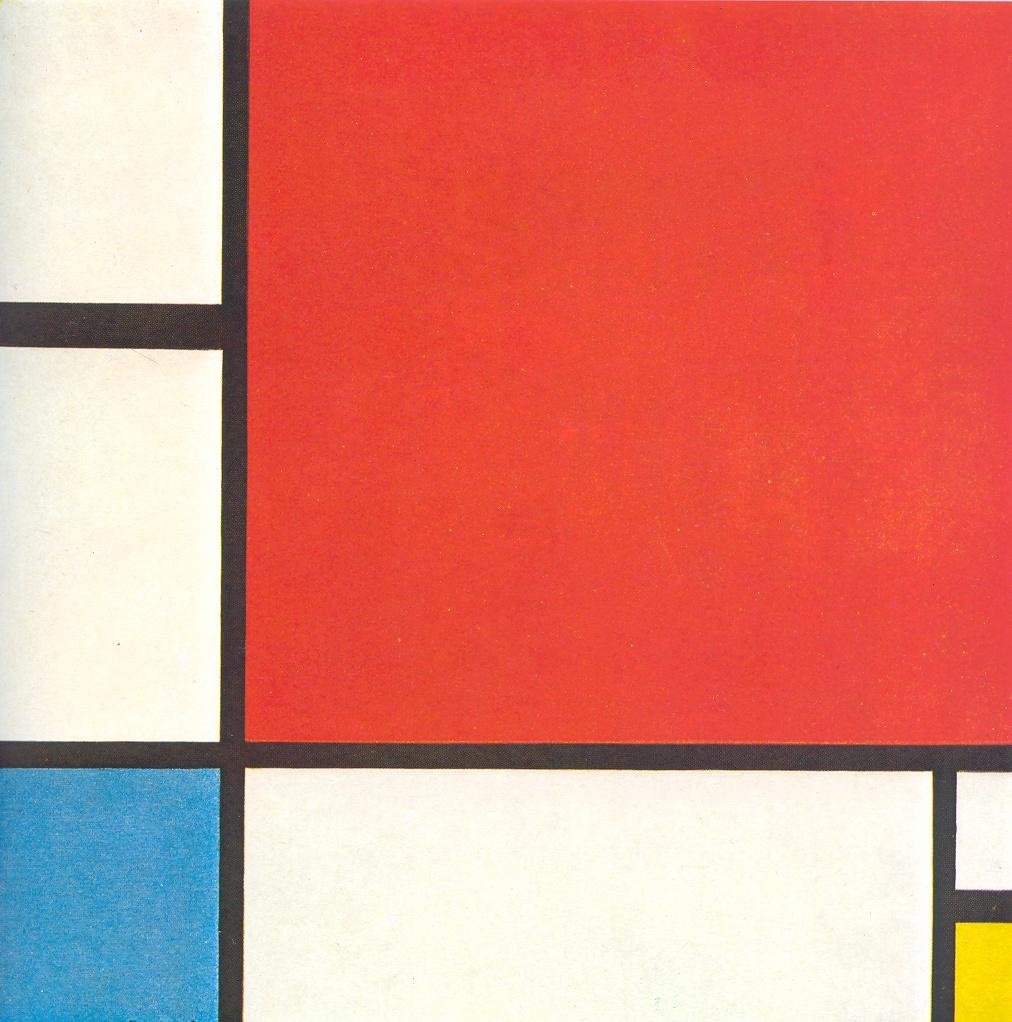
Nothing is depicted. Black lines divide the canvas into areas of white, red, blue and yellow. The red dominates, though it does not sit at the centre of a symmetrical design. The smaller blue and yellow sections lie across unequal intervals of white, so the weight of each coloured area depends on what has been left beside it. Mondrian allows himself only the three primaries, black, white and the right angle. That still leaves the size and position of every block to be judged. None of those judgements comes out symmetrical here, and the balance is reached by adjustment.
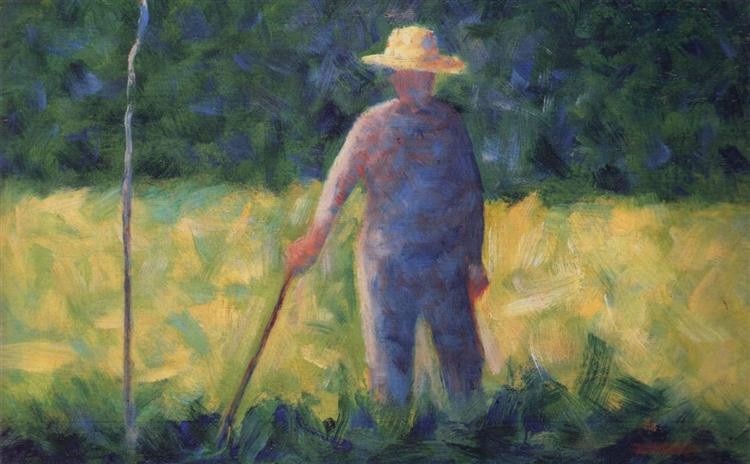
A long tool sets the diagonal of the gardener's stance, and his body follows its angle. The growth around him is painted in broader, rougher marks and described less closely than the man and his work. Anyone expecting the technique familiar from Seurat's later paintings will not find it in this picture on wood. What holds it together is plainer: a body, a tool and a patch of cultivated ground.
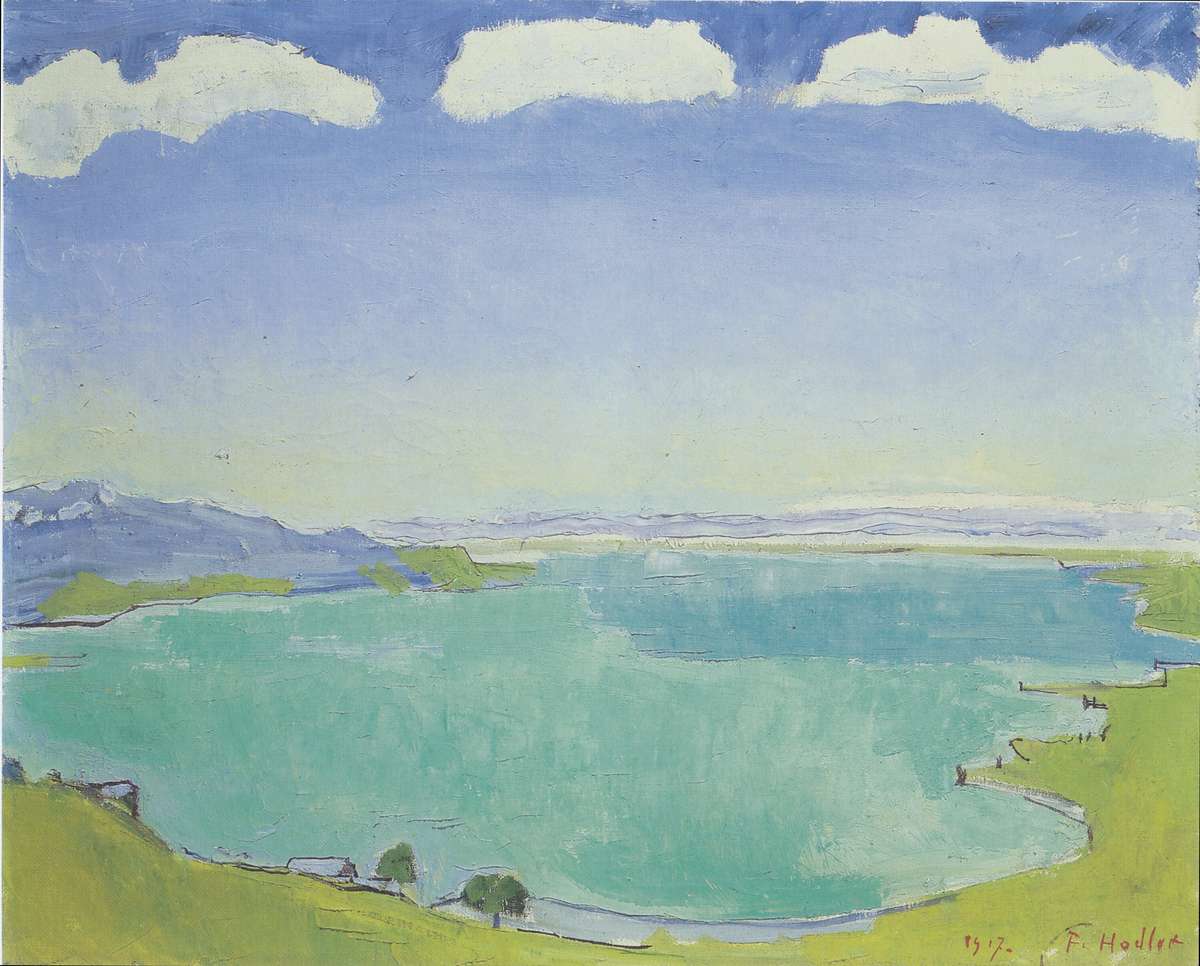
The lake fills the centre of the canvas as a single broad curve of turquoise, set apart from the band of mountains behind it and the strip of cloud above. Hodler keeps the view recognisable, but he describes a great distance with a few clean boundaries between areas of colour. Small details of place count for little beside those large shapes and the intervals between them.
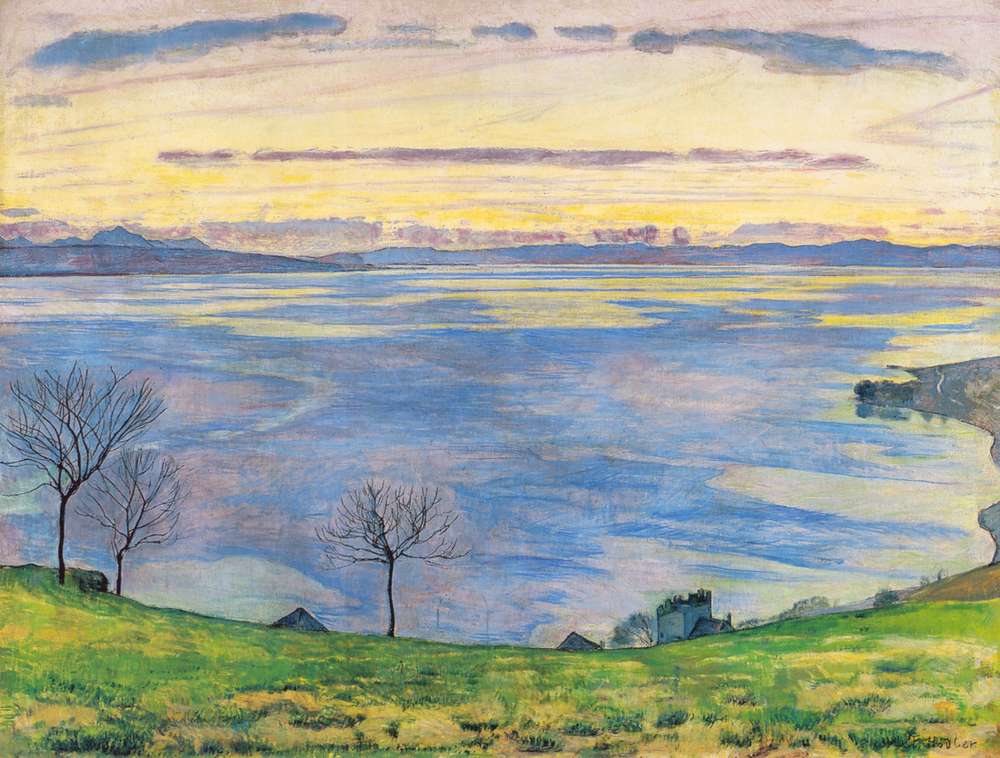
This was painted more than twenty years before the two views from Caux, from a different vantage point, and it is the more firmly anchored picture. Bare trees cut across the horizontal bands of water and evening sky. They fix a near viewpoint from which the distant light is seen, and they keep what might otherwise be stripes of colour tied to a particular spot. At Caux, Hodler lets the enclosing curve of the lake do that work instead.
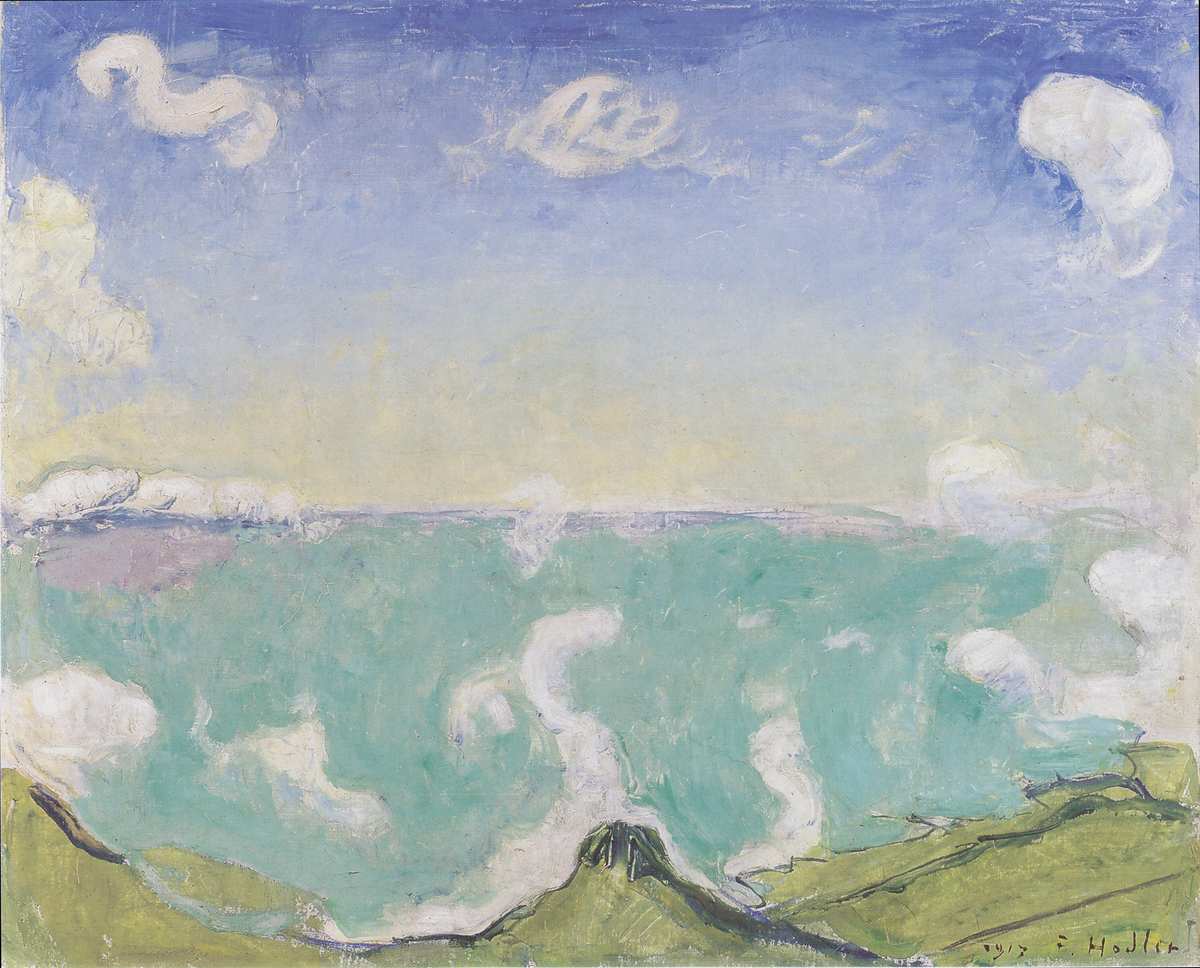
In the other Caux view, the cloud is a strip above the mountains. Here, as the title says, the clouds are the main event. They rise above the lake in broken shapes that loosely echo the curved line of the foreground without copying it. The echo ties near to far, while the ground stays solid and the clouds are plainly vapour.
Winckelmann's pen is still poised above the open book, but his head has turned away from the page, as if he has stopped in the middle of writing. The pen and book identify the scholar, and Kauffman paints him at the moment his attention leaves them.
What connects a fez, a cat, a tree and some distant industrial forms? The picture does not say. Each is painted with the same care, yet they never come together in one continuous, naturalistic space. Their scales do not match, and neither the tree nor the background is reconciled with the figure. Rousseau identifies Pierre Loti through an accumulation of objects and leaves the joins between them in plain view.
Venus lies asleep with her body exposed, while the satyr leans towards her and looks. Only he is aware of the encounter. Poussin makes this inequality plain through the contrast between the two bodies, the sleeper vulnerable and the satyr intent, and he leaves what happens next open. The satyr is not the only one looking.
Light falls in only a few places: an ageing face, two hands and a dark object held close to the chest. Together they emerge from the surrounding dark as one concentrated group. There is no narrative, no setting and no one else in the picture. With so little else lit, the face and hands have to carry it.
A circular form, broken into segments of colour, meets a dark vertical. One seems to rotate while the other stands firm, and bands of colour mark the point where they cross. The shapes are abstract, but the title calls this a meeting. Once told that, it is hard not to read them as two figures.
She faces forward, and a slight tilt of the head keeps the symmetry of the pose from stiffening. Modigliani gives the long neck and sloping shoulders in a few economical curves and leaves the colour around her rougher and less finished. There is no setting and there are no attributes, so everything rests on her posture and the shape of her head. The title makes her a servant, but the painting tells no story about her.
A trout lies across the near foreground with its mouth open and its body bent, and little else in the picture competes with it. The spotted skin is rendered closely enough to identify the fish, but Courbet gives at least as much weight to the physical fact of the animal: its heaviness and its presence. Seen this close, with so little around it, this is a single catch, not food laid out at a comfortable distance.
A woman bends towards a pool. Where her reflection might be expected, the water holds something else: a dark form. Everything around her is easy to read and pastorally calm, from the pale animals grazing nearby to the green slopes and the open air. The strangeness stays in the pool, yet it unsettles the whole scene. A title like Vanity leads us to expect a woman admiring herself. The painting does not settle what the water shows in place of her image, or what she makes of it.
The silhouette of the Parliament buildings survives the orange-red haze, though its edges are soft and partly dissolved. Reflections carry the colour down into the water. There the architecture is even less solid than above.
The models share the studio with an easel and a painted scene made from them, so the people in the picture have to be told apart from their painted versions. Segantini does not hide how the work was produced. He makes the making part of the subject.
Horses' limbs, raised arms and falling bodies collide, with almost no space between one action and the next. The title names a general condition, not a documented battle. Böcklin packs the bodies so tightly that the destruction is unmistakable, and he gives the viewer no safe distance from which to watch it.
This is a double portrait of Fuseli himself and Bodmer, but the bust of Homer is too large and too prominent to be a decorative reference behind their conversation. It shares the space with them almost as a third presence and seems to govern how the two men sit and address one another. The gesture that passes between them may acknowledge the ancient poet, or defer to him.
Costumes, gifts and faces crowd the panel around Mary and the Child. Each of the Magi has features of his own, something to bring and a place in the compressed space, even where bodies overlap and faces press close. Almost no empty space surrounds any single figure.
Ritz shows the church interior as a place of work. Small figures move through the building with their equipment. The large arch rising above them makes their presence among the old fabric they have come to examine look slight and temporary.
A flock of sheep moves from the shaded foreground towards the pale distance, and the eye travels with it. Tall trees enclose the near space, but an opening in the middle distance lets the view carry on beyond, in the direction the sheep and the evening light are already taking.
Explore this selection in Artline
See the selected works alongside books and events from their period, or compare when the artists lived. The books and events provide context, not evidence of direct influence. Works without confirmed dates remain in this guide.
Pictures in company
Some of these pictures are best seen together. Each of Segantini's paintings turns on an image that does not simply repeat its source. In My Models, painted figures stand beside the living ones, and in Vanity a pool fails to return a woman's reflection. Mondrian's canvas depicts nothing, while Itten's title asks us to look for figures among his shapes. Itten's Meeting also shares its year with Modigliani's Servant, and the two could hardly be further apart. Zünd draws the eye into depth through a gap in the trees. By contrast, Hodler at Caux compresses distance into a few broad areas of colour. Scholarship and the past run through several pictures as well: Kauffman's Winckelmann pausing over his book, Fuseli and Bodmer before Homer, and Ritz's archaeologists made small by the church they have come to examine.
Further reading
Wassily Kandinsky; translated by Michael Sadleir · Read free · English
In Michael Sadleir's English translation, Kandinsky's treatise argues that colour and form in painting are independent and carry spiritual and emotional force of their own. It is most useful read beside Mondrian's grid and Itten's Meeting. It also applies, more loosely, to Hodler's lake views, where simplified shapes and intervals do much of the describing.
 Art, literature & history