The collection of the Staatliche Kunsthalle Karlsruhe was shaped first by the interests of the rulers of Baden and then by public collecting. Its paintings include work by German, Dutch, Flemish and French artists.
The twenty chosen here run from two panels of Grünewald's Tauberbischofsheim Altarpiece to Kandinsky, Beckmann and Max Ernst. On the way there are portraits, landscapes and still lifes, as well as a Cupid stung for stealing honey, Böcklin's Poverty and Care given human form, Rubens's founding of Constantinople and Winterhalter's company of listeners in a garden. Some have been admired for generations; others are less likely to turn up in a survey of art history. Two places appear twice: Rouen, painted by Monet and by Pissarro, and Karlsruhe itself, in two views by Carl Kuntz.
Artline chose these works from the museum's documented holdings, independently of the museum. Any of them may be on loan or off display. Dates and attributions keep the qualifications given in the collection records.
1927 · Oil on canvas · Staatliche Kunsthalle Karlsruhe
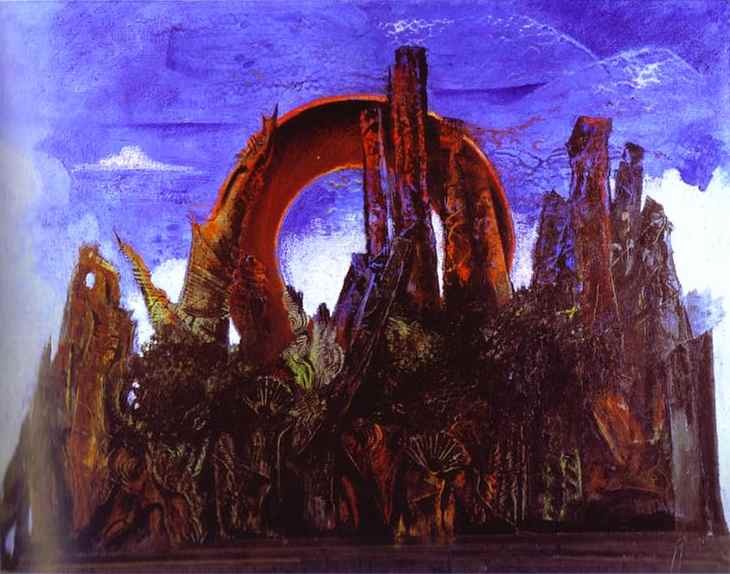
Ernst builds his forest by repetition. There are enough upright forms across the canvas for them to read as trunks, yet their dense, jagged surfaces look just as much like rough construction, and none of them becomes a comfortably familiar tree. Overhead, a red arc works at a scale quite unlike anything beneath it.
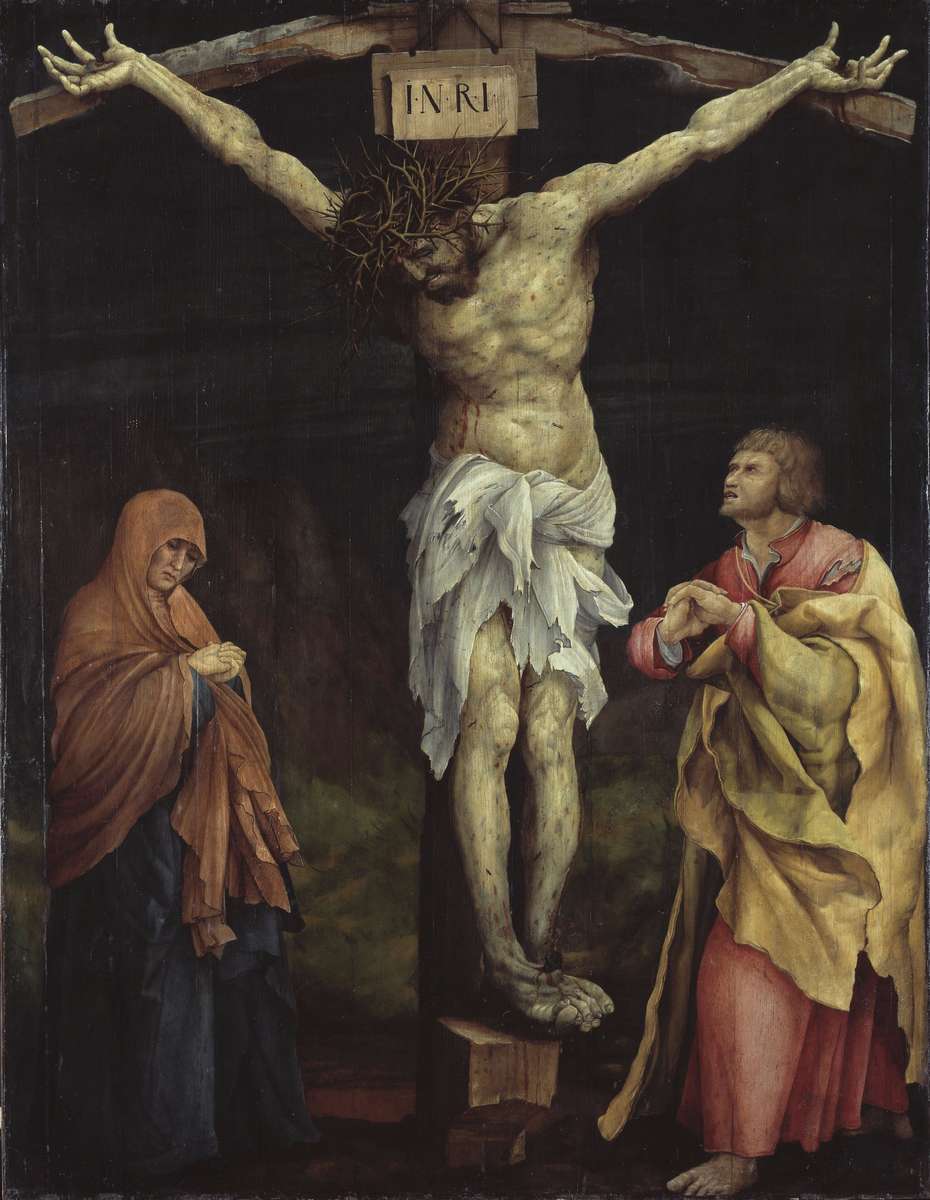
Grünewald gives Christ's body almost nothing to compete with. There is no elaborate setting, only a confined, dark space, and the figure's strained outline and bodily detail carry the severity of the scene. Below, Mary and John respond by gesture alone. With so little else in view, the outstretched arms and the positions of the two mourners are hard to overlook.
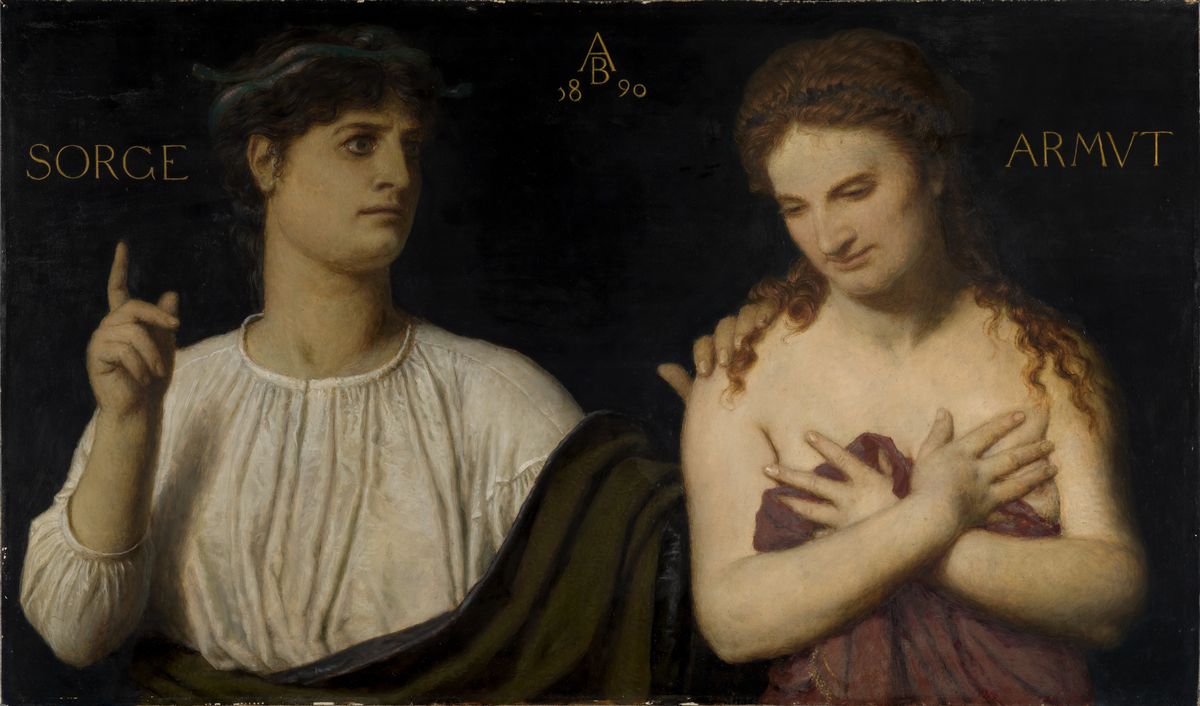
Two women are paired closely. One raises a finger and the other folds her arms. Without the names Poverty and Care they might pass for unnamed sitters. Böcklin has given abstract conditions human form, but a raised finger and folded arms are ordinary, particular gestures, and the labels never quite absorb them.
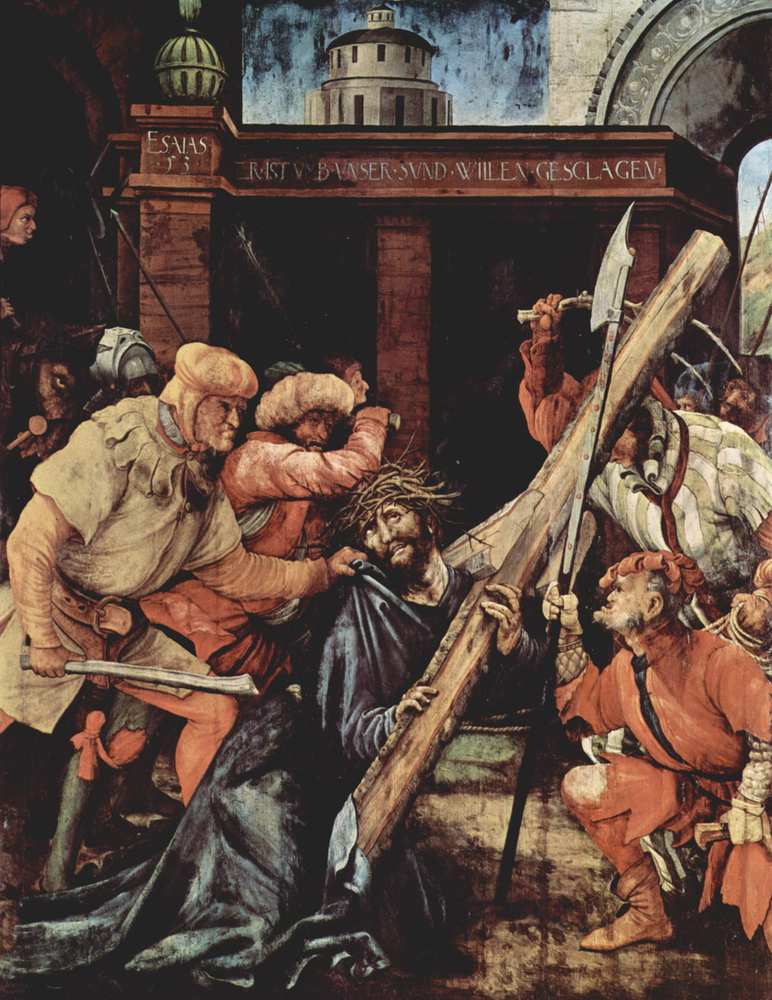
Christ's bent body has to make its way through a space already taken up by other people and by the huge weight of the cross. The diagonal timber is both burden and obstacle. It cuts through the crowded group beneath an architectural opening and keeps the figures from separating easily.
The Crucifixion from the same altarpiece leaves its figures in a sparse, dark space. Here suffering is congested and on the move.
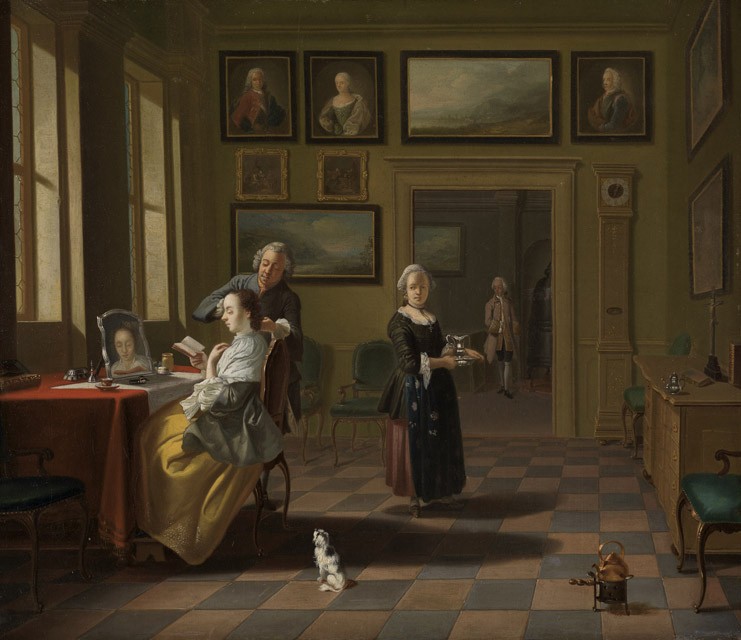
Pictures already hang on the walls of Juncker's room before a mirror adds one more image to them, and tiles and furniture fill out the rest. The seated woman is placed firmly among these things, busy with the everyday grooming that the title calls her morning toilet.
If you look for a scene, the painting offers hints of one: a contour that might be a body, another that might be terrain. They never come together into anything dependable. Meanwhile the coloured patches and crossing black marks set up relationships of their own, and the picture holds together whether or not any area is identified as an object.
A still life is not supposed to contain events, yet Beckmann's title names one. The fallen candle lies as a horizontal break among objects crowded into a compressed space, and strong contours insist on how close together everything is. Drapery and a framed surface add further layers without opening up any room between them.
c. 1877 · Oil on canvas · Staatliche Kunsthalle Karlsruhe
Madame Jeantaud's extended arm draws the sofa into the pose, so the furniture has a real say in how she occupies the picture. Her dark clothing rises against its pale surface, while her hat and upright torso pull in another direction. Nothing overt happens. Whatever movement Degas finds lies in that asymmetry.
The title identifies the three sisters only through their father, Julius Johann von Vieth und Golssenau. Graff avoids the regularity of three portraits lined up side by side. He draws them into a compact group, linked by hands and inclined heads, and small differences of tilt and contact keep each one distinct. Against the dark background their pale faces form a single close outline.
1824 · Oil on canvas · Staatliche Kunsthalle Karlsruhe
A sharp silhouette rises in the distance above low, spreading rocks and pools. That contrast of vertical and horizontal is very nearly the whole drama. No figure stands on the shore whose reaction might set the mood, and Friedrich leaves these relations exposed beneath a violet-blue sky.
For a view of a city, this gives the city surprisingly little room. Kuntz approaches Karlsruhe across fields, with animals in the foreground and no architectural landmark close at hand. Tall trees and a broad sky make the town one part of a wider worked landscape, and farming takes up a large share of the picture.
Here the palace is the destination and the garden is the way in. Lawns, trees and small groups of animals soften the approach. The formal architecture stays distinct and organises the whole view from the far side of open grounds, which leaves the foreground to the garden.
1883-1885 · Oil on canvas · Staatliche Kunsthalle Karlsruhe
Trees and sloping ground stand between the viewer and the water. Cézanne gives these near forms real structural weight through adjoining areas of green, blue and ochre, and the sea takes its place within the same arrangement. Depth here is built from colour relationships as much as from recognisable objects.
1896 · Oil on canvas · Staatliche Kunsthalle Karlsruhe
From Pissarro's raised viewpoint, the connections made by the bridges are easier to follow than they would be at street level. Small figures, vehicles and river traffic keep the structure busy under a heavy sky. The rain weighs on the working city without dissolving its routes.
1874 · Oil on canvas · Staatliche Kunsthalle Karlsruhe
The masts are the fixed points, firm verticals against broken water and sky. In the river below, short marks make the reflections less stable than the boats they echo, and Monet holds the port together through that difference.
Cupid has the honeycomb, and the bees have found Cupid. His lifted hand turns his small body into an image of discomfort, and the picture confines the episode to a narrow space where little else happens. The moral about desire gets its point from the choice of victim: Cupid himself pays for the sweetness, and the price is a physical one.
The work is listed under Cranach, but its image credit names the workshop of Lucas Cranach the Elder or a copy after him, so whose hand painted it remains an open question.
Winterhalter gathers a company in a garden to tell stories, and much of the picture goes to the listeners. Their varied poses and elaborate clothes make them as conspicuous as any speaker, and the garden setting suits their shared leisure.
Modersohn-Becker gives the fruit solid volume with simplified colour and does not catalogue its surface detail. The rounded forms sit close to pale cloth and a dish on the tabletop, and their weight comes from how the shapes relate to one another.
c. 1622-1623 · Oil on oak · Staatliche Kunsthalle Karlsruhe
Rubens condenses a city's foundation into one coordinated group. The ruler's gesture links command to the work of construction, and the other figures carry the action across the panel beneath a broad sky, with an eagle above. The ruler's costume marks him out, and so does the way all this activity seems to take its direction from him.
1890 · Oil on canvas · Staatliche Kunsthalle Karlsruhe
Bare trunks cut across the coloured houses and divide the narrow gaps where small figures appear. Gauguin, like Cézanne at L'Estaque, lets trees stand in front of his subject and builds the obstruction into the design. Here it becomes a pattern of interlocking surfaces, in which foreground and buildings press together into one arrangement of colour. The village is still recognisable, but deep, continuous space is no longer the only aim.
Explore this selection in Artline
See the selected works alongside books and events from their period, or compare when the artists lived. The books and events provide context, not evidence of direct influence. Works without confirmed dates remain in this guide.
Rouen and Karlsruhe, twice each
Two painters made the Rouen pictures, and they hardly seem to be looking at the same city. Monet's is a port of masts and unsteady water. Pissarro looks down from a height in the rain and sees a network of routes, with bridges, figures, vehicles and river traffic all in play. Kuntz painted both Karlsruhe views, and they have more in common than their two destinations suggest. One reaches the town across farmland and the other reaches the palace through its garden. Yet architecture fills the foreground in neither, both approach across open ground, and animals appear in each.
Further reading
Wassily Kandinsky; translated by Michael Sadleir · Read free · English
Kandinsky's own statement of his aims, in Michael Sadleir's English translation. He argues for a search for meaning in colour and in form that need not depict objects. Improvisation 13 is the only painting by him in this selection, so it is the place to see whether the argument holds up in paint.
 Art, literature & history