Twenty paintings from the Hungarian National Gallery, from the history pictures of Madarász and Munkácsy to Szinyei Merse in the open air, portraits by Ferenczy and Rippl-Rónai, and Derkovits's Bridge Builders.
The Hungarian National Gallery is in Buda Castle in Budapest and is devoted to art made in Hungary and by Hungarian artists. Its collection follows Hungarian painting from earlier centuries into the modern period, and alongside grand history, portraiture and landscape it makes room for scenes of everyday life.
The twenty paintings chosen here cover that range. History comes from Viktor Madarász and from Mihály Munkácsy's battlefield at Isaszeg, while Simon Hollósy contributes a study of an advancing crowd. Munkácsy also supplies the opposite extreme: one woman at a collection box. Every one of Pál Szinyei Merse's pictures here is set out of doors, whether a picnic, a balloon, a meadow of poppies or a lady in violet against a landscape. Károly Ferenczy and József Rippl-Rónai contribute portraits and self-portraits, and Ferenczy's include his own children. László Paál paints a village road and the inside of a forest, and Lajos Gulácsy paints literary and fantastical encounters. The latest picture, Gyula Derkovits's Bridge Builders, turns to industrial labour.
Artline chose these works from the museum's documented holdings, independently of the museum, and individual works may be on loan or off display. Dates and attributions follow the linked records and keep their qualifications.
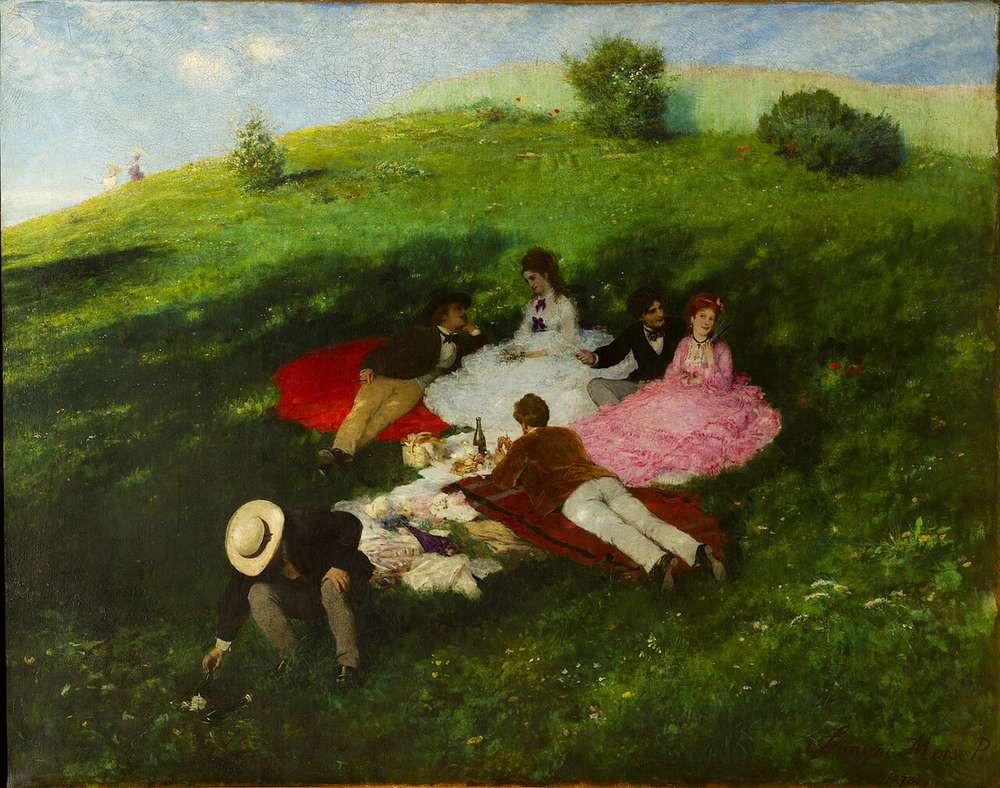
A party has settled round a white cloth in the open air, and nobody is posing. Some are busy with the food, others with conversation or their own thoughts, and they make no formal ring. That ease was carefully made. Szinyei Merse holds the afternoon together through the gaps between the figures and the objects scattered on the cloth.
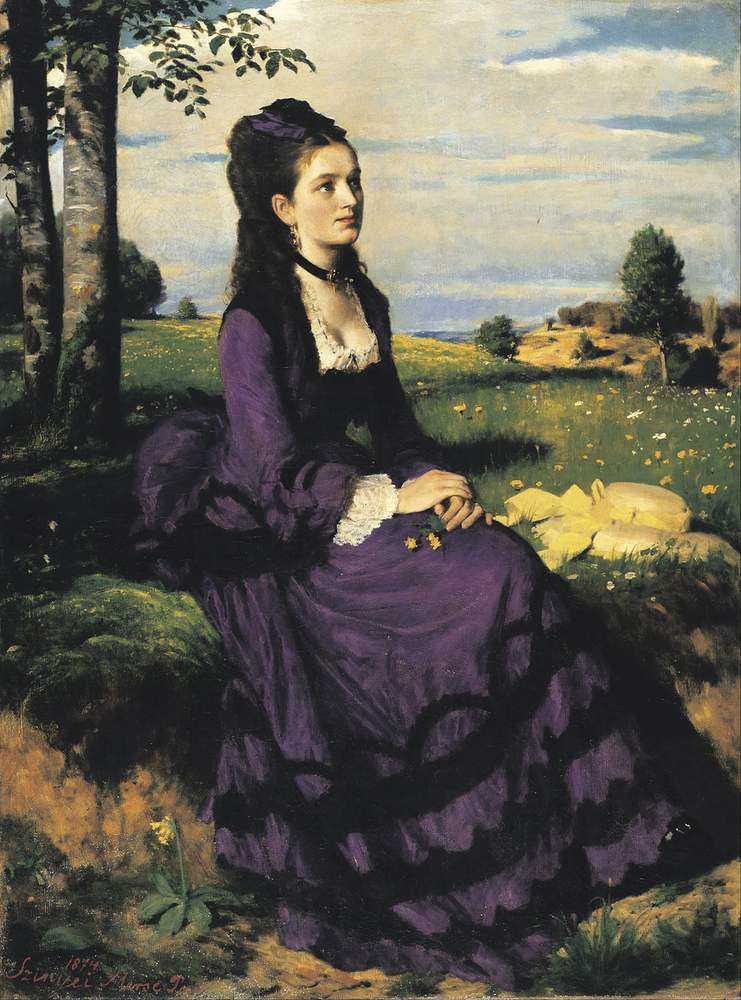
The title does not name her. It identifies her by her dress, and the painting gives the dress much of the work. The violet fills a large part of the canvas, and its dark folds bring the figure forward from a landscape of green and gold. The colour sets her apart from that background while staying closely related to it. Szinyei Merse builds the portrait partly out of costume, and the shape the dress gives her body counts for as much as her face.
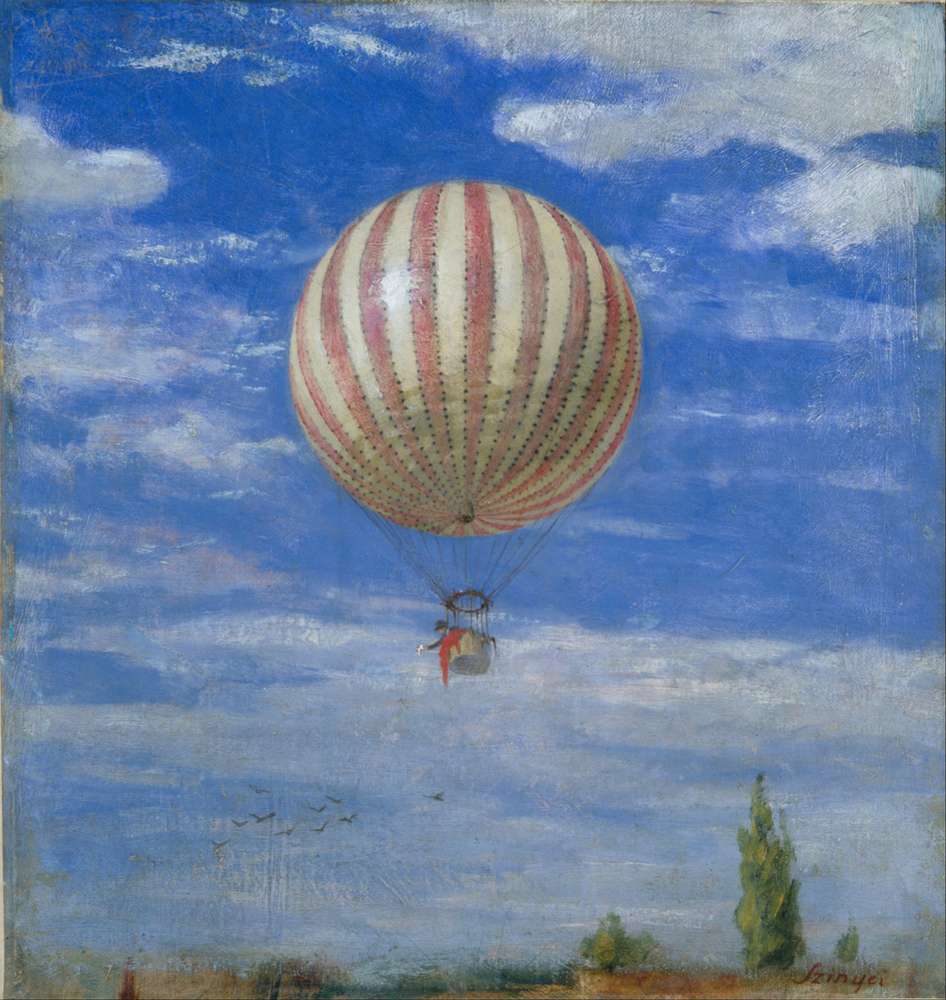
Szinyei Merse gives the sky, usually the backdrop of a landscape, to a striped balloon. It fills the sky, and the stripes make the rounded envelope clear against the blue. The basket hanging beneath gives a sense of the height, while the land shrinks to a narrow strip below. The whole weight of the picture shifts upwards.
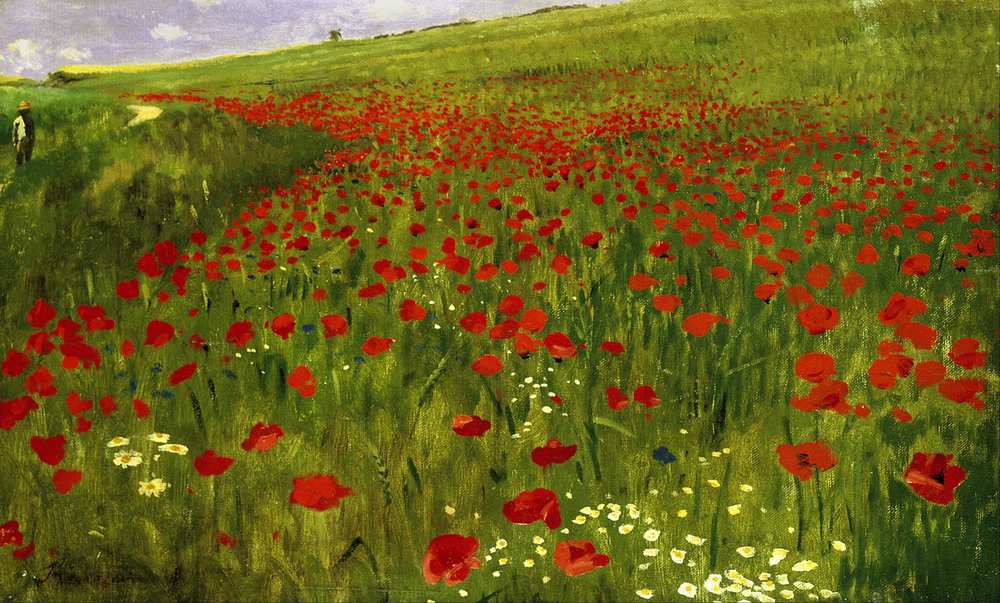
Szinyei Merse's latest picture in this selection has the plainest subject. Each red touch could be a single poppy or part of a pattern spreading through the green, and he leaves both readings open. The horizon is narrow, so the meadow itself holds the attention.
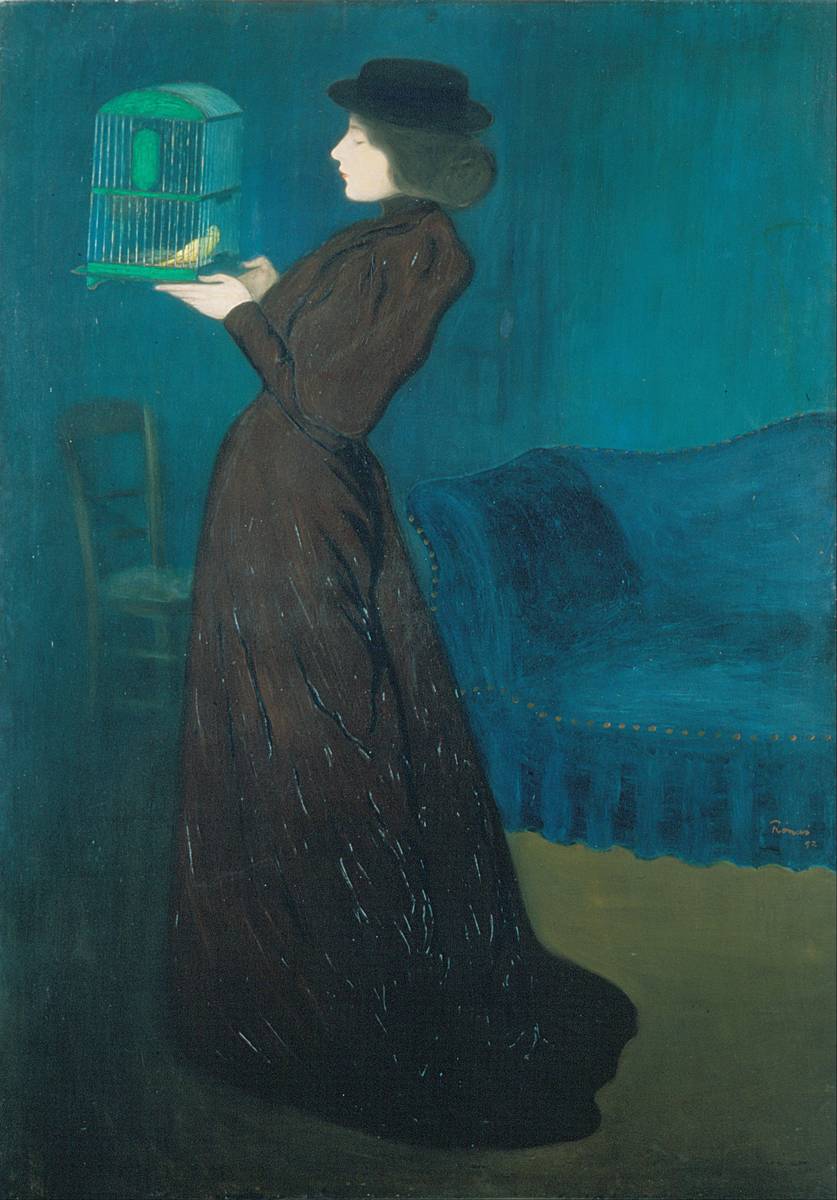
The woman is a long dark silhouette in a blue-green room, and the only thing that breaks her outline is the small cage she holds. Why a cage? Rippl-Rónai offers no anecdote. He keeps the room plain enough for that one object to change the whole arrangement, and builds the picture from the upright body, the hands and the suspended cage.
Rippl-Rónai painted himself in front of a wall crowded with pictures, which places the likeness firmly within his profession: a painter among pictures. The brown hat of the title sits above a turned face, and a grey coat spreads across the foreground as a broad area beneath them. The crowded wall was chosen as part of the self-portrait.
Most of Ferenczy's pictures in this selection keep people at close quarters. Here the person is small: a dark figure standing where shaded vegetation meets clear sky, with the landscape dominant. The open space around the figure keeps it distinct, and its smallness gives the measure of the view.
Béni and Noémi share a blue surround but not a pose. A raised arm and joined hands give them different postures, and neither mirrors the other. Ferenczy connects them while keeping their actions distinct, so the picture is read across the space between them as well as face by face, and never settles into two matching likenesses in a single frame.
Here Ferenczy shows himself at work. His raised hand points towards something beyond the edge of the canvas, and whatever he is considering stays out of view. Painting equipment identifies the studio. A few years earlier, Rippl-Rónai had placed himself against a wall of pictures. Ferenczy shows the activity itself, and the working gesture keeps the picture from settling into a conventional portrait.
The three children are grouped close together, yet each turns in a different direction, and they are not made to look outwards together. Flowers and a curtain help to organise the group. As in the double portrait of Béni and Noémi, being close does not mean sharing a pose.
Everything gathers at the narrow gap where the figures' heads almost meet. Around them is a richly patterned setting, but Gulácsy withholds the usual clues to space, so the garden is hard to map, and costume and gesture have to carry the relationship. That the figures are close is clear. Where they are, and what has brought them together, is not, which seems apt for a garden that the title gives to a magician.
The title promises a meeting, and Gulácsy paints the moment before it. A path and some trees still separate the figure in red from the approaching women. It makes an instructive pair with The Magician's Garden, painted at about the same time, where the figures' heads almost touch. In this picture the distance has not yet been crossed.
Paál gives the picture to a road. Reddish and ordinary, it links houses, trees and scattered figures, with no grand view beyond. The warm ground and the upright autumn trees pull the eye in different directions, and between them the village gains depth and continuity without a single focal point.
Where The Road to Berzova opens out along a village route, this picture closes in. Tall trunks gather round a pale opening, and the wood becomes something like an interior lit from far off. The repeated verticals give order without uniformity, since growth stays uneven and the foliage is dark. The opening hints at a way through, but the enclosing trees fill most of the view.
For a battlefield picture, it is notably short of heroes. Small figures and animals are scattered across a wide, darkening landscape, and the ground runs on well beyond any single action. Broken light picks out activity here and there, but no dominant figure draws the event together, and the field is hard to take in at once.
A woman reaches towards a collection box fixed to the wall, and that is the whole action. Munkácsy isolates her in a dim interior and lets the light fall on her face and clothing. The gesture tells us she is giving, and nothing in the picture explains what moves her to it.
The title promises a people, and Madarász shows them as a group defined by effort. The figures strain around a raised body and a tall support, and bent limbs, cloth and lifted arms show how difficult the body is to handle. The suffering is given a physical structure before any one face stands out. What holds the group together is the task in hand more than any shared expression.
The woman and child stand. The men facing them have the seats, the arms and the ceremonial apparatus of the room. Madarász conveys institutional power through how space and objects are shared out as well as through faces. Standing upright sets the pair apart, but it also exposes how unequal their position is, since they have so few means of occupying the room.
Because this is a study for The Rákóczi March, its unevenness is part of the interest. Some faces already stand out from the advancing crowd while others are still rough marks, yet the movement of the whole group is settled. You can see the arrangement still being put together: the crowd moves as one before its members have become individuals.
Pale beams cut across workers in orange above blue water. Derkovits fits the people and the structure they are building into one tight network of edges, and the same divisions organise both, so the labour cannot be separated from the bridge.
Explore this selection in Artline
See the selected works alongside books and events from their period, or compare when the artists lived. The books and events provide context, not evidence of direct influence. Works without confirmed dates remain in this guide.
What holds a group together
Many of these pictures turn on what binds several people together, and the answer changes with the subject. In the room where Ilona Zrínyi faces her judge, people are sorted by power. Among Dózsa's people the bond is shared physical effort, and in Hollósy's study it is the forward push of a crowd. Szinyei Merse lets his picnic party hang together loosely. Ferenczy keeps Béni and Noémi, and his children, close while giving each a posture of their own, and Derkovits binds his workers tightest of all, into the framework of the bridge. Against these stand the solitary figures: Munkácsy's woman at the collection box, Rippl-Rónai's woman with her cage, the small figure on Ferenczy's hilltop. In those pictures a single gesture, an object or simply open space does the organising that a group does elsewhere.
Harold Speed's book is a general guide to drawing, not a study of Hungarian painting. It offers a working vocabulary for how figures, masses and colour are organised in a picture. That vocabulary can be tried out on these pictures, from the placing of Ferenczy's sitters to Derkovits's tight arrangement of workers and steel.
 Art, literature & history