The J. Paul Getty Museum in Los Angeles is known for its European paintings, drawings and sculpture. The twenty paintings chosen here run all the way from Carpaccio's hunters on a lagoon to Monet's wheatstacks in snow, and portraits make up a large share of them. Some follow the conventions of rank closely: Titian's Alfonso d'Avalos in armour, Van Dyck's Agostino Pallavicini in a sweep of red, Goya's Marquesa de Santiago in her mantilla. In others Rembrandt laughs and Ducreux yawns, and Khnopff's Jeanne Kéfer is dwarfed by a set of pale doors. Around them are pictures built on a story or an occasion: Noah's animals approaching the ark, a street hung with flags for a national holiday, Ensor's crowd of masks and banners, musicians coming to blows, a girl fending off Cupid. The rest don't fit any group: those wheatstacks, a hare that Hoffmann treats as seriously as any sitter, and Chardin's goblet, fruit and walnuts.
Artline chose these works from documented holdings, independently of the museum. A painting's place in the collection does not guarantee that it is on view. Dates and attributions keep the qualifications given in the linked records.
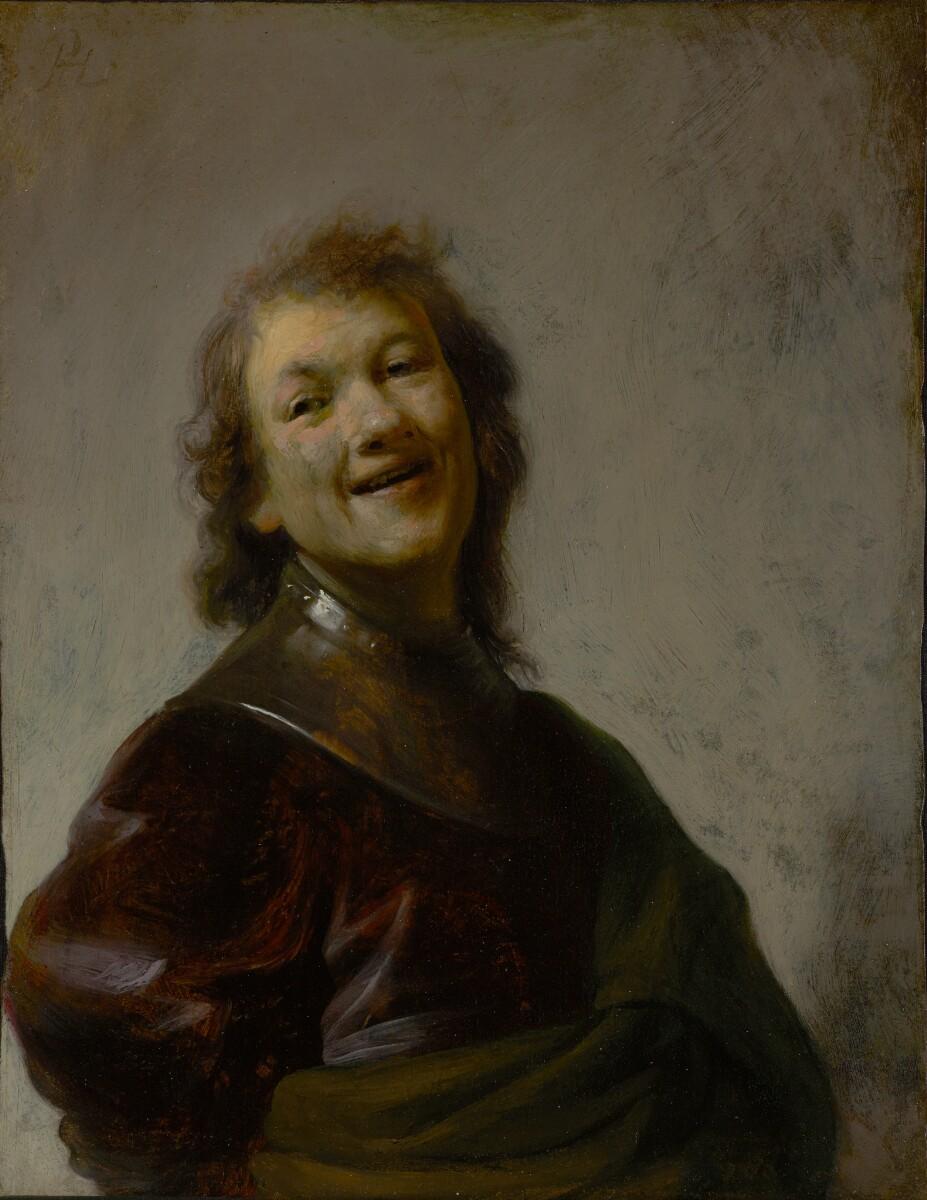
Rembrandt tips his head back and laughs, an expression that would have no place in a formal portrait. He painted it in loose strokes on a small copper plate. The format is modest, and it suits an experiment with a movement of the face that lasts only a moment.
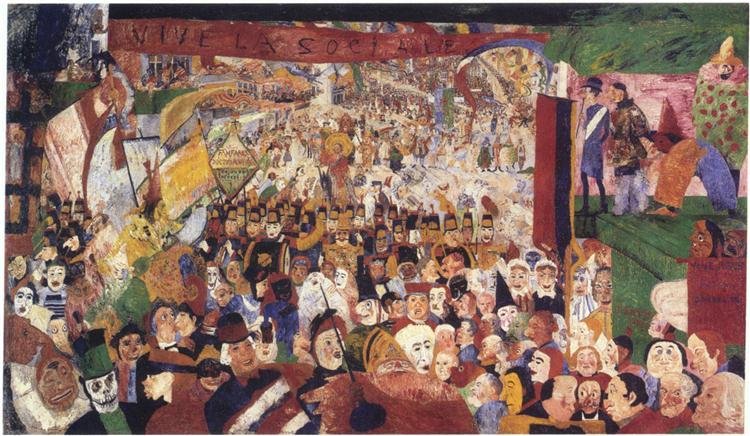
Where is Christ? The title announces his entry, but he is hard to find among the banners and insistent faces pushing forward. Ensor painted the picture in 1888 but set the event in 1889, as though the procession had not yet happened. The crowd seems more interested in its own spectacle than in the arrival it has supposedly turned out for. Some of the faces are plainly masks. With others it is hard to say where the disguise ends and the real features begin.
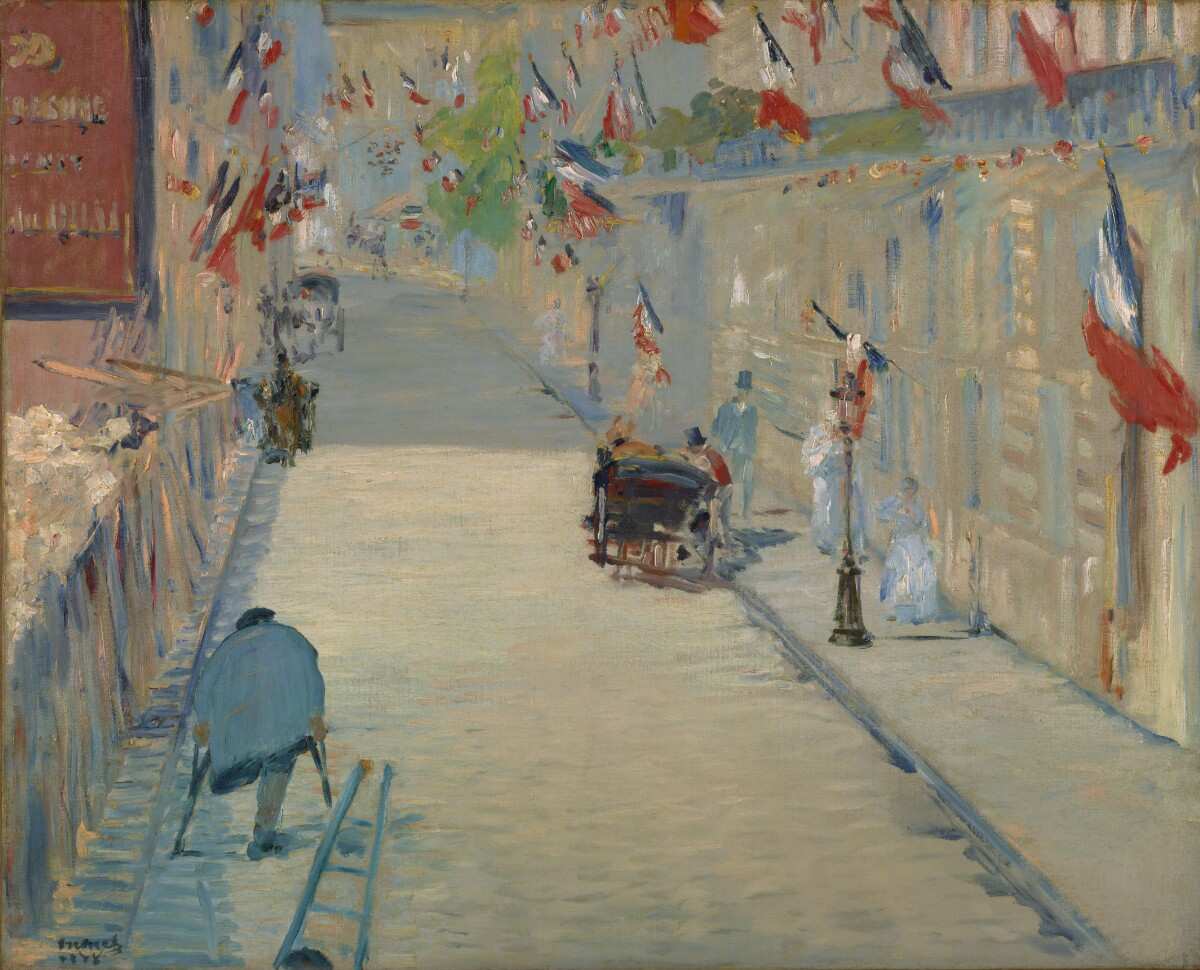
The flags are out for a public celebration, which the Getty identifies as the national holiday of 30 June 1878. At the near edge, though, Manet places an amputee on crutches, and with him there it is harder to see the street as a scene of untroubled festivity. He may have been a veteran, but the painting gives no way of knowing.
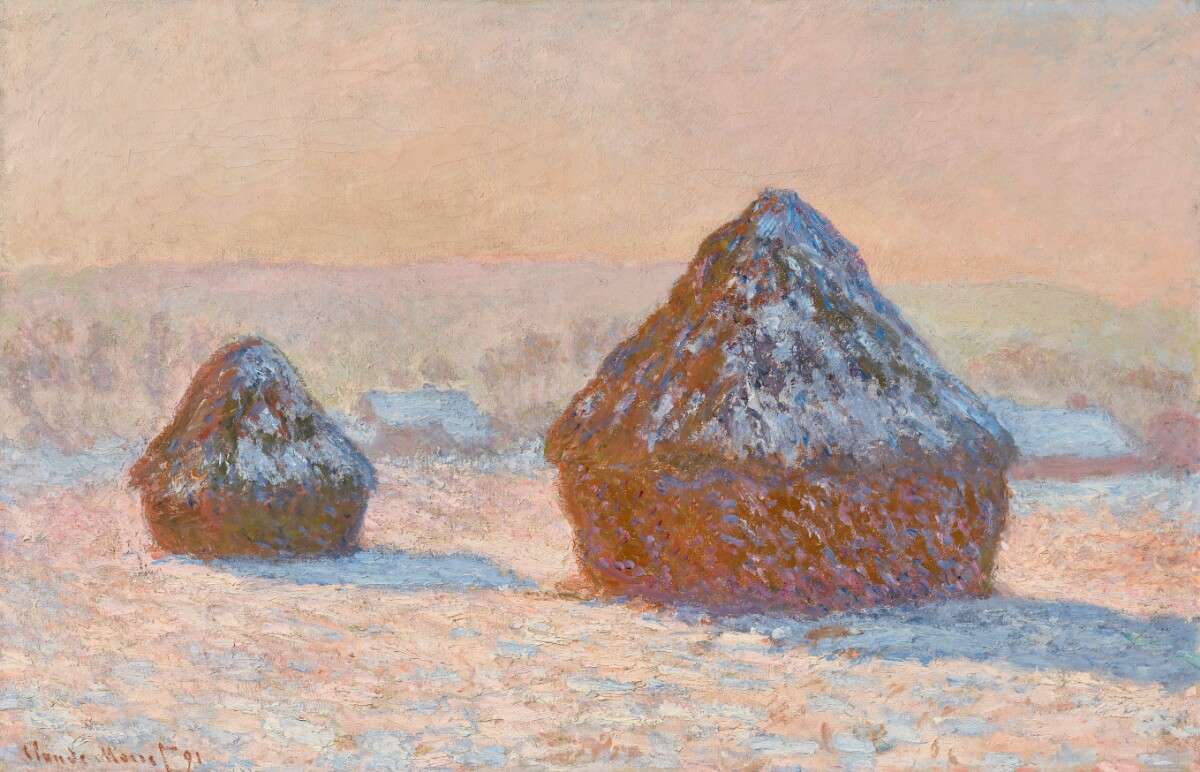
Monet returned to the wheatstacks many times, in different seasons and at different times of day. Their fixed shapes gave him a constant against which to measure changing light. On this snowy morning the stacks stay dark and solid, while blue and pink shadows spread across the ground around them.
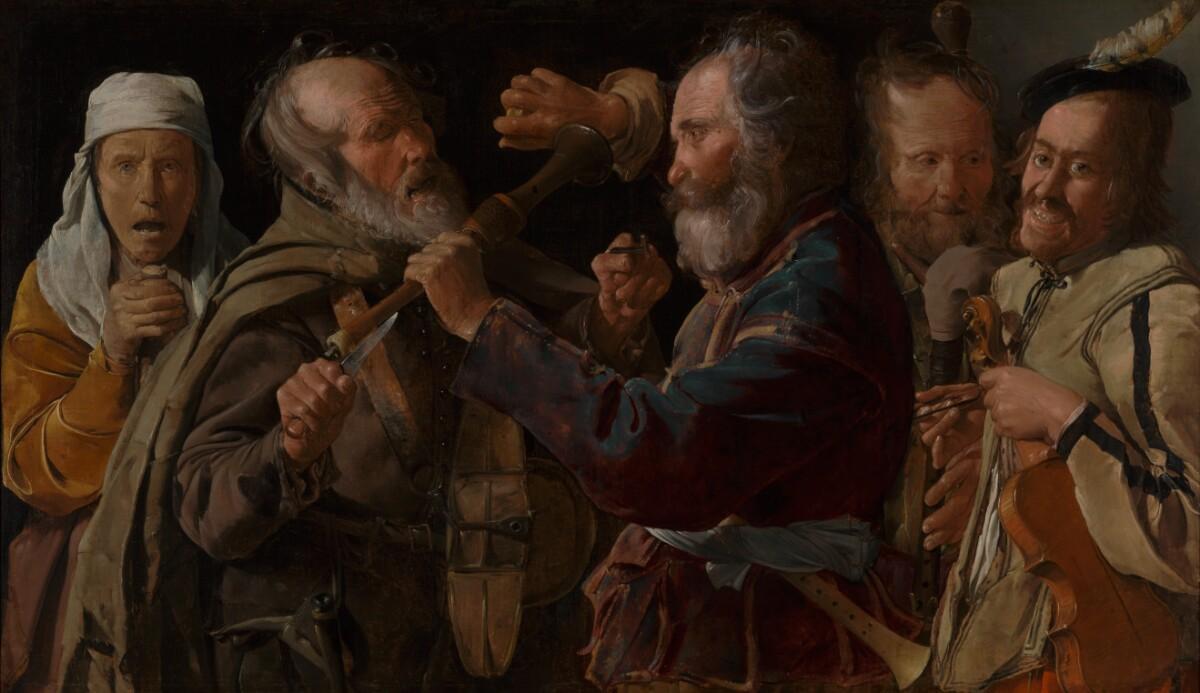
A group of musicians has come to blows. La Tour packs them so tightly that there is hardly any room around the quarrel, so faces, shoving hands and tangled bodies are left to explain what has gone wrong. The instruments are still in the thick of it, a reminder of the music these players might have been making together.
A shared letter brings someone else into this double portrait without showing them. Whoever wrote it, or whoever it is meant for, is somewhere outside the frame. David seats Zénaïde and Charlotte close together with the sheet between them, and their contrasting dresses keep the two sisters distinct even though the pose joins them so closely.
The yawn takes over Ducreux's whole upper body. His outstretched arms pull at his coat, and his open mouth drops all the composure expected of a portrait sitter. A yawn is involuntary, but making one the subject of a self-portrait is not. Ducreux chose to present himself at the very moment when dignified control seems to slip.
Leonilla does not sit upright in a chair. She reclines across a furnished terrace, and Winterhalter spreads light over her pale dress and surrounds her with drapery, plants and a view into the distance. What announces her rank is less her face than everything around it: the terrace, its furnishings and the ease with which she lies among them.
Maria Frederike holds a small dog among carefully arranged ribbons, a bonnet and fur. Pastel lets Liotard tell each of these textures apart, and he gives her turned face the same close attention. The formal dress decides how she is presented. The dog adds a living weight in her hands.
Titian gives the armour real substance as an object: light falls on its curved metal quite differently from the way it falls on Alfonso d'Avalos's face. Beside him Titian places a smaller page. In this picture authority means having someone to attend you as well as owning the equipment, and the difference in size between the two makes the hierarchy plain before any biography is read.
A red garment spreads across much of the lower canvas, almost like a piece of architecture built around the sitter. Van Dyck sets Agostino Pallavicini's pale face and hands above all that ceremonial weight. The costume governs how his body fills the space, and it declares him the holder of an office.
The hare holds the place a principal figure would normally occupy. Hoffmann's close attention does not stop there, though. The leaves, bark and smaller creatures around it are observed just as carefully, and no part of the forest is left as mere backdrop.
Hoffmann gives a whole panel to one hare. Here the story of Noah's ark gives Jan Brueghel the Elder a reason to bring many species into one place, all heading for the same destination, a gathering no one could have seen in life. He spreads them across trees and open ground, where their different bodies can be compared.
A woman reclines, displayed above a crowd of onlookers, and it is their attention that gives her a role in the scene. Cézanne's abrupt colour and awkward drawing take any polish or elegance out of the arrangement. Anyone coming from Bouguereau's smooth finish will feel the difference at once. The title reaches for something universal. The canvas shows something particular and rather uncomfortable: one exposed figure and many observers, whose looking is as much the subject as her body.
Carpaccio spreads his boats across open water so that the small actions in them do not block one another. Figures stand and take aim at birds, and poles and the low horizon mark out distances across the lagoon. For a hunt it is remarkably calm: a set of separate activities, none of them building to a decisive moment.
The large pale doors behind Jeanne Kéfer make a small girl look smaller still. Khnopff places her precisely against their nearly empty surface, with one hand drawn towards her chest. Almost nothing else in the picture holds the eye, so her stillness and that single gesture carry the portrait.
The Marquesa wears a dark dress and a pale mantilla, the lace or silk veil worn over the head and shoulders. Goya shows her full-length against a landscape, dressed for a formal public appearance, so her standing needs no explaining. The face is another matter. It is clearly one particular person's face.
about 1818–1819 · Oil on canvas · J. Paul Getty Museum
Géricault concentrates light on the forehead, cheek and open collar and sets the turned head against darkness. This is a working study, yet the title keeps the model's name, Joseph, and the painting treats him as an individual, not as an anonymous type.
The Love of the title is the winged child the girl is holding off with her arms. He is Cupid, which makes the struggle an allegory instead of a scene from life. Bouguereau's smooth finish keeps the crossing limbs and drapery easy to follow. Next to La Tour's brawling musicians this is hardly a fight at all. The playfulness comes from a carefully controlled contest of gestures.
about 1759–1760 · Oil on canvas · J. Paul Getty Museum
On a ledge, Chardin sets a silver goblet beside peaches, grapes and walnuts in their hard shells. This is far from a display of abundance. With so few objects and such restrained colour, small differences count for a great deal: metal against soft fruit, soft fruit against shell. Grapes trail towards the edge and loosen an arrangement that might otherwise have looked static.
Explore this selection in Artline
See the selected works alongside books and events from their period, or compare when the artists lived. The books and events provide context, not evidence of direct influence. Works without confirmed dates remain in this guide.
Dress, setting and the face
Many of these portraits do their work through what surrounds the face: Van Dyck's red robe, the terrace around Leonilla, the page at Alfonso d'Avalos's side, the ribbons and fur on Liotard's child, the letter shared by Zénaïde and Charlotte. Rembrandt's laugh and Ducreux's yawn seem to do without such props. They are staged too, but through face and body instead of possessions and office. Khnopff's Jeanne Kéfer is the odd case, because its setting stands out precisely for having so little in it.
Further reading
Walter Liedtke · Read online or download · English
Walter Liedtke's two-volume catalogue of the Metropolitan Museum's Dutch paintings can be read online or downloaded. It offers detailed comparisons for Rembrandt and for the way Dutch painters handled faces, interiors and still-life objects. Because it covers only the Met's Dutch pictures, here it is mainly useful for Rembrandt Laughing.
 Art, literature & history