The Germanisches Nationalmuseum in Nuremberg is a museum of cultural history as well as an art collection. Its paintings belong to a much larger account of life in German-speaking Europe, and they share the galleries with furniture, sculpture, applied arts and historical documents. In that company it is easier to see what a portrait or a religious picture was first made to do.
The twenty paintings chosen here run from Konrad Witz's Annunciation to Max Oppenheimer's Rosé Quartet. Dürer appears three times, with a Hercules, a portrait of Michael Wolgemut and one of the emperor Maximilian I. Cranach and Baldung appear twice each. Alongside the religious subjects and portraits, among them Luther in his Augustinian habit, there is a view of Nuremberg's own main market, a fool with a needle, a company of actors waiting offstage and an older girl carrying a younger child on her back. Towards the end of the range, Macke and Jawlensky loosen colour from natural appearance.
The selection was made independently of the museum. Dates and attributions follow the linked records, including their qualifications.
1500 · Tüchlein painting on plain-weave linen · Germanisches Nationalmuseum
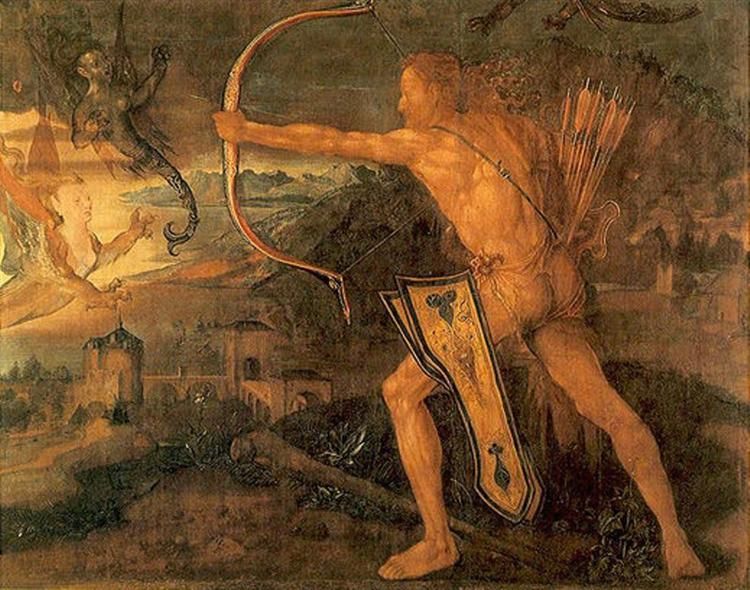
Hercules has turned much of his back to us as he twists to draw the bow, so the effort has to be read in his shoulders, back and arms. The face hardly comes into it. The muscles pull against one another, and the outstretched arms set the line of the shot. The Stymphalian birds are there because the legend calls for them, but Dürer seems far more absorbed in how a body holds such a strain. The Wolgemut portrait is on wood, but this is a Tüchlein, a painting on cloth, in this case plain-weave linen.
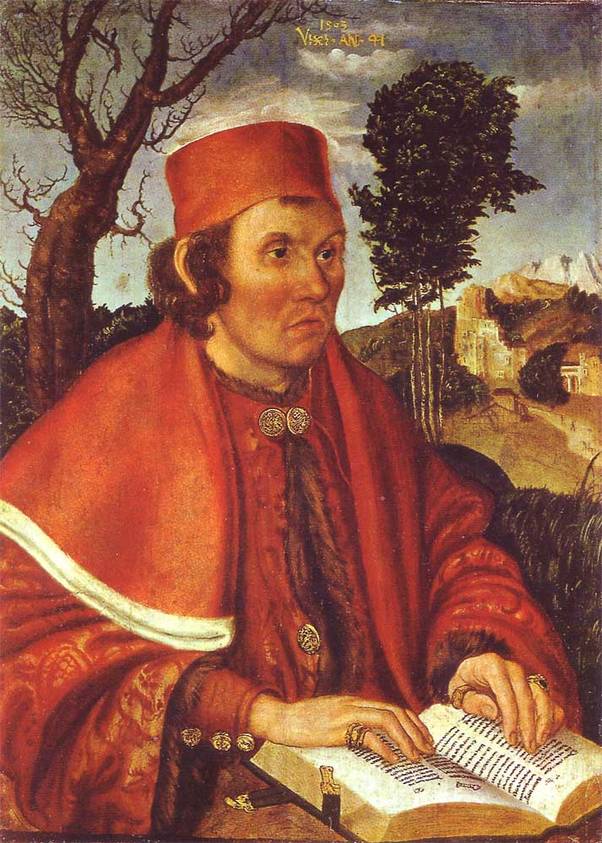
Reuss holds an open book, which brings his hands into the portrait on almost equal terms with his face. A red cap and red robe carry the colour from head to body, and trees frame his face against the landscape behind. Cranach's later Luther, elsewhere in this selection, has a book too, but there it goes with a monastic habit and marks a religious identity. Here it keeps company with a red robe and open country.
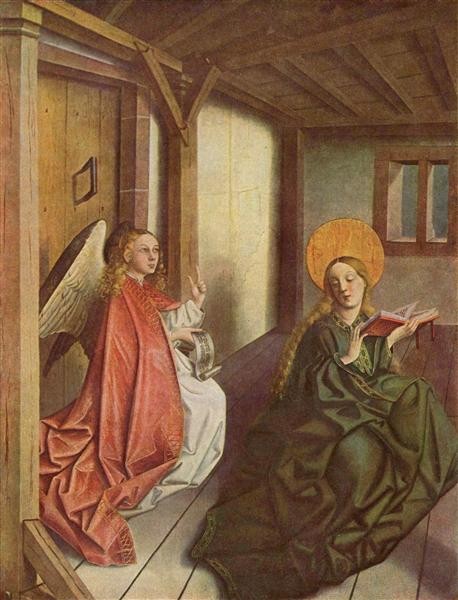
The earliest picture here sets the Annunciation in a timber room with a low ceiling, and nothing is done to make the room grander for the occasion. Walls and heavy folds of cloth press in on the angel and Mary, who are left with barely enough space between them.
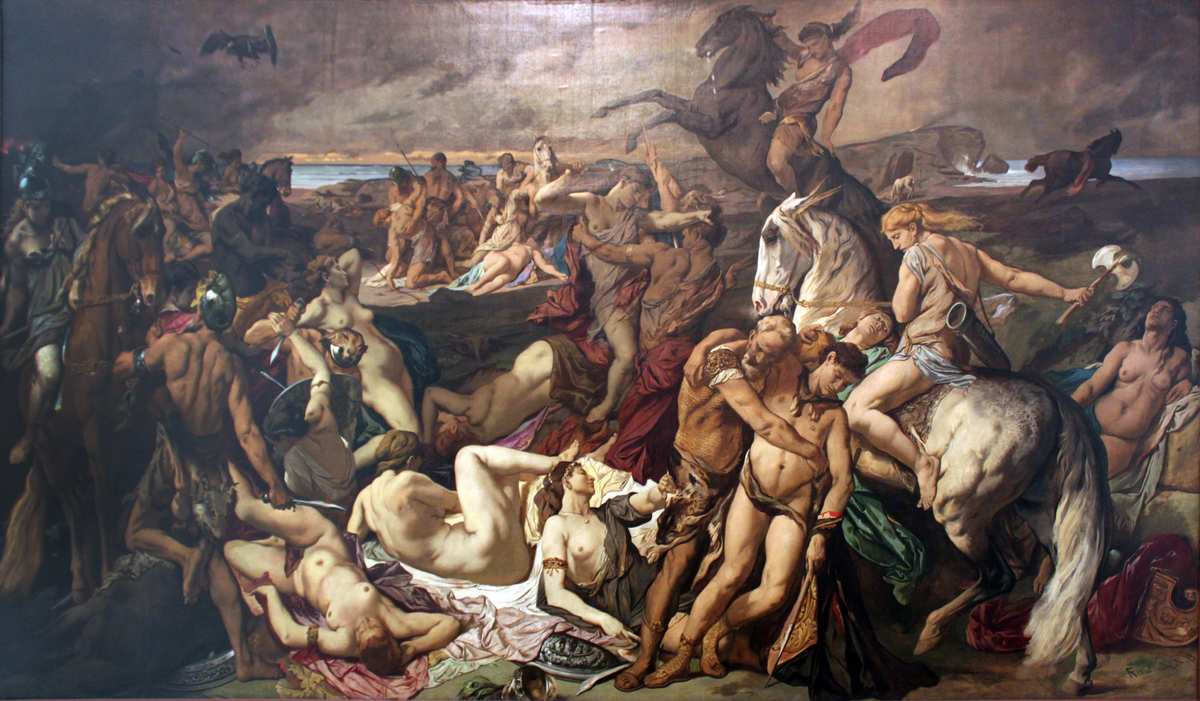
There is no decisive blow here and no single group to follow. Feuerbach spreads the battle across a broad horizontal format as many separate fights, linked by repeated limbs and opposing movements. A rearing horse lifts one part of the struggle above the press of bodies. Elsewhere the eye passes from one fight to the next without finding anywhere to rest. You could call the result sustained energy. The charge of diffuseness is harder to dismiss, because apart from that horse the picture offers nothing for the eye to gather round.
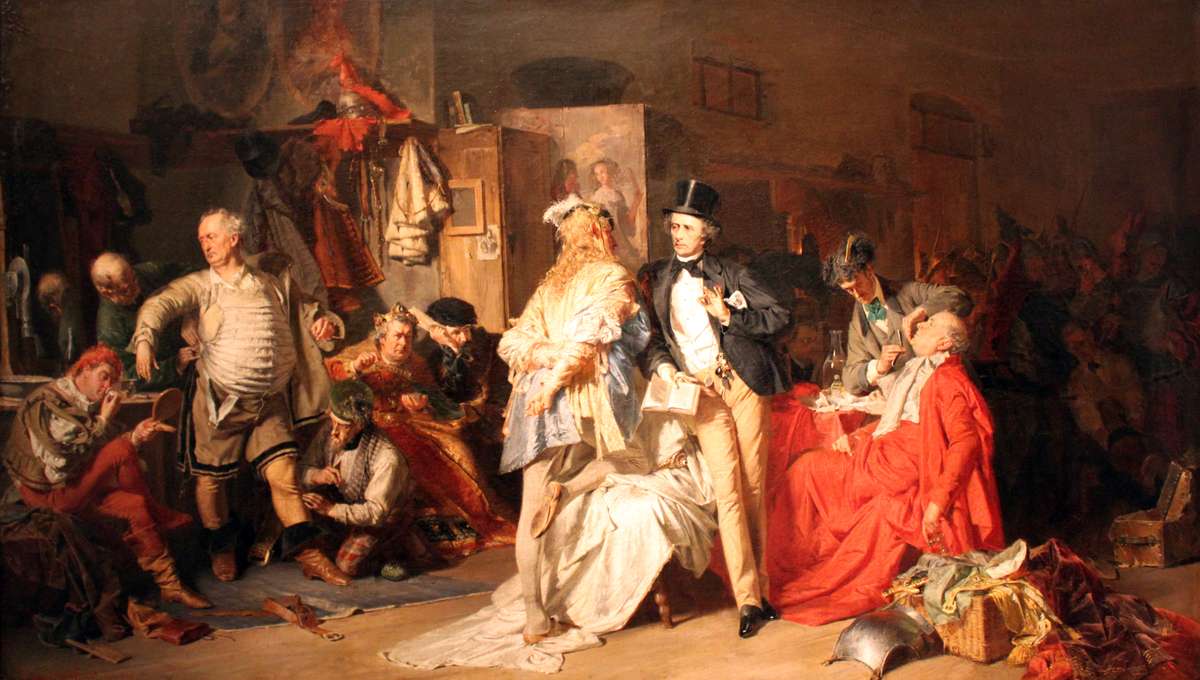
Offstage, the actors are still in costume, dressed for parts they are not playing at the moment. Grützner breaks the company into small groups, some standing and some seated, and the waiting seems to interest him as much as the theatre itself.
A dark cap and a plain background leave almost nothing to compete with the face of Michael Wolgemut, shown here as an old man. On this limewood panel Dürer follows the uneven contours around the eyes, cheeks and mouth closely, and he declines to smooth old age into a general emblem of wisdom. Whatever respect the portrait pays its sitter lies in that attention.
Nuremberg's main market, seen from the south, is the subject closest to home in this selection. Buildings enclose the square, and stalls and small figures break it into separate pockets of activity. Keeping the people small lets Strauch fit a great many occupations across its breadth, while a church façade anchors the view without overwhelming the market around it.
Habit and book declare a religious role before the face has quite registered. One hand is raised near his chest and the other stays with the book. These are familiar signs of piety and learning, and Cranach accepts them and works inside them. What he adds is an individual face.
A needle is about as small as a prop can be, but the tight framing enlarges the gesture as the fool lifts it near his grinning face. The ass's ears rising from his cap tell us what kind of figure he is before we have worked out what he is doing. Herneisen keeps the performer very close, and costume and action together make the foolishness a deliberate performance.
Cornelia Adriana Munter draws her daughter against her own body, and Tischbein builds the double portrait on that closeness and on the difference in their sizes. Pale faces and pale clothing stand out from the dim setting and above the mother's green dress, which makes it easy to see exactly where the two figures touch.
Dürer gives Wolgemut nothing but a dark cap and a plain ground, but here the emperor's face has company: an inscription, heraldic devices and rich clothing, all kept in plain view. Together they turn the likeness into a statement of imperial authority. These signs announce Maximilian's rank, and his features are not asked to carry it.
The place is still easy to read, with trees, buildings and mountains fitting together around an open slope. What has loosened is the colour. Macke lays it on in bright patches that do not always follow natural light and shade, and accents of blue and yellow jump between separate objects, so that things belong together by colour as much as by where they stand in the view.
A quartet needs four players doing different things at the same moment. Oppenheimer overlaps arms, bows and instruments so closely that the musicians' movements merge into a single web of lines, bound together by repeated contours. Yet each player keeps a separate body, instrument and task, which are the differences an ensemble depends on.
The two girls sit close together, and only one of them raises her arms. That single difference stops them from becoming a matched pair and gives the picture its movement. Pechstein holds the bodies against their surroundings with broad outlines and flat, emphatic colour, and posture counts for far more than anatomical detail.
The title calls this a head, not a portrait, and identifies it by colour, though it names only black and green. Blue and pink are there too. None of these describes ordinary skin, yet the face stays legible, held together by its enlarged eyes, long nose and proportions. Jawlensky seems to be testing how much of a face the placing and scale of its features can carry once natural colouring has been set aside.
The title pulls two ways. It names a particular ruin, the Temple of Juno at Agrigento, and then calls the landscape “ideal”, which means the view need not be an unedited record from a single spot. Ruins, water, trees and small figures are gathered into an ordered prospect, and Hackert ties the temple to the surrounding terrain through a sequence of arranged passages leading back into the distance. Strauch's market takes its title from the place it was seen from. Here the viewpoint may itself be part of the composition.
Judith stands upright and sharply outlined beside the sword and the severed head of Holofernes, and she looks composed. Baldung shows what the violence has produced, but nothing in her pose recalls the act itself. That gap makes the picture hard to settle on. Her calm sits awkwardly with the head beside her, and Baldung does nothing to reconcile the two.
After Baldung's Judith, who barely moves, this is a restless picture. The child twists, so mother and child never settle into a stable, symmetrical devotional image, and dark drapery sets off their pale bodies. The parrots near the figures add further points of activity. Whatever they may signify, in the composition they work first as interruptions.
Witz squeezes his Annunciation into one cramped room. Stetter opens the Nativity out. His buildings divide the picture into connected spaces, with room for distant figures as well as for the group around the newborn child, and architectural passages lead the eye away from the main event and back again. The birth holds the centre, but it is not the only thing happening.
She is given a role rather than a name, and the picture shows what the role involves: the girl carries the smaller child on her back. Uhde makes this practical task the substance of their relationship. Side light picks out both faces and the worn clothing in a modest room.
Explore this selection in Artline
See the selected works alongside books and events from their period, or compare when the artists lived. The books and events provide context, not evidence of direct influence. Works without confirmed dates remain in this guide.
Threads across the selection
Some pictures answer one another beyond the pairings made in the entries. Tischbein's mother, Baldung's Mary and Uhde's elder sister are all shown with a child, and each picture makes something different of it: closeness in a double portrait, restlessness in a devotional image, a chore in a modest household. Performance links another group, from Herneisen's fool playing up at close range to Grützner's actors waiting in the wings and Oppenheimer's musicians in the middle of playing.
Harold Speed's general manual of drawing has chapters on contour, tone and the arrangement of figures, and its practical terms work just as well for paintings. They help in comparing Dürer's close description of Wolgemut's face with Jawlensky's simplified head, and in untangling the overlapping arms and bows of Oppenheimer's quartet. It is a manual, not a commentary on these pictures.
 Art, literature & history