Twenty works by Frida Kahlo: self-portraits that double, split or crowd the figure, with family pictures, portraits of other people and a still life alongside.
Frida Kahlo's self-portraits are known far beyond museums, and the familiar photographs of her, along with the dramatic events of her life, can get in the way of the paintings themselves. Yet there is a great deal in them to see: the plants and animals she chose, the clothes she wore, the people she remembered, and the strangely direct way she painted a face.
The self-portraits are at the centre of this selection, but they do not have it to themselves. Passengers on a bus, an older woman knitting, her father with his camera and a still life of cut watermelons are here too. In that company the self-portraits look less like one image repeated than a run of quite different pictures: a face against a background that says little about her surroundings, a body doubled, a body split open, a face increasingly crowded by monkeys and leaves. Diego Rivera appears twice, in very different relations to her. Several works carry writing, and others reach past the painted surface with glass or a mirror. Some of the pictures are tender, some are hard to look at, and a few resist easy reading. Biography comes in where it clarifies what is shown.
Twenty editorial choices, not a catalogue. Several works show pregnancy loss, injury and blood explicitly. Reproductions keep their recorded credits and rights labels; an image that circulates freely is not a licence to reuse it.
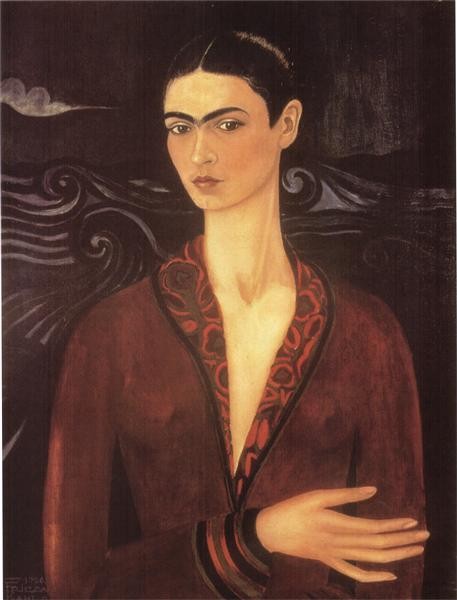
An early picture, painted when Kahlo was still a young artist, and a formal one. The long neck, the dark hair and the deep red velvet of the dress make a deliberate image rather than a casual likeness, and she looks straight out. The background says little about where she is, a reticence that stands out beside several of the later self-portraits here, which are thickly hedged with leaves and animals. The carefully controlled pose suggests a painter working out how she wished to appear.
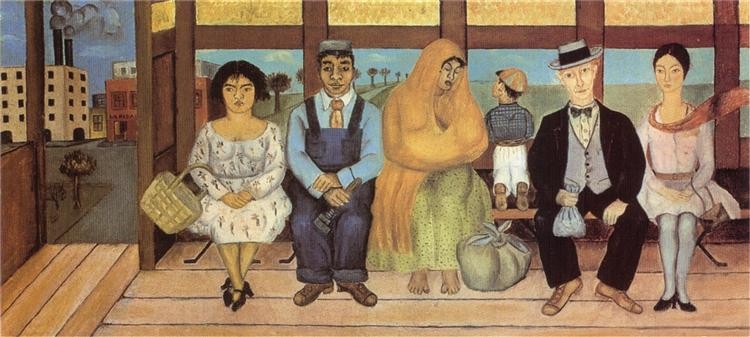
Here Kahlo turns from her own face to other people. A row of passengers shares one bench, with a city visible through the windows, and what they wear and carry sets them apart: work clothes, a hat, a basket, a child held in someone's arms. The bench does the opposite. It seats them side by side, so the social distances between them are measured at very close quarters.
1931 · oil , canvas · San Francisco Museum of Modern Art (SFMOMA), San Francisco, CA, US
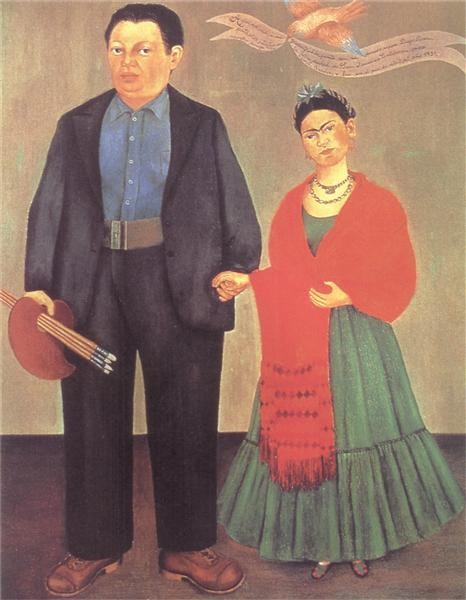
There is an irony in who holds the tools. Rivera has the palette and brushes, yet it was Kahlo who painted the picture, and he is much the larger figure: his large dark suit beside her smaller, brightly dressed form, the two linked by joined hands. A written banner turns the double portrait into an addressed document. The title spells her first name Frieda, with an e.
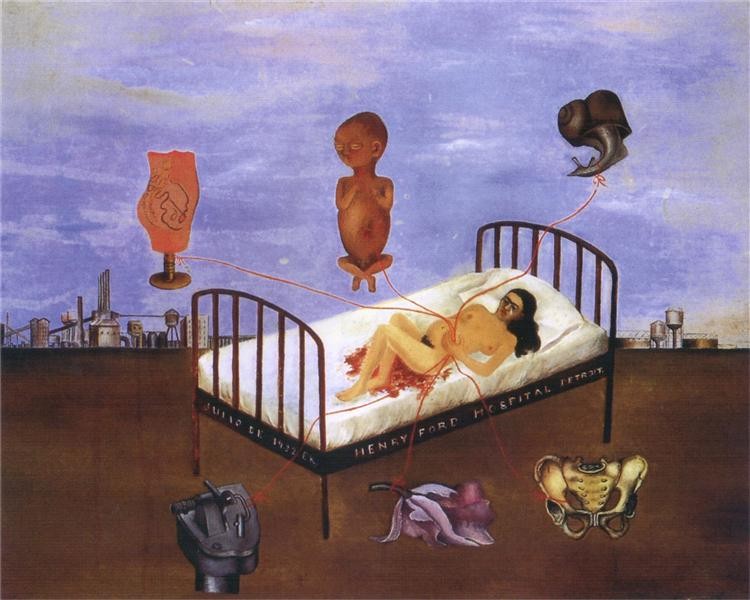
After losing a pregnancy in Detroit, Kahlo painted herself in a hospital bed set out in the open, against an industrial horizon. The alternative title, The Flying Bed, catches the strangeness of it: a hospital bed with no hospital around it, and so no walls to shelter the patient. Red cords run from her body to a set of separate forms, some of them anatomical. The cords join them as experiences, or perhaps as emblems of what has happened, rather than as objects that could ever share a room.
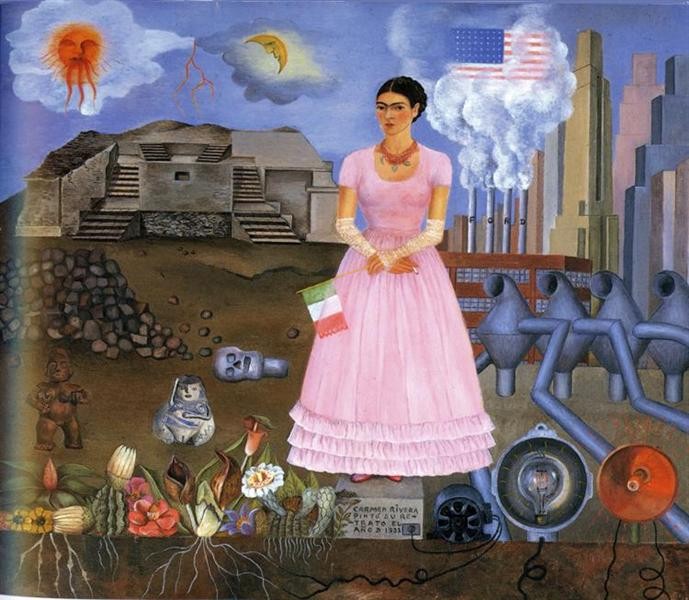
The picture divides in two. Historical forms and plants fill one side, factories and machinery the other, and underground, roots and cables spread as rival networks. Kahlo stands on a pedestal at the dividing line. Because the two landscapes never run into each other, the argument about Mexico and the United States stays schematic, close to a diagram, and her figure is the only thing holding the comparison together. A pedestal is a place for display, and on it she can look stranded, belonging fully to neither side.
1936 · Oil and tempera on zinc · Museum of Modern Art
A family tree taken literally, in oil and tempera on zinc. A red ribbon traces descent, joining generations who could never plausibly share one scene at the same scale, and it ends with the child in the courtyard, presumably the 'I' of the title. Above the house, Kahlo's parents appear in their wedding clothes, another moment from the family's history folded into the same picture. Likeness matters less here than placement: where each person is put, and what connects to what, carries the information.
1937; assembled after 1939 · oil , masonite · Museum of Modern Art
The familiar reproduction, like the one here, shows only the painted panel: a monkey sitting close beside Kahlo among leaves and a ribbon. The object in MoMA's collection is more than that. Some time after 1939 a mirror was assembled with the painting, placing the viewer's own reflection beside the painted pair. A double portrait of woman and monkey becomes a three-part encounter, completed by whoever happens to be looking.
1937 · oil , masonite · National Museum of Women in the Arts
Kahlo stands full length between parted curtains, as if on a small stage, holding flowers and an inscribed letter. The dedication names Leon Trotsky as the portrait's recipient, and the picture is arranged as a gift: the flowers and letter are things to offer, and she is presented at a public distance, with room around her to stand. The close-up self-portraits with animals later in this selection leave no space for that kind of formal appearance.
1938 · Oil on aluminium, with painted-glass surround · Centre Pompidou
As the title suggests, the frame here is part of the work. A small self-portrait painted on aluminium is combined with a separate surround of painted glass, whose flowers and birds bring Mexican decorative craft into the making of the picture. The two are not on the same surface. Where they overlap, Kahlo's face is seen through the glass, so the decoration lies in front of the portrait as well as around it. Take the surround away and the portrait would lose much of its appearance.
Two seated Fridas, hands clasped. Their expressions are much alike, so it is the clothes that tell them apart. More than their hands joins them: each has her heart visible, and a blood vessel runs from one to the other. Blood has stained the pale skirt, which makes that shared line look vulnerable; the clasped hands are the steadier connection.
The cutting is already done. Kahlo sits in a loose suit with the scissors still in her hand, and the hair she has cut off lies on the floor around her, so the picture shows both her changed appearance and what the change has removed. Across the top runs a line of song lyrics, another voice in the picture. The words bear on love and feminine presentation; they sharpen the scene without settling what the act meant.
Everything here presses in on the face. A necklace of thorns catches at Kahlo's neck, a hummingbird appears with it, a cat and a monkey are at her shoulders, and dense leaves behind her shut off any view. The animals and plants invite symbolic reading, and a viewer may want a key to them. The picture does not need one to work: thorns at the neck and creatures this close register as pressure before anyone decodes them.
1942 · Óleo sobre masonite · Museo de Arte Latinoamericano de Buenos Aires (Malba)
In outline the arrangement looks symmetrical: a monkey on one side of her face, a green parrot on the other. Colour unsettles it. The parrot's green comes close to that of the garment below, which ties the bird to her, while the dark monkey stays apart. A slight turn of her head disturbs the balance further.
Earlier self-portraits here give her a few animals for company; this one gives her a crowd. Several monkeys press round her white blouse, limbs overlapping, against heavy leaf cover, and the picture could easily dissolve into clutter. It holds together because the movement is spread around the edges of a figure that stays still, and because the clear outline of her face gives the eye somewhere to rest.
Doña Rosita Morillo, an older woman, is shown knitting. The pale yarn and needles stand out against her dark dress, so the eye goes first to her hands at work. Plants enclose her much as they enclose Kahlo in the self-portraits, yet the face is unmistakably someone else's.
A broken architectural column stands in place of the hidden structure inside the torso: the support itself is what has failed. Straps bind the body, and nails and tears mark pain at its surface. Fissures carry on into the landscape behind, as though the damage did not stop at the edge of the body.
A deer with Kahlo's face, its body pierced by arrows rather than the nails of The Broken Column. The animal body brings a different kind of vulnerability: a deer can run, but it is also a target. Tree trunks close round it and divide the forest into narrow slots. There is an opening beyond them, but no clear way to reach it.
A small portrait of Diego Rivera sits on Kahlo's forehead, in the place sometimes given to a third eye, and his inset face has an extra eye of its own. Below it her face is streaked with tears, and her hair is loose. In the double portrait earlier in this selection the couple stood side by side, linked by joined hands. Here there is no room and no setting, only her face, and he is inside her image of herself.
Guillermo Kahlo is shown with a camera, which identifies his working life, and in formal clothes, composed and correct. Beneath the portrait runs an inscription in his daughter's words, an account of him that the likeness alone could not supply. He has appeared once before in this selection, in his wedding clothes above the house in the family-tree picture, where he was one link in a ribbon of descent.
No face at all this time, only cut watermelons in uneven slices, the flesh a brilliant red. The inscription "VIVA LA VIDA", meaning "long live life", sits within the flesh of one piece. Its letters stay among the rind, seeds and slices rather than floating above the fruit as a motto, so the words belong to the still life instead of being laid over it like a caption.
Explore this selection in Artline
Open these twenty works alongside books and events from their period. The lifespan view includes Frida Kahlo, Diego Rivera, Georgia O'Keeffe, Tarsila do Amaral and Remedios Varo. These comparisons provide historical context, not claims of direct influence.
Words, glass and a mirror
Writing is the most frequent way these pictures reach beyond the painted likeness, and the words are rarely mere captions. They do different jobs, and they sit in different places. The banner in the double portrait with Rivera and the dedication to Trotsky are addressed to someone. The lyrics running across the top of Self-Portrait with Cropped Hair borrow the voice of a song, the lines beneath Guillermo Kahlo read as testimony, and "VIVA LA VIDA" is an exclamation lodged in the fruit itself. The Frame and Fulang-Chang and I reach outward through material instead, one by putting painted glass between the viewer and Kahlo's face, the other by adding a mirror in which the viewer appears. In this selection a picture is often a letter, a document or an assembled object as well as a likeness, and more than once it is turned towards someone outside it: a named recipient, or a stranger caught in the mirror.
Further reading
Frida Kahlo; introduction by Carlos Fuentes; commentary by Sarah M. Lowe · Publisher page; purchase or library
The diary itself, with its painted and written pages set side by side, introduced by Carlos Fuentes and with commentary by Sarah M. Lowe. Its pages come from a different period from the early paintings here, and it is most useful beside the later works, where inscriptions share the surface with the image.
Jodi Roberts · The Museum of Modern Art, 2019 · Free publisher sample PDF
A whole book on a single painting, Self-Portrait with Cropped Hair, written by Jodi Roberts for MoMA's One on One series. It looks closely at the suit, the scattered hair and the song lyrics painted across the top of the canvas. The publisher's free sample covers only part of the book.
 Art, literature & history