The Museum of Fine Arts Ghent, usually called MSK, holds painting and sculpture from several centuries, but this selection keeps almost entirely to the nineteenth and twentieth. The one exception, and the only piece of older Flemish painting here, is Frans Snyders's greyhound seizing a young boar, a picture whose subject is plain at a glance.
Little else is so straightforward. At one extreme are Bouguereau's bather and Lefebvre's woman with a plate of fruit, academic figure painting at its most polished, built on studio staging and inherited ideals. At the other are James Ensor's crowd of masks and Frits van den Berghe's drawing of a nude, neither of which settles into a single reading. In between, a few concerns recur. Work is one: George Minne draws a single shoemaker at his bench, while Gustave De Keukelaere allegorises a whole industry. Italy is another, named in the titles of a nursing mother, a tavern card game and a Venetian feast. And several woods and parks show how differently a stand of trees could be handled. Many of these pictures also depend on their titles more than one might expect.
Artline made this selection independently, from documented holdings of the Museum of Fine Arts Ghent. Dates and attributions retain the qualifications given in the linked records.
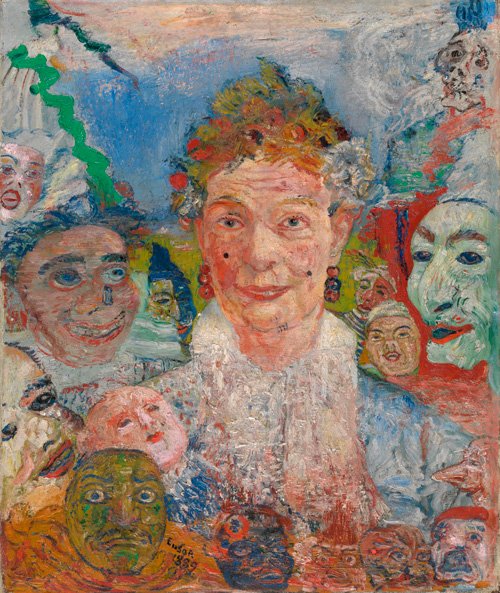
Faces crowd around the old woman. Some are frankly grotesque masks; others sit so close to living features that it is hard to say where the mask ends and the wearer begins. Ensor leaves her almost no room, and the bright colour does nothing to relieve the crush. If anything, it makes it more oppressive. Carnival, nightmare or allegory? The picture gives no hint of whether an event or some private meaning lies behind the gathering.
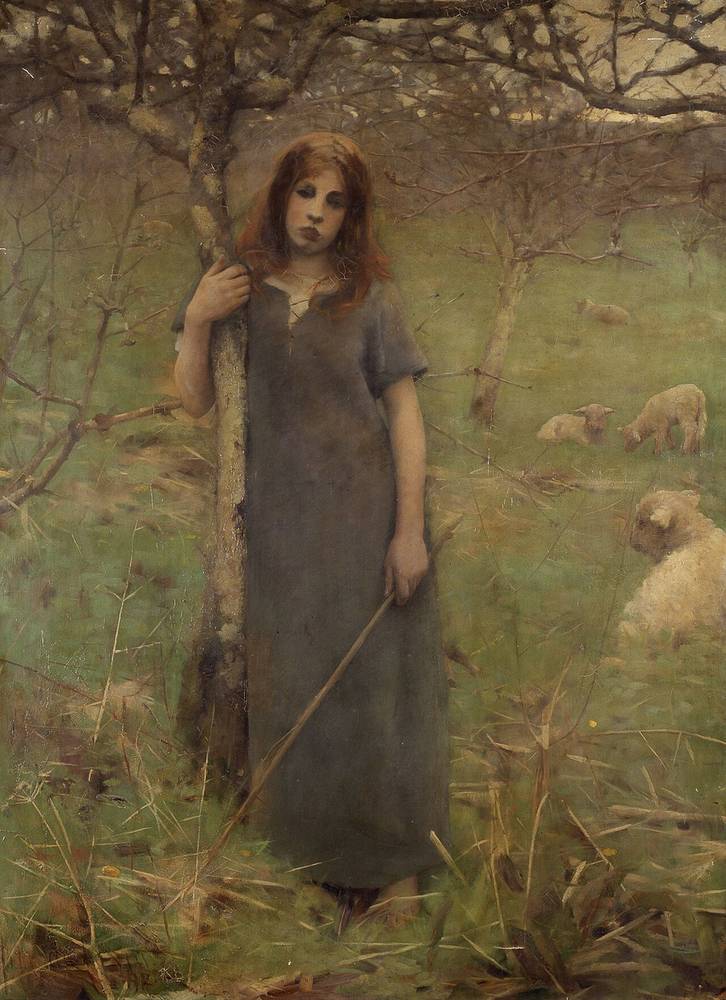
A girl stands upright among trees and grazing animals, still and central, as though she had been placed there for the picture. Without the staff in her hand she could be anyone out in the country. With it, she becomes the shepherdess a pastoral scene needs.
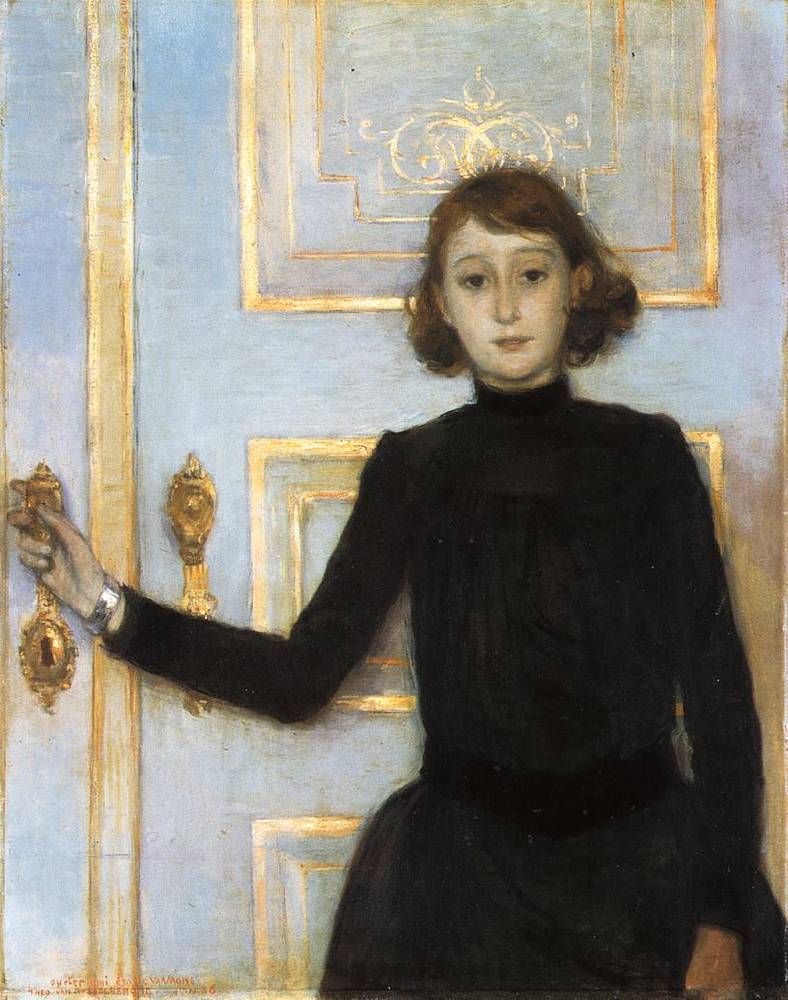
Van Rysselberghe sets Marguerite van Mons against a pale door, and her dark dress makes an almost unbroken vertical against it. The door is the telling detail. Her hand rests near the handle, just where someone would come in or go out, so the setting seems to promise an arrival or a departure. The picture never takes up the hint, and nothing suggests that she has been interrupted or is about to move.
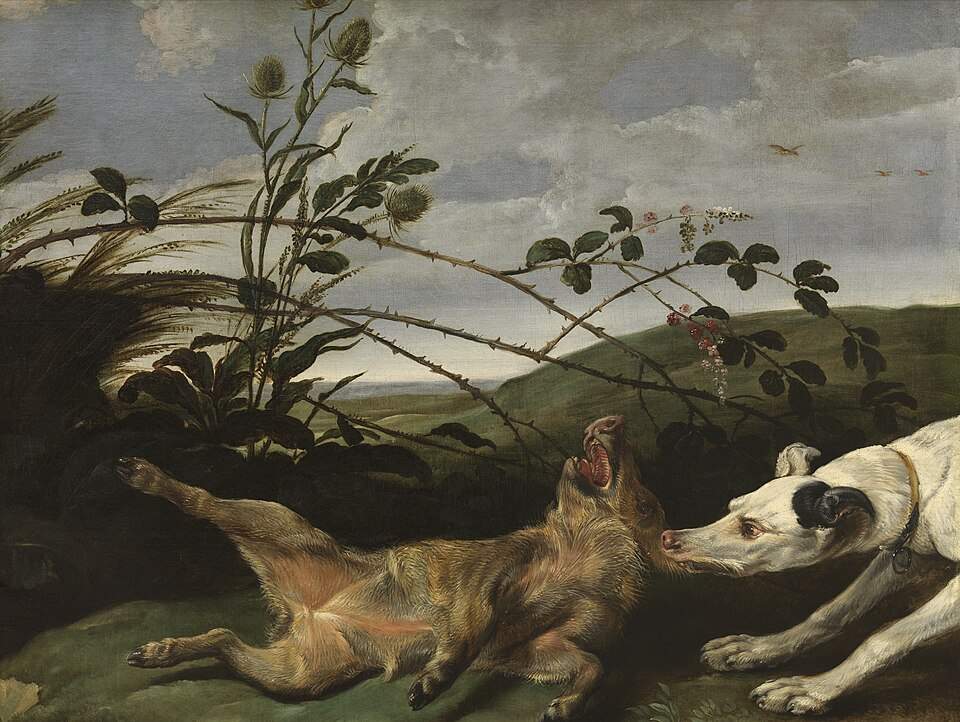
Snyders paints the chase at the moment of contact, in a tangle of dense vegetation, as the greyhound's forward rush turns into pressure on the young boar. A long-limbed dog against compact, struggling quarry: there is no doubt how this ends.
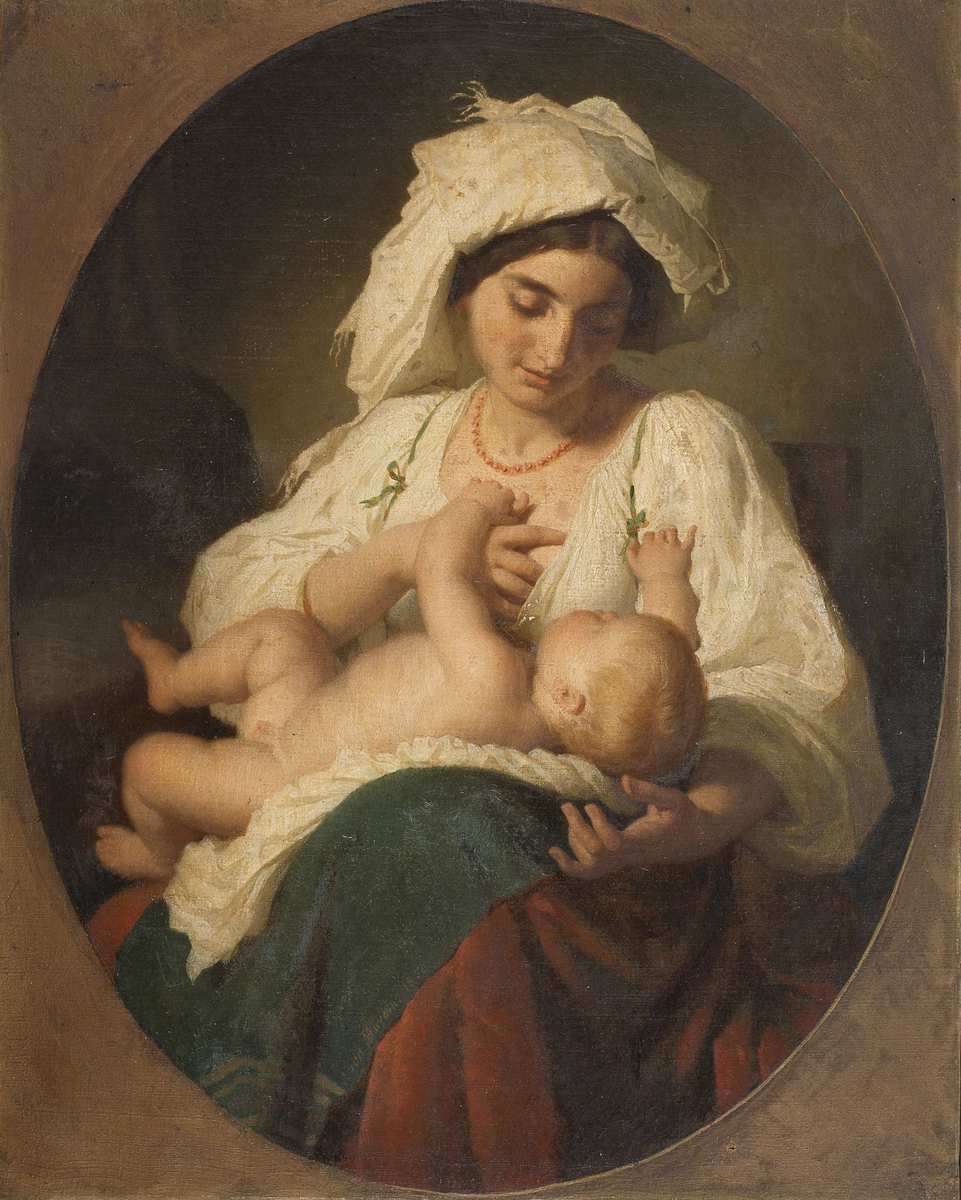
The painting looks inward. The mother's arms curve around the nursing child, the curve of the picture repeats the embrace, and the tight framing lets in little beyond the two of them. She does not turn outwards to pose; her attention stays on the feeding. Her cap and blouse mark out a particular costume.
c. 1913 · Oil on canvas · Museum of Fine Arts Ghent
Metalworkers repeat similar poses across a shallow, compressed space that looks less like a working floor than a frieze, or a sequence of demonstrations. Their tools identify the trade and the title makes them stand for the whole of it, so the allegory works rather like a catalogue. These figures represent their labour more than they perform it. Compare Minne's shoemaker: there the tools explain why the man bends as he does, whereas here they are closer to labels.
Elsen's autumn is announced by brown leaves; otherwise the picture is about the way into the wood. A lighter opening between the trunks draws the eye in, and thick stands of trees alternate with gaps, so that the crowded foreground eases into a more open distance. Clearly organised and workmanlike, it lets nothing happen that might distract from that route.
Rough rock and foliage behind the bather make her smooth, continuous contour all the clearer. The contrast looks calculated, as if the setting were there chiefly to set off the body. Both are invented: Bouguereau imagined the scene and idealised the figure, smoothing her into a demonstration of inherited academic standards of beauty.
1887 · Pen in zwart, gewassen, en potlood op papier · Museum of Fine Arts Ghent
Minne drew the shoemaker in black pen, with wash and pencil, and gave his workshop as much attention as the man. Tools and shoe forms stand in rows around him, hemming him in and accounting for his posture. He is bent low over close, demanding work in a crowded room, and the drawing sets down the conditions of his trade object by object.
The path into the park disappears into greenery almost as soon as it starts. Lighter patches break up the dark mass of leaves, but the view never opens: there is no distant prospect and nothing to say where the path leads. Heins puts the viewer inside the enclosure, not outside looking in. He does the same in his covered market in Ghent, where the roof happens to be timber instead of leaves.
c. 1900 · Oil on panel · Museum of Fine Arts Ghent
A procession of people, with a horse among them, struggles up a stony road, and the crowd thickens as it climbs the picture. Meunier does not gather the religious subject into any one figure or gesture. It lies in the effort and endurance of the whole group on the hill.
In De Jans's tavern, heads and hands converge on a small patch of tabletop where the cards lie, and onlookers pressing in at the edges close the circle. The cards themselves are harder to make out than the attention they command. Who is winning seems to matter less than how absorbed everyone is.
Sacré turns a virtue into a difference in height. One figure stands, another sits, and posture alone settles who is placed to give and who to receive, while the religious setting supplies the moral frame. Meunier spreads his religious subject through a whole climbing crowd; Sacré compresses his into a single relationship. The result is clear, rather schematic, and leaves the viewer little to work out.
Closely spaced stems fill this coppice, and a path threads between them towards nothing in particular. Elsen's autumn wood opens into the distance and Heins's park shuts the viewer in. Van den Abeele offers only the modest, repetitive fact of trees growing close together, with no distant peaks or dramatic weather. The intervals between the trunks are uneven enough to stop the wood flattening into a pattern, though only just.
A heavy timber roof sets the scale, dwarfing the stalls and workers beneath it. Daylight falls in patches, catching parts of the busy floor and leaving others dim. Heins shows the covered market as a working building, full of repeated tasks and movement.
Lamplight picks out a seated figure and some visitors in a shadowed, unequal encounter. Their postures carry the drama and suggest distress. The title names the emotion outright, but the picture is more reticent: whatever brought these people to this moment lies outside the frame.
Raised on horseback, the sitter gains height and command, and the other mounted, uniformed riders place him in a public setting. De Lalaing characterises him largely through this organised outdoor gathering, so the portrait becomes a display of rank. Van Rysselberghe works the opposite way with Marguerite van Mons, who is defined by a door and her own pose. For all the display, the title does not name the man.
1931 · Pen en mengtechniek in zwart op papier · Museum of Fine Arts Ghent
The nude's outline breaks down into the marks around it, and the figure can only partly be made out among fantastic, half-legible forms. Somewhere in there, according to the title, is a bird, and a red one. The record, though, gives the medium as pen and mixed technique in black on paper, which leaves the title as the only source here for the colour.
Mellery's feast is mostly a hall. The costumed guests occupy only a small part of the decorated room, and they are no match for the scale of its architecture and paintings.
c. 1874 · Oil on canvas · Museum of Fine Arts Ghent
The plate of fruit and the costume establish the woman's role before the title names it, and the title then hardens that role into a social condition. She is shown in profile, which allows little exchange with the viewer and underlines the studio staging. What we see is servitude as a constructed image, something a studio could stage but not document. The word 'slave' cannot be ignored, but it tells us nothing about who modelled for the picture or in what circumstances.
Explore this selection in Artline
See the selected works alongside books and events from their period, or compare when the artists lived. The books and events provide context, not evidence of direct influence. Works without confirmed dates remain in this guide.
Named and unnamed
Marguerite van Mons is the only person in this selection whose name appears in a title. Everyone else is identified by type: an old woman, a bathing woman, a shoemaker, card players, an Abruzzi woman, a female slave, even the rider of De Lalaing's equestrian portrait. A title of this kind tells the viewer what sort of figure to see, and the pictures tend to answer it with props. The staff makes a shepherdess; tools make metalworkers; a cap and blouse, with the help of the label, make a woman of the Abruzzi. Lefebvre's picture works by the same means, with a costume, something to hold and a descriptive title, but the type it arrives at is a social condition instead of a trade or a region, and there the convenience of the method becomes uncomfortable. The comparison with Van Muyden is telling. Both women are costumed and both are known only by their titles, but the nursing mother is absorbed in what she is doing, while Lefebvre's woman holds her plate in profile, posed for a viewer she does not engage.
Reynolds's discourses make the academic case for idealised figures and elevated subjects. His assumptions are eighteenth-century, but the argument for the ideal is useful background to Bouguereau's bather and to the staged figure subjects elsewhere in this selection.
 Art, literature & history