The Centre of Visual Arts and Research stands in the old walled city of Nicosia. It opened in 2014 to house the Costas and Rita Severis collections of paintings, costumes and historical material connected with Cyprus. Travellers and visiting artists made many of the images. That makes them valuable as records, though it matters who was doing the recording. They show what visitors chose to paint and, where captions were added, what those visitors believed about it.
This selection of twenty takes in harbour views of Kyrenia, buildings in Famagusta, the salt lake at Larnaca, flower studies, pencil studies by Léon Bakst and a portrait of a woman by an unknown painter. Some works are much better documented than others. Several are anonymous, and the oldest has only a tentative attribution. Allan E. Balfour is at the other extreme. He wrote his own captions, recording where he was and what he took each site to be, and not everything he believed can be taken as fact.
Artline selected these works from the museum's documented holdings, independently of the museum. Some may be away on loan.
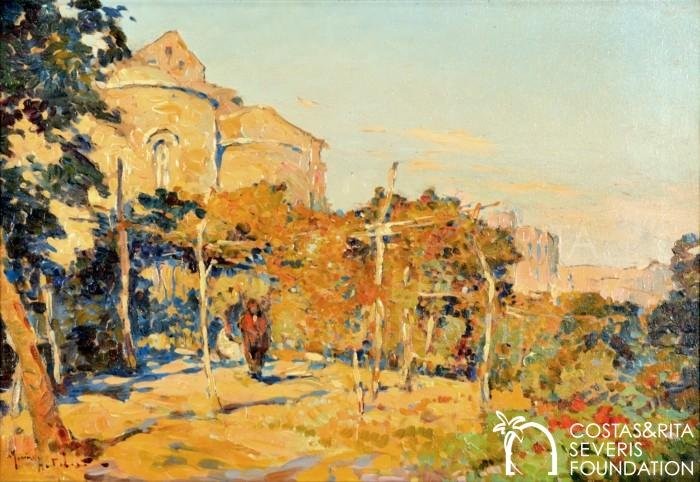
c. 1930 · Oil on canvas · Centre of Visual Arts and Research
Robert approaches the church across a foreground of trees and cultivated ground. Its stone walls appear beyond them as part of a farmed landscape, not as a monument pushed to the front. Famagusta looks very different in Francis Arundale's much earlier watercolour of the mosque, later in this selection, where a Gothic building and a minaret share the town's skyline. Robert sets his church among fields.
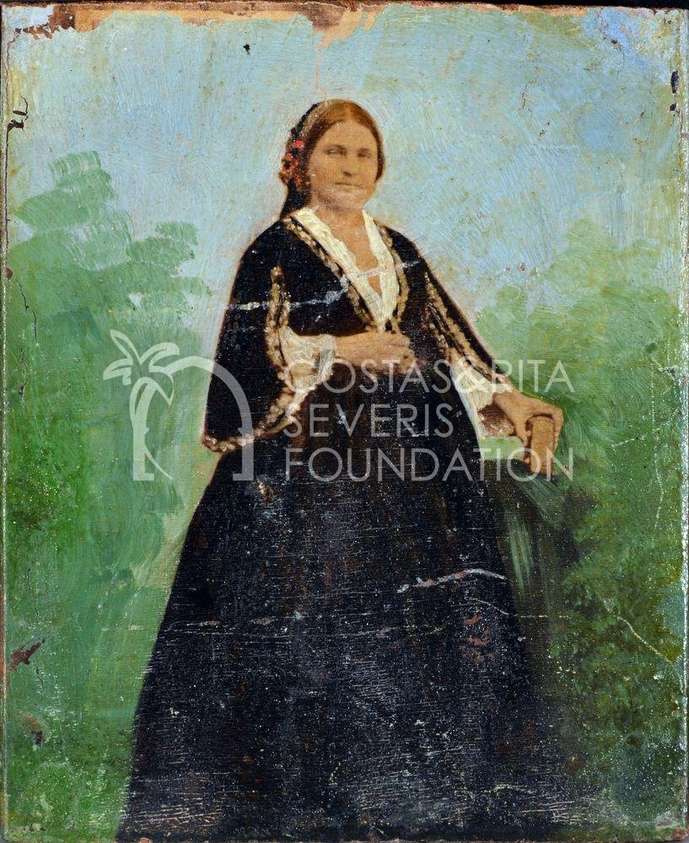
c. 1889 · Oil on board · Centre of Visual Arts and Research
The sitter's name has survived; the painter's has not. Mrs Razzini's dark dress with light trim stands out against the pale background, and her hands rest near her waist. That pose gives the portrait its formality. Among the landscapes, plant studies and drawings in this selection, it is the only work devoted to a named individual.
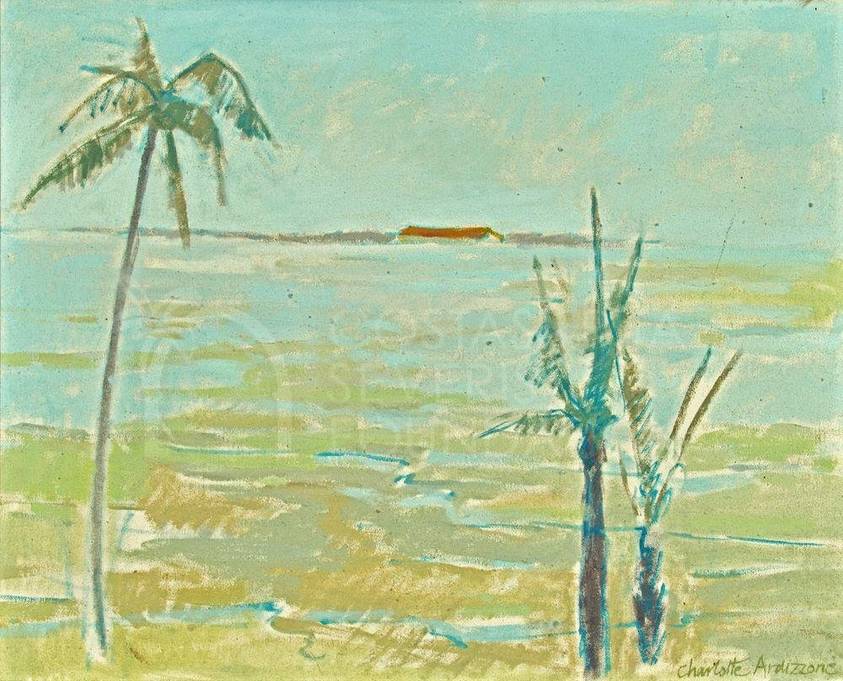
c. 1950 · Oil on canvas · Centre of Visual Arts and Research
Lake and sky lie in pale horizontal bands, broken by slender palms and stems. Artizzone puts little else on the canvas, so the thin uprights are what show how far the open water extends. Her title names only the island. Allan E. Balfour's watercolour of the salt lake at Larnaca, later in this selection, is more particular: it names the place and the distant mountain, and his inscription records the day.
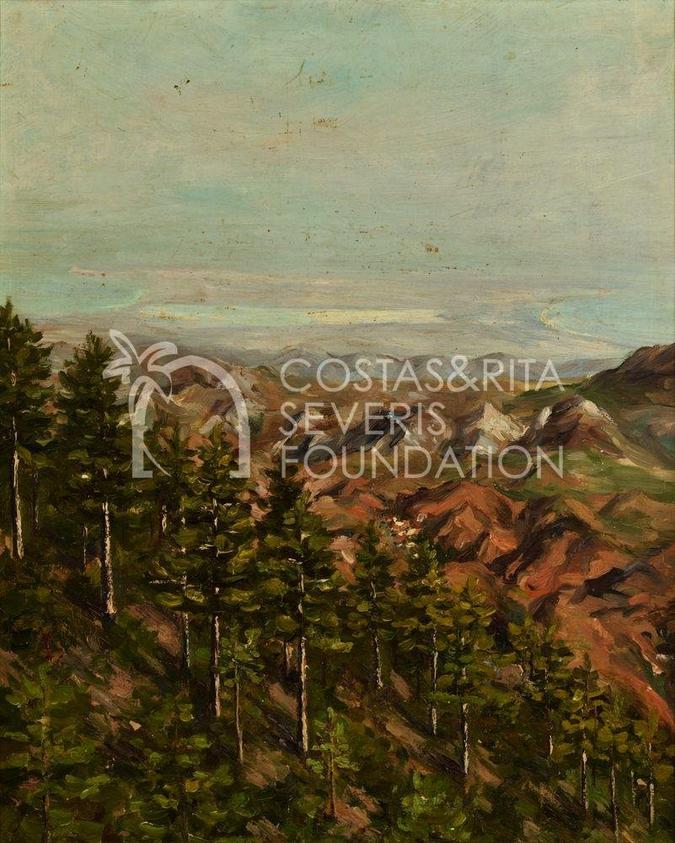
c. 1950 · Oil on board · Centre of Visual Arts and Research
The slope is shown through the trees themselves, which grow denser or sparser as the ground falls away. Darker trunks hold the foreground, and hills carry the view into the distance. No record of the painter's name survives.
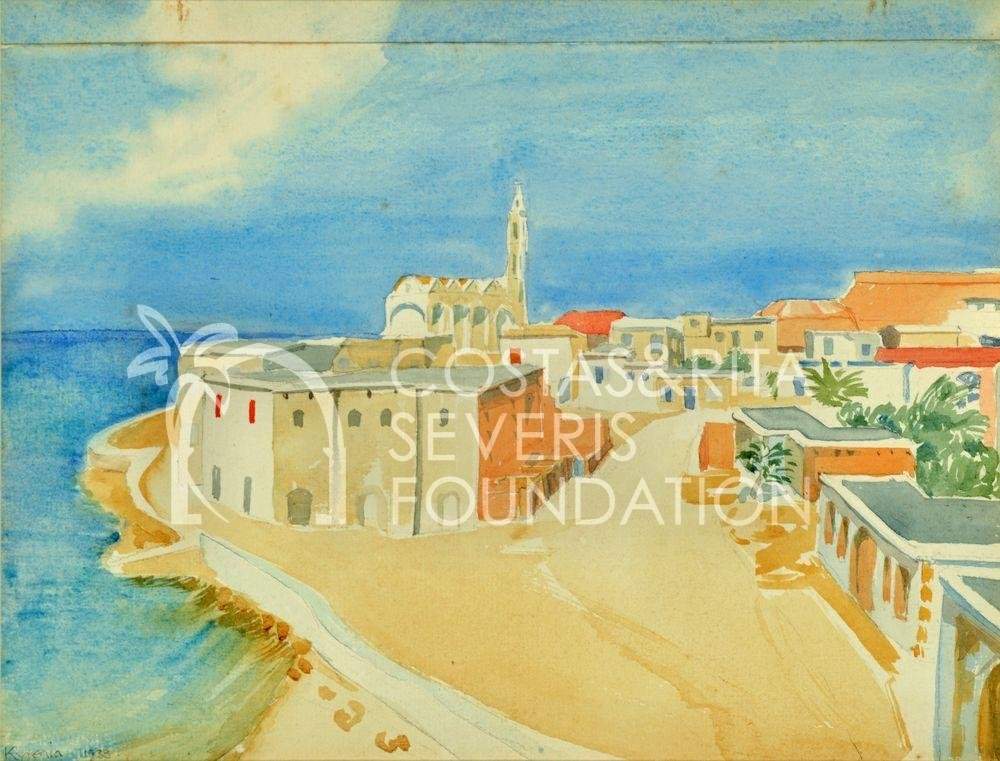
1933 · Watercolour · Centre of Visual Arts and Research
Crawford's title identifies the waterfront buildings as carob stores. They follow the curve of the shore and face the water, and with the broad quay in front of them they give the harbour a working edge. Kyrenia appears more than once in this selection. T. H. Pritchard's view attends to masts and reflections, and Balfour's to the lighthouse. Only Crawford's tells us what the buildings were for.
1933 · Watercolour · Centre of Visual Arts and Research
The title names Pedoulas, but Crawford painted no view of the place. Instead the sheet holds flowering stems, with their branching joints, leaves and blossoms kept separate on the open paper. Were the stems picked there? Nothing on the sheet says so, and nothing else explains how the title relates to the plant.
c. 1879 · Watercolour · Centre of Visual Arts and Research
Scott-Stevenson paints from high ground and sets out the land in successive distances: rough ground close by, ridges further off, then the coastal plain running towards the sea. The near ground gives a physical scale to the broad bands beyond. She also wrote about her life in Cyprus, and her book Our Home in Cyprus appeared soon afterwards.
1921 · Pencil · Centre of Visual Arts and Research
A bent arm and a few folds are enough to organise this lightly drawn standing figure. Bakst left the head unfinished and drew no setting, so the drawing concentrates on the pose and the way the fabric hangs. It looks like a quick study. His other sheets here have titles that name an ancient statue or artefact. This one does not say whether he was drawing a sculpture or a living model.
1921 · Pencil · Centre of Visual Arts and Research
Bakst visited Cyprus in 1921 and made studies of ancient artefacts and sculpture, and the CVAR connects these Cypriot studies with his costume work. Here the object's profile takes up only a small part of the sheet, and darker strokes pick out one side. The drawing gives no archaeological context to show what the object was, and the museum's title is just as general.
1921 · Pencil · Centre of Visual Arts and Research
The gesture of bent arms, with hands held near the chest, is repeated across the frontal torso, while the head is less defined. Bakst took this arrangement of the body from the sculpture and did not try to copy every part of it, so the gesture gets more attention than the face.
c. 1840 · Pencil drawing · Centre of Visual Arts and Research
The caption is specific where the drawing is loose. It names the task in hand, shaving a priest, but the interior is only sketched in, and the nearby objects leave much of the setting unclear. Other figures gather round the seated man, which makes this a small group scene rather than a portrait of one person. The drawing does not tell us who they all are or what the occasion was.
1938-03-09 · Watercolour · Centre of Visual Arts and Research
Water fills the view, and the title identifies the distant mountain as Stavrovouni. Balfour's inscription gives the place and the exact day. His other watercolours in this selection carry similar dated notes, so each one reads as a stop on a journey. Taken in date order, his sheets in this selection go from Bellapais Abbey to the lighthouse at Kyrenia and finish here at the salt lake, all within the same month.
1938-03-05 · Watercolour · Centre of Visual Arts and Research
Balfour brings the tower close enough for its masonry to show against the water, and beyond it a sailing vessel extends the harbour view. His caption calls it an "old Roman" lighthouse. That records how Balfour understood the tower; it is not an archaeological dating.
1938-03-01 · Watercolour · Centre of Visual Arts and Research
Trees and a green slope surround the ruined arches, setting the abbey in a wider landscape. Balfour's caption on the mount records his visit and gives his understanding of the site's history.
1933 · Watercolour · Centre of Visual Arts and Research
Open flowers, buds and leaves grow from a single branching stem, so the plant appears at several stages of growth at once. Against the pale background every junction is clear. Crawford relies on the spaces between the parts, which lets the small plant fill the sheet while each structure stays distinct. From Pedoulas uses the same method. Her watercolours here all date from 1933, including the carob stores at Kyrenia.
c. 1925 · Watercolour · Centre of Visual Arts and Research
Pritchard draws buildings and masts in fine lines, and their reflections carry some of the verticals down into the water. Not every area has its own wash. The warm-toned paper shows between the marks, and in places the bare sheet supplies the colour.
18th century · Watercolour · Centre of Visual Arts and Research
The question mark in the attribution matters. The museum tentatively associates this watercolour with Pars, but the attribution remains uncertain. It is the oldest work in the selection. An irregular border encloses ruins, trees and small figures, and beyond them mountains open out, so that the figures look tiny against the breadth of the landscape.
1833 · Watercolour · Centre of Visual Arts and Research
Arundale's title calls the building a mosque, and a minaret shares the skyline with it, but the architecture he drew is Gothic. The title and the stonework belong to different stages in the building's history; in his view the older building is still standing despite the changes. Small figures and lower structures around it show that the place is lived in. This is a historical view, dated 1833, and the site does not necessarily look like this today.
c. 1900 · Watercolour · Centre of Visual Arts and Research
Broad tree crowns are the strongest shapes in this watercolour by an unknown artist, held up on thinner trunks above the low ground. The trees stand apart from one another, and the gaps between them break up what might have been a continuous mass of green across the hilltop. In Trees at Platres, also by an unknown painter, the spacing of the trees works differently: they thicken and thin to show the slope.
1921 · Pencil · Centre of Visual Arts and Research
This small sheet from Bakst's visit to Cyprus has an annotation as well as a drawing. A few contours give the pose of the frontal statue, including a hand held towards the chest, a gesture similar to the one in Ancient Female Statue.
Explore this selection in Artline
See the selected works alongside books and events from their period, or compare when the artists lived. The books and events provide context, not evidence of direct influence. Works without confirmed dates remain in this guide.
Using the records
The linked object records give the inscriptions and catalogue details that this guide only summarises, among them Balfour's captions and the annotation on Bakst's small statue study. They matter most where the name of a building or an attribution is uncertain, such as the tentative link between the Amathus ruins and Pars. Present-day place names, access and condition need to be checked separately. The selection is based on collection records, not on what is currently on display, and permission to reproduce an image is a separate question from permission to visit the museum.
Further reading
Esmé Scott-Stevenson (1880) · Free digitized English edition through Google Books; availability and sign-in requirements can vary.
Esmé Scott-Stevenson's first-hand account of living and travelling in Cyprus, published in 1880. She painted the view towards Agia Irini Bay and Morphou in this selection, so you can read one of the artists in her own words and compare the book with her picture. She writes from a British colonial viewpoint.
 Art, literature & history