Twenty paintings from the Clark Art Institute in Williamstown, among them Piero della Francesca's Madonna, Constable's harvesters, Sisley's snow at Moret, Dudley Hardy's Sarah Bernhardt and Bouguereau's nymphs hauling at a reluctant satyr.
The Clark Art Institute in Williamstown, Massachusetts, grew from the collections assembled by Sterling and Francine Clark. It is especially strong in nineteenth-century French painting and also holds earlier European art. This selection of twenty works draws on both and ranges beyond them, opening with a fifteenth-century Madonna by Piero della Francesca. Several painters appear more than once, so you can set an artist against himself: Gainsborough as portraitist and as landscape painter, Turner among costumed figures in warm light and then off Margate at evening, Renoir with a bather, a woman crocheting and a table of onions. Other pairings cross from one painter to another. Renoir's bather and Bouguereau's nymphs disagree about whether a picture needs the same finish everywhere. Constable's mill at Flatford and Sisley's mills at Moret take up the same kind of subject and handle it quite differently. And a few titles, Fragonard's and Lemoyne's among them, name more than their pictures are prepared to show.
Artline chose these works from documented museum holdings, independently of the museum. A work in the collection is not necessarily on view. Dates and attributions keep the qualifications given in the linked records.
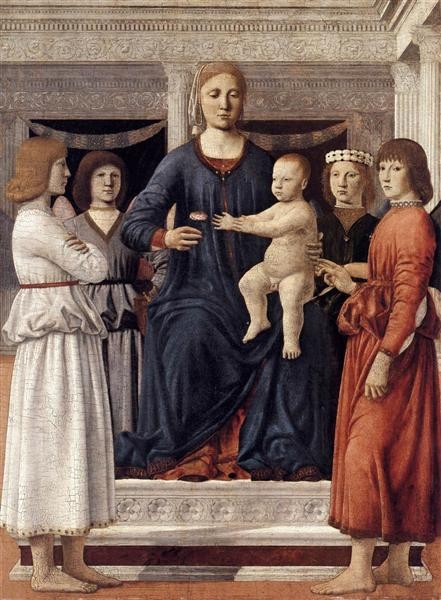
By a long way the earliest picture in the selection, and its only sacred subject. Piero places the Virgin and Child in an ordered space among the angels of the title, whose poses hold the whole group in balance. Within that steadiness, hands and glances single out particular relationships between the figures, and the closest is also the most direct: the contact between mother and child.
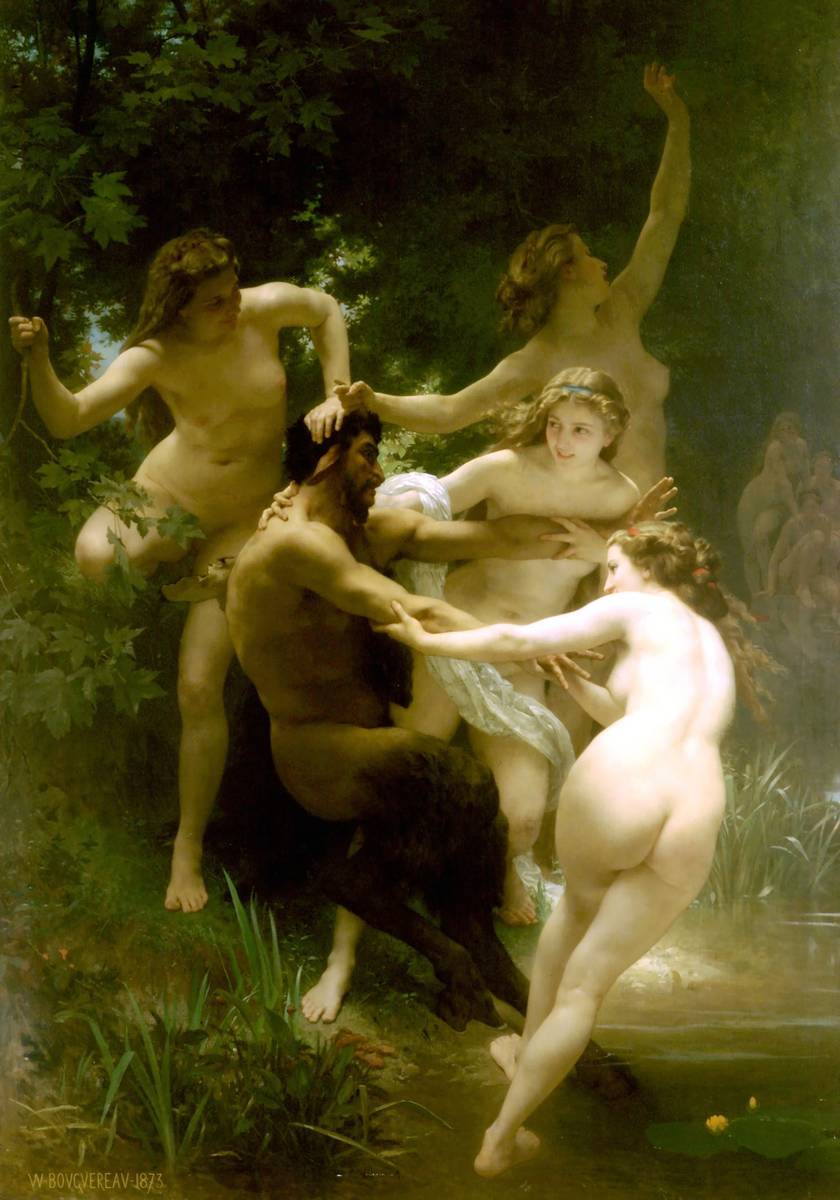
At the water's edge the nymphs haul at the satyr and he resists, so that the bodies lock into a single chain: a mythological tug-of-war, carried out through pulling, pushing and the search for support. Bouguereau's smooth, continuous modelling keeps every part of it legible, each shift of weight and each grip, even where limbs overlap. Polish of this degree can look airless, but here it earns its keep. In looser paint, a struggle this tangled would be much harder to follow.
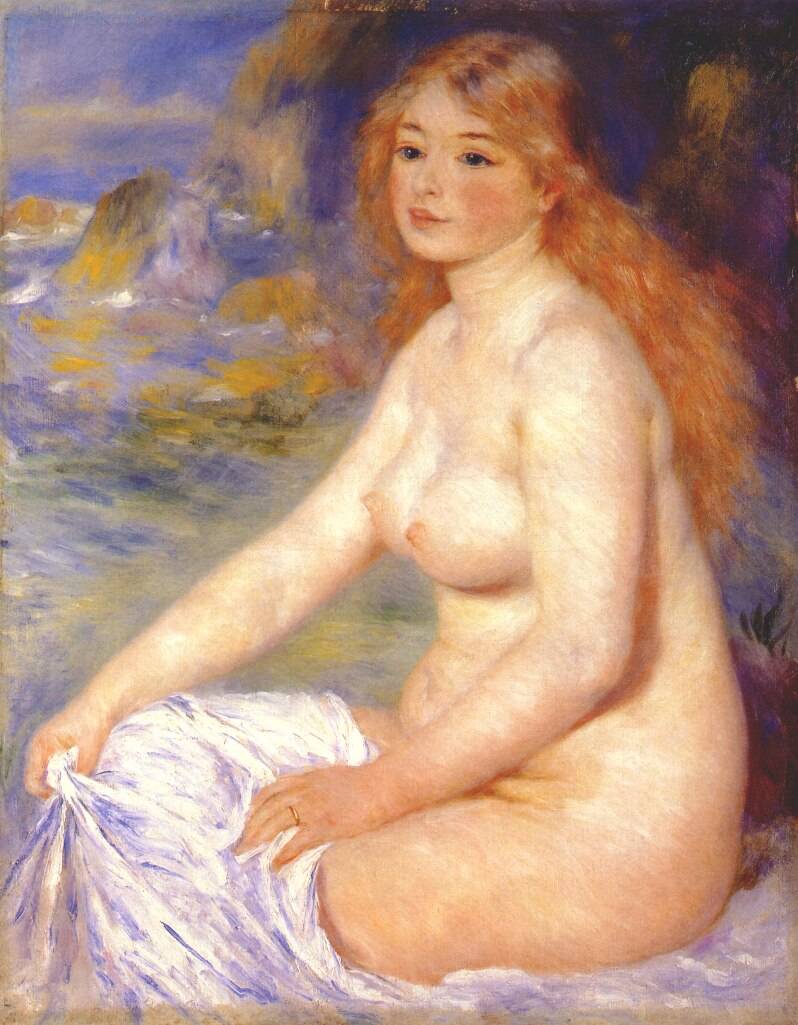
Bouguereau smooths every limb of his struggling group. Renoir is more selective. He models the seated body continuously and handles the landscape behind it more loosely, and the white cloth gathered across the bather's lap adds a third kind of surface between skin and setting. The water and rocks are not pushed out of sight; it is the change of handling that keeps the bather in front of them.
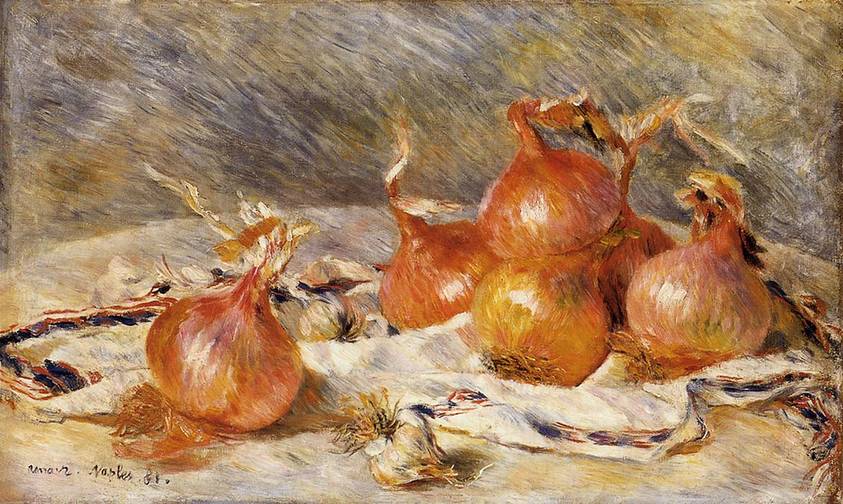
In the same year as the Blonde Bather, Renoir took up a far humbler subject: onions, garlic and a crumpled cloth on a table, in warm light. So modest an arrangement holds more kinds of surface than you might expect. The dry onion skins do not fold the way the cloth does, the light rounds out the bulbs, and the flat tabletop is unlike either. Looser strokes run the table into the background, yet the objects keep their separate forms.
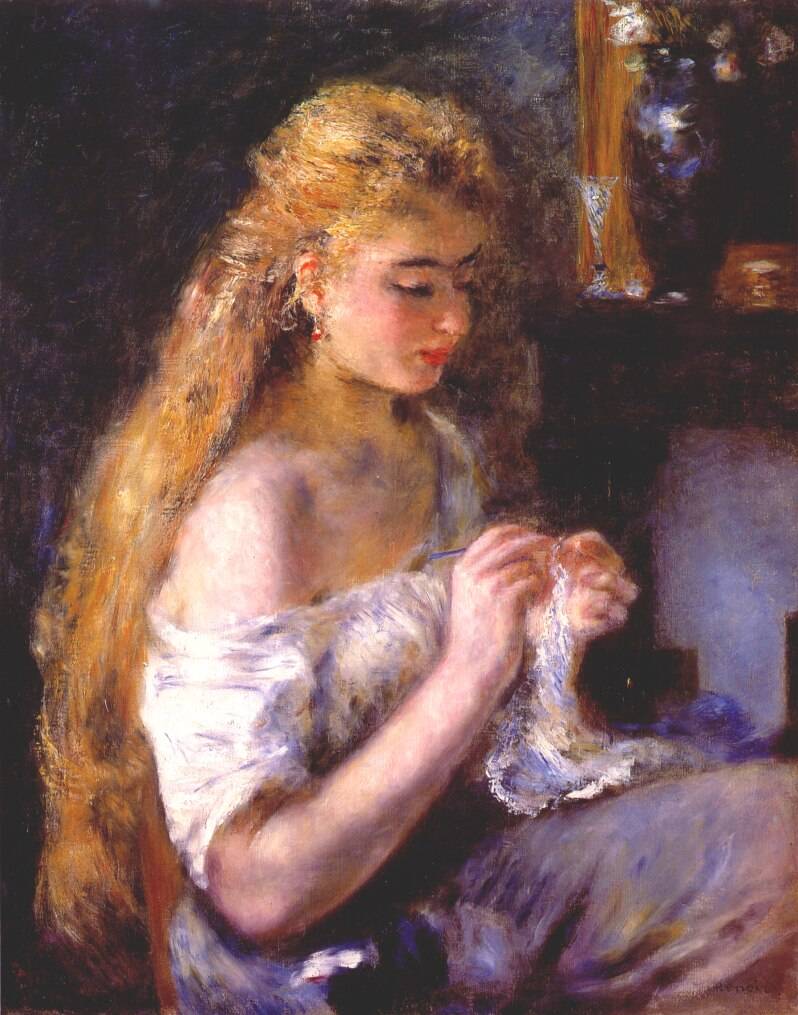
She does not look out at us. Her eyes stay on the work she holds close to her chest, following what her fingers are doing with the thread, and Renoir frames that small task between a pale blouse and a darker skirt.
A pale horse picks its way over rough rock with its rider, and smaller figures follow along the path behind. The White Mountains open out in the distance, but Homer, like his title, puts the bridle path first. The view will have to wait until the uneven ground has been crossed.
Brightly costumed figures gather in only part of the view, and no single action draws them into a story. Vegetation and warm light give the scene its breadth, and Turner gives the surroundings as much weight as the company. The title does nothing to narrow matters. Taken as an ordinary phrase, it sounds almost like permission to read the scene however you like.
Turner's other picture here could hardly be further from that warm, crowded scene. In the pale water and sky, a few firmer strokes make the boats and a sail recognisable, while other forms nearby are only loosely indicated. You are given enough to find the boats, and not much more. If this is evening, it is a pale one.
The soft hat does much of the work. Its shadow falls unevenly across the face, so that one eye catches more light than the other and some features stay in shadow altogether; the encounter is less symmetrical than it first seems. Degas builds his own likeness from carefully controlled differences of tone. Lower down, the red scarf stands out against the pale coat as a separate accent.
Morisot gives her firmest definition to a passing gesture. The raised arms make it plain that the girl is arranging her hair, while her clothing and the room around her are only lightly stated.
Gainsborough places the two young sitters close together without making a matched pair of them: their expressions differ. Their faces and pale clothing emerge from softly painted foliage, and because the setting is handled so loosely, the figures never look cut out and pasted onto it.
Here the proportions of the Linley portrait are reversed. Masses of trees and changing light establish the depth first. The house and a few figures come afterwards, just enough to show that people live here, and the house is tucked into the woods rather than set apart from them.
Lock, mill buildings, moving water: this is a landscape with work built into it. Constable ties trees, banks and reflections together with rough marks but lets the structures keep their distinct forms, so the mill reads as one working part of the river around it.
At Flatford the work is built into the lock and the buildings. Here people are doing it. Harvesters spread across a field so large that no single figure dominates, and each of them is part of a shared task. Constable organises the view in broad bands of field, trees and sky, which keeps the labour at the scale of the surrounding countryside. Does that scale dignify the harvesters, or simply absorb them into the view?
Mills and water again, but where Constable's structures hold their forms, Sisley lets reflections loosen the shapes of his buildings. Snow, architecture and water share a narrow range of cold colours without merging into one another, and movement and depth come from small shifts within that range. Thin verticals break into the sky.
Set this beside Renoir's Onions and the difference in temperature is plain. Renoir's table sits in warm light; Sisley's woven basket, grapes, apples and draped cloth are held together by cool shadow. Each of them needs a different kind of description, and although the marks are loose, the fruit keeps its rounded forms and the cloth its softer folds.
A figure reclines among lilies and patterned textiles, and Moore gives body and furnishings related pale tones and echoing curves. The figure is still recognisably a person, but it also works as one element in a pattern of shapes and colours across the surface, and the arrangement counts for more than any story. It is the flowers, not the figure, that give the picture its title.
The title says warrior. What the painting shows is a turning figure in a yellow costume, bright sleeves and a white ruff catching the light, with no battle and no story. The dress and movement fit the title, and the turn gives the pose an energy that a static stance would lack, but Fragonard's broad handling leaves the exact role open. If anything, the effect is theatrical.
Lemoyne's title is more certain than his picture. An older man leans towards a young woman. She turns, and the way she holds her hands complicates his approach. The elegant setting gives no further clue as to whether his attention is welcome, let alone returned.
Hardy needs very little to establish the actress: a long, pale silhouette and a small darker accent at the head. The figure partly merges with the lightly described room, and Sarah Bernhardt holds her place in it simply by being more defined than anything around her.
Explore this selection in Artline
See the selected works alongside books and events from their period, or compare when the artists lived. The books and events provide context, not evidence of direct influence. Works without confirmed dates remain in this guide.
What the hands do
Hands carry a good deal of the telling in this selection, though they do not all tell the same kind of thing. In Piero's Madonna, working with glances, they sort a balanced group into particular relationships. In the Bouguereau the grips are the story itself; without them there is no contest. Renoir's crocheting woman and Morisot's girl are each occupied with their own hands, one with thread and the other with her hair, and in both the small task is most of what the picture shows. In all of these the hands settle what is happening. Lemoyne's are the exception. The woman's hands are where some answer to the man's approach might be found, and instead they make his proposal harder to read.
Further reading
Anne Dayez, Michel Hoog and Charles S. Moffett · Read online or download · English
Written for the Metropolitan Museum's Impressionist centenary exhibition, this catalogue gives historical context for Renoir, Degas, Morisot and Sisley, and its discussions of individual works bring out how differently these painters approached figures and landscape. It has little to offer on the Old Master, British and academic pictures in this selection.
 Art, literature & history