The Centraal Museum collects art connected with Utrecht alongside work from wider Dutch traditions, and it follows art and design into the modern period. The city has its own history of painting, which includes artists who responded to Caravaggio in the seventeenth century.
Much of this selection stays close to Utrecht. Willem Cornelisz. van Swanenburgh paints its burgomasters with the city messengers, its banner and Vredenburg Castle. Hendrik van Oort and Bruno van Straaten paint its streets, a canal and its gates, and in one case the water has frozen and walkers and skaters have taken it over. Around that core are religious scenes, still lifes and portraits, among them Thérèse Schwartze's group of a mother with her children. Isaac Israëls has more paintings here than anyone else. His subjects, from women at a sewing table to a boxer at rest and a crowd at a fair after dark, take the selection a long way from the burgomasters' tiled room.
Artline made this selection from the museum's documented holdings, independently of the museum. Dates and attributions keep the qualifications given in the linked records, including approximate dates and date ranges.
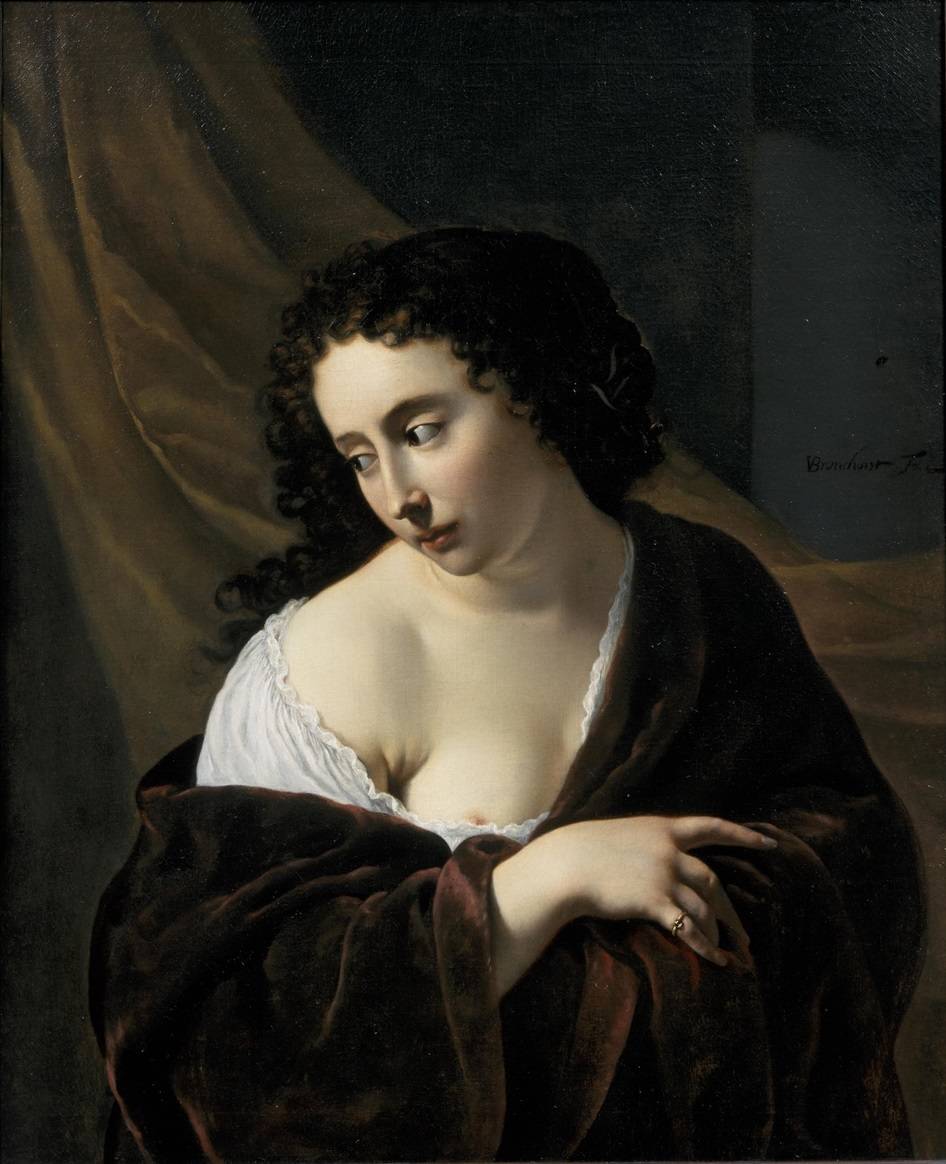
She is not named, and Bronckhorst gives her no elaborate setting, so the portrait rests on pose and dress. Her head tilts above a loose wrap and one hand lies across the fabric. These are small adjustments, but they are enough to show how her body sits beneath the clothes.
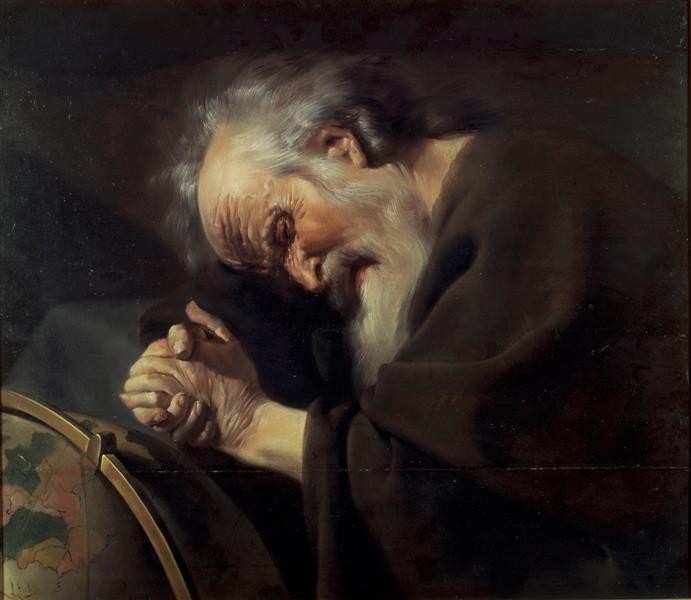
Heraclitus was an ancient philosopher, and Moreelse had no way of seeing him. This bent old man with a globe to contemplate is therefore a characterisation, not a likeness. Bronckhorst's young woman is a face without a name. Here the name comes from antiquity and there was no face to go on, so the expression had to be invented along with everything else. Moreelse gives his closest attention to the clasped hands and to the light across aged skin.
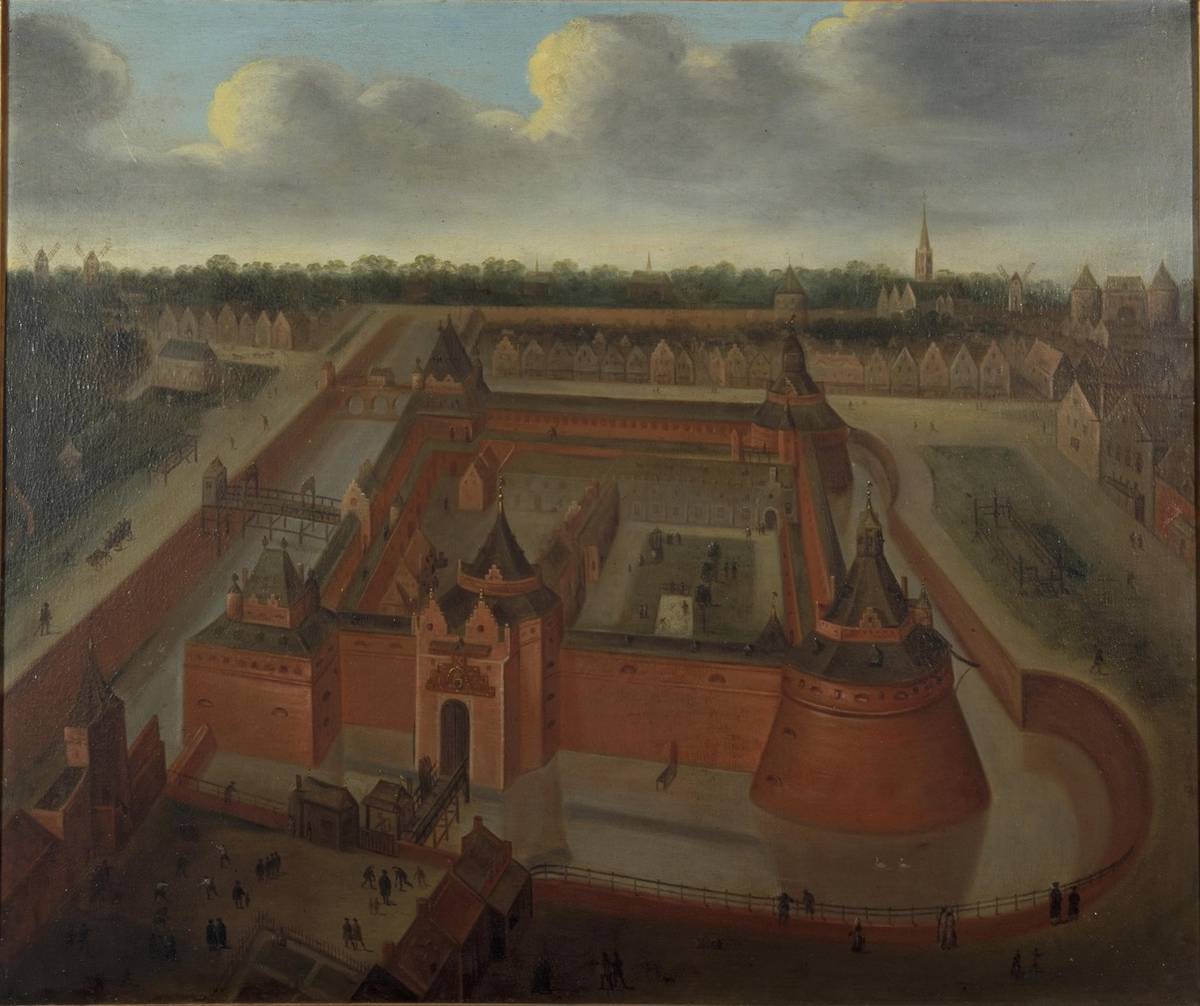
Nobody approaching Vredenburg Castle at ground level could have seen it like this. The viewpoint has been raised so that the walls, towers and surrounding water can be taken in together. Van Swanenburgh gives up the experience of arriving for a view that explains how the place is put together.
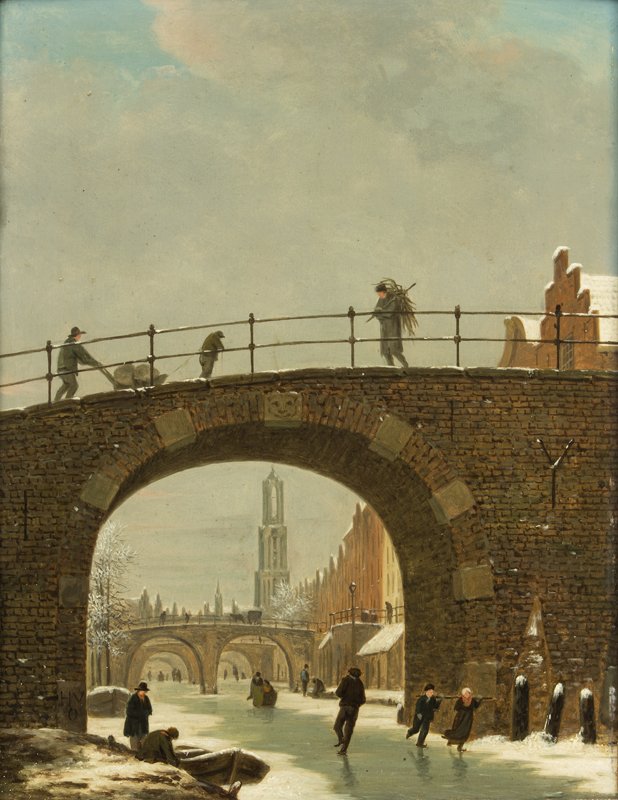
The Oudegracht view is built on a change of level. A bridge splits the scene in two: some people stand on it above the canal, others are down by the water, and through the arch a second crossing carries the route onward. The figures are small, and they are spread across these heights to show how people moved through an uneven part of the city.
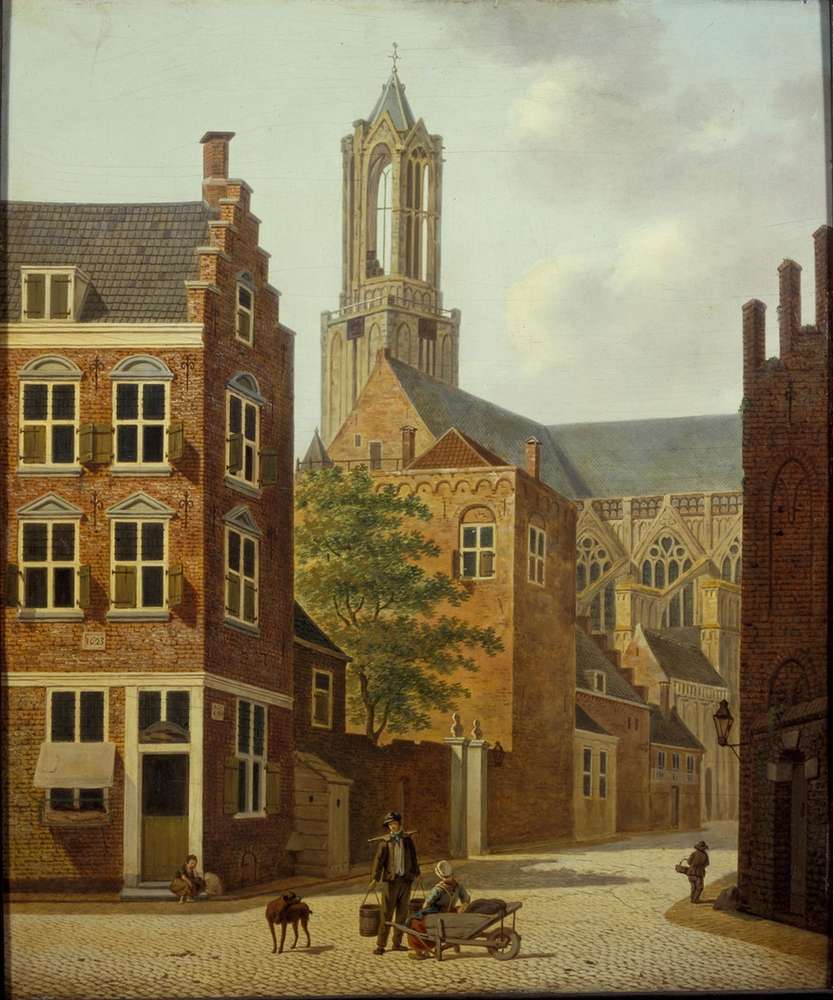
On the Pausdam the buildings have the upper hand. Tall façades leave only a fairly narrow strip at their foot, and a cart and pedestrians make their way along it. That is enough to show a street in use without reducing the architecture to a backdrop. The irregular roofline stops the façades settling into an even rhythm.
Winter has changed what the place is for. The water that normally separated the Tolsteeg Gate from its surroundings has frozen, and walkers and skaters have taken it over, while walls and a windmill make a solid skyline above them. Van Oort records a use of the city's edge that lasts only as long as the ice.
Van Oort's Tolsteeg Gate carries the same approximate date, but here the water is open and doing its ordinary work. Van Straaten sets the Weerd Gate on the far side of a broad expanse of it, so the city appears as it might to someone travelling towards it. Boats of different sizes mark out the distance, and a bright sail catches the eye before the shore does.
The infant is small, and De Veer does not enlarge him. The heads and hands of the group turn towards him instead, and that convergence is what makes him the centre of the picture. The gathering is kept tight, with shadow closing in at its edges.
Dress tells the burgomasters from the city messengers before any face is read, and Van Swanenburgh records these distinctions of office as carefully as he records likenesses. The tiled room places everyone within a single order, and an opening connects that order to the city outside.
Lazarus, raised from the dead, comes out of his tomb before witnesses, and Marienhof conveys the miracle through that audience as much as through the man brought back to life. De Veer's Adoration, from about the same time, packs its figures tightly together. Marienhof spaces his onlookers out so that each reaction stays distinct, and a rocky setting holds them in one scene around Christ and the tomb.
Van Swanenburgh painted this in the same year as the burgomasters. The officials have gone, and the civic emblem becomes the subject in its own right. The banner's broad division into red and white reads at once, while the tangle of bodies and weapons beneath it takes longer to sort out. The armoured figures, presumably the men responsible for carrying or defending it, are there to hold it up, and the picture gives them second place.
The title names the mother in full and simply counts the children. The painting is more generous to them. Six sitters are a lot to hold together without falling back on one shared pose or expression, and Schwartze manages it by grouping them closely and letting their different heights and glances keep each child distinct. The clothing is elaborate, as befits a formal family portrait, but the faces never harden into a repeated pattern.
The women along the table share a task rather than a pose. Bent heads recur from one working place to the next, linked by runs of pale fabric, and repetition of that kind could easily flatten the workers into a pattern. Israëls's loose handling keeps it irregular enough that none of them looks interchangeable. Schwartze, in much the same years, kept her family group distinct through height and glance. Here the unevenness of the paint does that job.
Fields and rows of trees divide the land into settled patterns. The rainbow crosses them without belonging to any of them, a passing effect laid over an ordered landscape and set off by dark clouds.
The earliest of the Israëls paintings here takes him to the Prinsengracht in Amsterdam. The title identifies the women by their work, but the picture shows them walking, not working. They move close together at the same pace, and that shared stride, more than any glance towards the painter, makes them a group. Israëls puts them at the centre and keeps the street around them busy.
The man is not named. The title identifies him only by his colour and his sport. The ropes place the scene in a boxing ring, yet he is sitting down, a trained body at rest rather than in action, and light and the turn of his body give him a solid presence in the crowded interior.
Bright machinery and a packed crowd compete for attention. Israëls picks out parts of people with small touches of light and leaves many faces unfinished. The broken handling suits the subject: at a crowded fair after dark, people are seen in fragments, wherever the light happens to fall.
Fruit, lobster and vessels crowd the table, but nothing has simply been heaped; each object has been placed. Most of the interest lies in the surfaces, in how differently the fruit skins, the lobster's shell and the darker vessels take the light. The display spreads towards the edge of the table without spilling over it.
Ormea fits a still life and a seascape into one picture, as his title promises. Large fish lie on a ledge close to the viewer, and beyond them tiny boats are out on a distant stretch of water. The jump in scale is abrupt, and it may simply be an awkward join, but it makes the pairing of catch and sea impossible to miss.
The latest of the Israëls paintings here leaves the fairground and the ring behind for a girl with a book. The book is small within the picture, but her whole pose is arranged around it. Israëls does not clear the room to underline her concentration. The furnishings and pictures around her stay in view, loosely painted, and she keeps her eyes on the page regardless.
Explore this selection in Artline
See the selected works alongside books and events from their period, or compare when the artists lived. The books and events provide context, not evidence of direct influence. Works without confirmed dates remain in this guide.
Officials and passers-by
Taken together, the Utrecht pictures show the city in two quite different ways. Van Swanenburgh's Utrecht is, broadly, the city as an institution: officials sorted by office, an emblem held up by armed men, a castle seen from above so that its plan can be grasped. Van Oort and Van Straaten come down to the level of the street and the water. There the figures and boats are small. They show what a place was used for and give its buildings and distances a scale. Israëls's Factory Girls on the Prinsengracht, set in Amsterdam rather than Utrecht, reverses that proportion. The people no longer give the street its scale. They are what the picture is about.
A practical, general guide to drawing, in which Harold Speed works through line, mass and the organisation of a figure. His terms help when comparing the carefully posed portraits in this selection with Israëls's more loosely painted figures.
 Art, literature & history