Twenty paintings from Rouen's fine arts museum, from Monet's cathedral and Pissarro's Pont Boieldieu to portraits, myths, history pictures and religious scenes by French and other European artists.
The Musée des Beaux-Arts de Rouen holds one of the notable public collections of painting outside Paris. It spans several centuries of French and other European art and includes important works by artists associated with Normandy. Monet painted Rouen Cathedral repeatedly, but the city's artistic history goes well beyond that famous series.
Of the twenty paintings chosen here, two take Rouen itself as their subject: Monet's cathedral and Pissarro's Pont Boieldieu at sunset. Around them are Sisley's landscapes, portraits by Ingres, Sargent and Blanche, history paintings by Delaroche and Delacroix, myths by Fontana, Boucher and Moreau, religious scenes by Le Brun and Van Loo, Judith Leyster's card players, a village funeral by August Hagborg and a crowded church ceremony by Herman van der Mast. Some are easy to walk past on a first visit. Géricault's study of a seated model seen from behind is one of them.
The selection is independent of the museum and drawn from its documented holdings. Dates and attributions keep the qualifications given in the linked records.
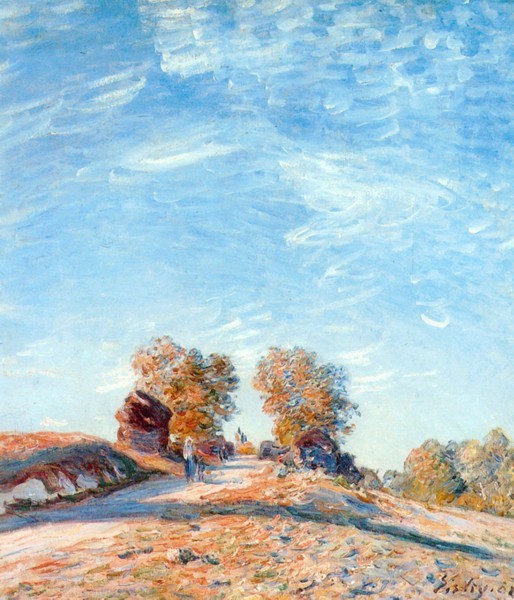
1891 · Oil on canvas · Musée des Beaux-Arts de Rouen
Nothing dramatic happens. A path climbs through warm, sunlit ground towards the trees, and a few walkers appear along it at different points. They work less as characters than as a scale: their shrinking size measures out the depth of the open hillside.
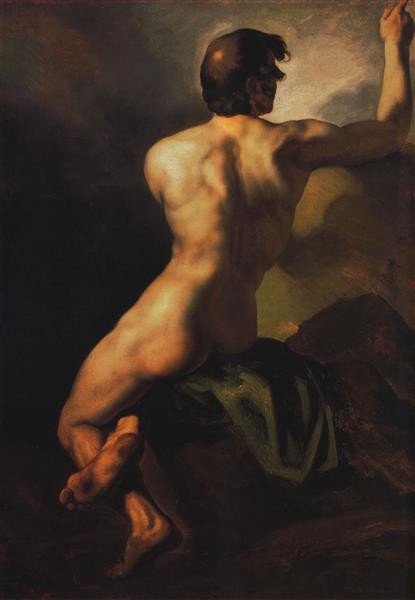
An academy, in this sense, is a study made from the nude model. Géricault's model sits with his back turned, so there is no face to read and the back has to carry the pose. Light picks out the join between back and raised arm. Lower down, the compressed legs take the weight of the seated body.
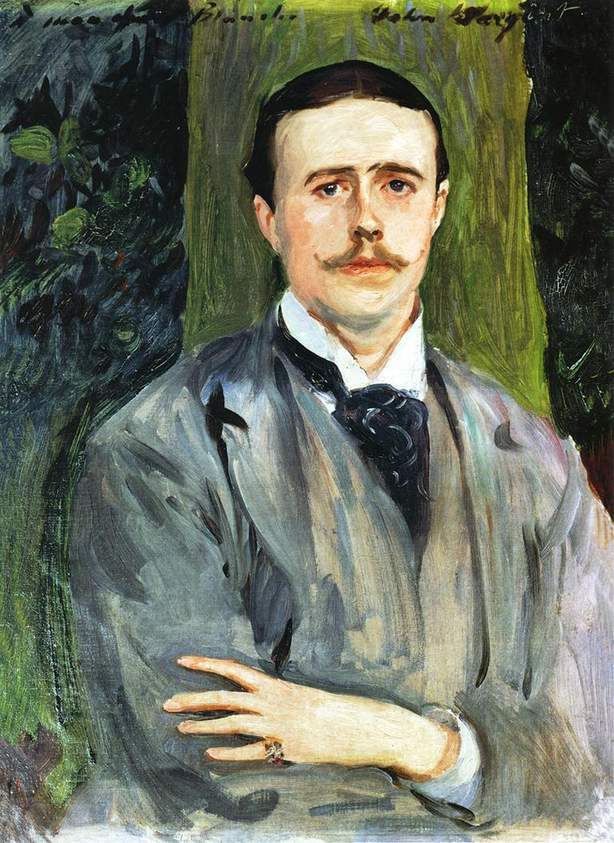
c. 1886 · Oil on canvas · Musée des Beaux-Arts de Rouen
The grey coat is one broad shape, and the hand crossing the chest breaks into it and loosens its stiffness. Beyond that, a pale shirt and a green background divide the canvas into a few clear areas, and nothing else clutters the setting. Sargent saves his sharpest painting for the face and handles the clothes broadly.
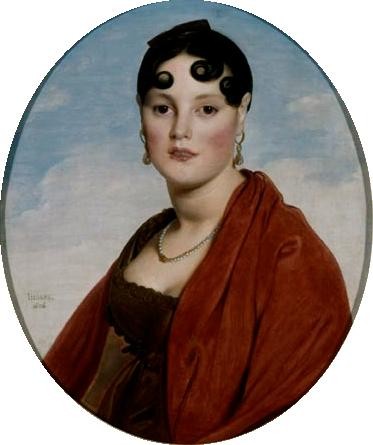
1806 · Oil on canvas · Musée des Beaux-Arts de Rouen
The title gives the sitter a formal name and a nickname: Madame Aymon, known as La Belle Zélie. The portrait is an oval, and its edge repeats the curves inside it, in the curls, the shawl and the turn of the face. Ingres gives each of these shapes a firm outline, which makes the design of the likeness emphatic. It could hardly be further from the broad handling Sargent gives Blanche's coat.
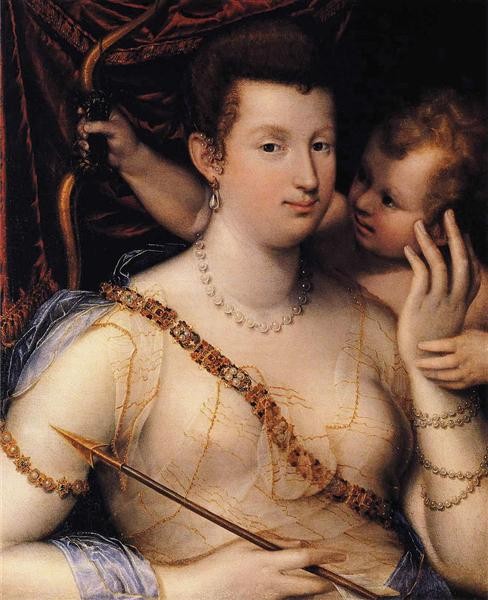
Cupid leans in towards Venus's cheek, bringing the mythological pair unusually close. Fontana picks out the pearls, veil and embroidered fabric with the kind of attention a portrait would receive. The picture may in fact be closer to portraiture than its subject suggests: tradition names a particular model for it, although the identification is not certain.
1814 · Oil on canvas · Musée des Beaux-Arts de Rouen
The title gives a rank, not a name. Géricault sets the polished breastplate, a hard surface across the torso, against the flesh of the face and hand, and the large hat takes up much of the space beside the soldier. The equipment is conspicuous throughout, yet it never entirely encloses the man wearing it. Géricault's academy study is the reverse case: a model with no uniform and no rank, and his face turned away.
Hagborg spreads the funeral along a road instead of gathering the mourners into one tight group. Villagers walk at different distances among the village's ordinary buildings, and the effect is closer to an event passing through a place than to a staged scene of grief.
1865 · Oil on canvas · Musée des Beaux-Arts de Rouen
An enormous ruin looms over the horses and small figures beneath it and almost outweighs them. The violence of the myth is hard to make out at first. You have to find it among the vast architecture and its dark openings, which slow down any quick reading of the scene. For once, the title is blunter than the painting.
1824 · Oil on canvas · Musée des Beaux-Arts de Rouen
This meeting never happened. The museum notes that Winchester never visited Joan in prison, so what Delaroche paints is an imagined interrogation, and he makes it work through colour and space. The cardinal's red robes fill the cell with their weight, while the ill Joan is hemmed into what room is left.
1894 · Oil on canvas · Musée des Beaux-Arts de Rouen
Monet crops so closely that almost none of the surrounding city appears, and the façade fills the canvas. Its stone is built up from grey and blue-violet marks that record the grey weather of the title.
The museum dates this canvas 1894, but notes that Monet worked on the cathedral series in 1892–1893 and dated the paintings later.
1840 · Oil on canvas · Musée des Beaux-Arts de Rouen
After Delaroche's cell, a crowd. Delacroix fills the canvas with banners, figures and crossing gestures, and you need the emperor's bright horse to find Trajan at all. His justice is shown as a public encounter in motion. The people around him are part of the subject, since the judgement is given in front of them.
The blessing is the point, and Van Loo makes sure it reads at once by setting the standing Child's raised hand clearly against the background. Yet the child making this ceremonial sign can only stand because Mary holds him up.
1897 · Oil on canvas · Musée des Beaux-Arts de Rouen
This time surf, not walkers, measures the distance. Bands of breaking water, one beyond another, lead out towards the rocks and the headland. Sisley handles the coastline fairly firmly and the water in changing, broken marks, so the shore can still be followed as it recedes.
Cupid again, now at his own wedding rather than leaning towards Venus's cheek, and Boucher's arrangement is about as far from Fontana's close pairing as it could be. The figures spread in an open curve across the clouds, with nothing earthly beneath them. Gaps are left between them, so the celestial company never closes into a solid crowd, and smaller winged figures and drapery carry the gathering further.
1896 · Oil on canvas · Musée des Beaux-Arts de Rouen
Monet crops the city away. Pissarro lets it in. The bridge runs as a clear diagonal through smoke and evening haze, and people and vehicles are small marks along it. Smoke and weather share the same air, and the river and buildings are seen through both. It is not easy to say where the mist of the title ends and the smoke begins. This is Rouen as a working city.
1893 · Oil on canvas · Musée des Beaux-Arts de Rouen
This is a second closely cropped church, and it pairs naturally with Monet's cathedral. Sisley paints the sunlit stone yellow and the shadows blue-violet, so the building divides into warm and cool areas. Monet uses blue-violet too, but for overcast light rather than shadow. The bigger difference is that Sisley keeps the street. Small awnings and figures set the church in its surroundings, while the close crop still gives its walls considerable scale.
The game is already under way, round a barrel that serves as a table. The woman in red turns from the players' circle towards the space beyond it, and another player holds cards where they can be seen. Both gestures take in someone outside the group, perhaps the viewer. Who is meant to see those cards? The picture does not settle it. Glances cross the barrel in several directions, and you are left to work out how the players relate to one another.
Many people take part in this ceremony, but they are not each treated as a separate portrait. Groups kneel or stand at different points in the church, and their dress and bearing mark out their roles. The architecture leads back to the mass further inside and gives the large assembly a common order.
Blanche, Sargent's sitter earlier in this selection, is the painter here. Valéry sits upright but rests his cheek against his hand. The hand props up his head and eases the formality of the pose, and the gesture may suggest thought. His pale face is set against a patterned red ground.
The "before Paris" of the title can be taken literally: Genevieve reads beneath an angel, with the city visible in the distance. Light falls mainly on the figures in the foreground, so the scene looks like secluded devotion. The city behind them ties it to a world beyond.
Explore this selection in Artline
See the selected works alongside books and events from their period, or compare when the artists lived. The books and events provide context, not evidence of direct influence. Works without confirmed dates remain in this guide.
The cathedral and the bridge today
You can still visit the places Monet and Pissarro painted, and comparing them with the canvases shows how much each picture selects. No modern view will match the painter's position or weather, and the historical surroundings have changed.
Further reading
Anne Dayez, Michel Hoog and Charles S. Moffett · Read online or download · English
This Metropolitan Museum publication combines catalogue entries with historical essays on Impressionism, including material on Monet, Pissarro and Sisley. It gives useful background for their paintings in this selection. The other artists here fall outside its subject.
 Art, literature & history