Twenty paintings from Auckland Art Gallery Toi o Tāmaki: a good deal of Rita Angus, Auckland's streets and waterfront, a cavalry battle and a funeral for an Egyptian cat.
Auckland Art Gallery Toi o Tāmaki is one of New Zealand's principal art museums. Its collections take in historical and modern painting and work by Māori and other artists from Aotearoa New Zealand, and it shows the country's art alongside work from elsewhere.
This selection leans towards New Zealand painting, and above all towards Rita Angus, who has six works. They range from the furnished portrait of Betty Curnow to a puzzling assembly of seahorses, rings and letters that declines to explain itself. Many of the other pictures name particular places: Auckland's Queen Street and wharf, and the views by Clas Edvard Friström and Frank Wright at Piha, Karekare and Grey Lynn.
Not everything here was painted from life. Matthew Thomas Clayton's two paintings look back at earlier events: a voyage of exploration and Hobson's landing at Waitangi. Of the works from outside New Zealand, Salvator Rosa's cavalry battle stands apart from everything else, in age as much as in subject. John Reinhard Weguelin's funeral for an Egyptian cat looks just as remote, but it sits closer to Clayton's pictures than its subject suggests.
Artline chose these works from the museum's documented holdings, independently of the museum itself. A work's place in the collection does not mean it is on display, and any of these may be on loan or off view. Dates and attributions keep the qualifications given in the linked records, including approximate dates and date ranges.
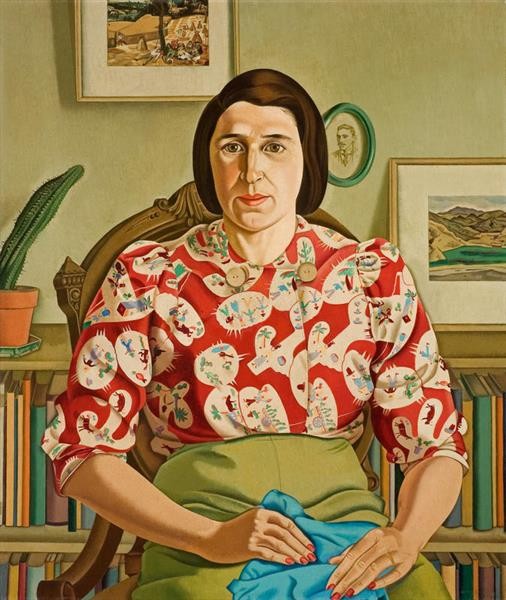
Angus places Betty Curnow in a particular room, among books, pictures and patterned cloth. The furnishings are part of the portrait rather than a backdrop, but they never crowd her, and what holds the picture together is her steady gaze.
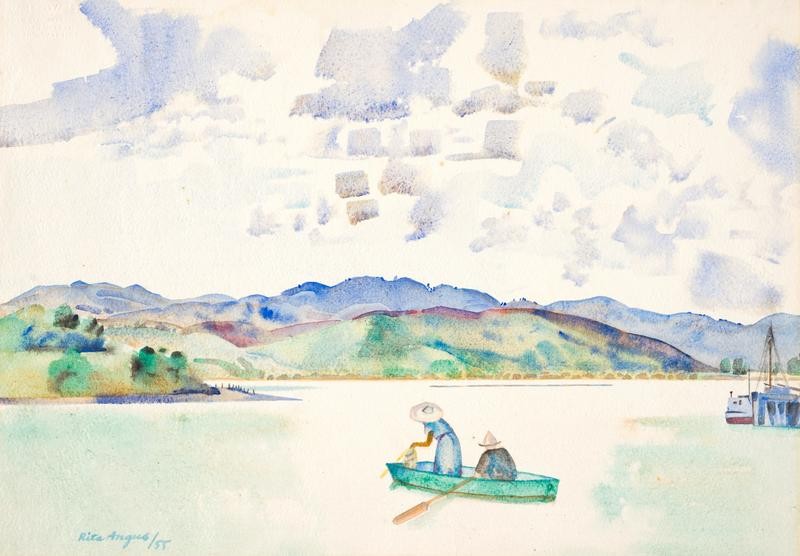
Mangonui is on paper, and the paper does some of the painting. Angus leaves intervals of it bare around the coloured passages, and those untouched gaps supply part of the light. The harbour itself is set out in relatively few divisions: low hills, broad marks of cloud, pale water, and a small boat that gives the water its scale.
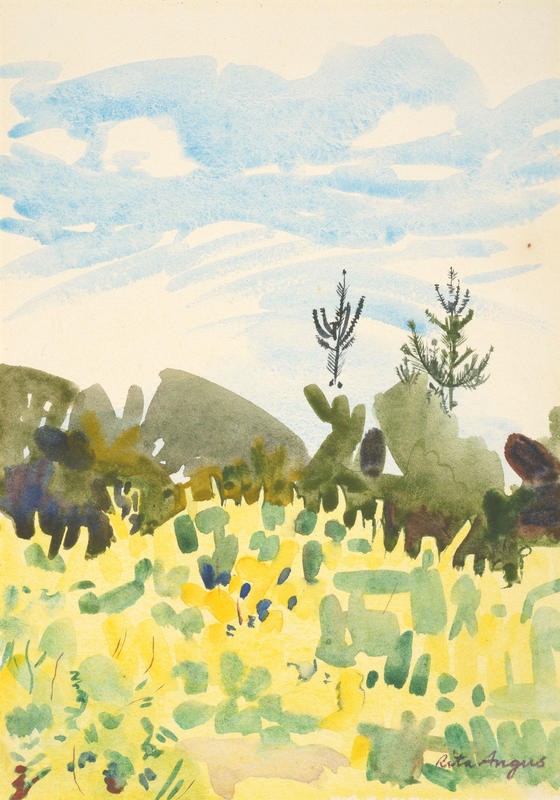
Yellow lupins fill the foreground, but not as a single block of yellow. Angus builds the clump from separate marks, and these keep differences within the growth. Higher up, the marks spread apart into shrubs and then a lightly indicated sky. That change of spacing does most of the work of turning plants into air.
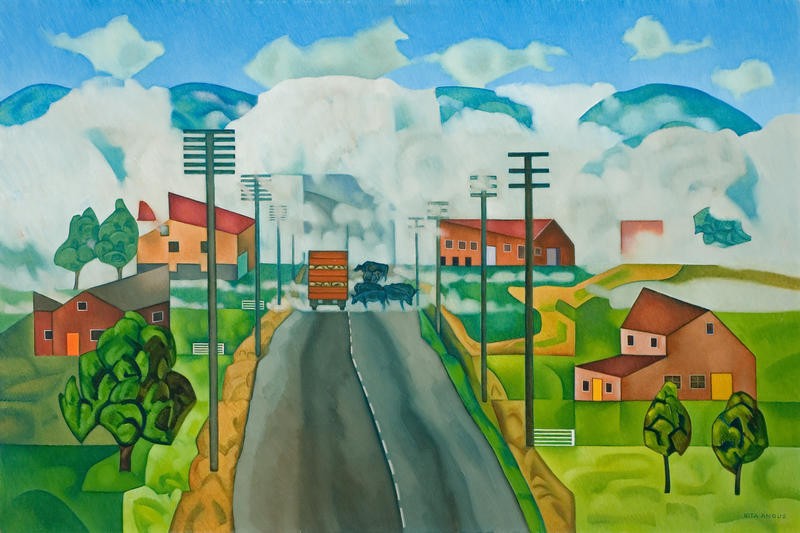
This is a curiously legible fog. Pale masses of cloud work against the clear directions of a road and telegraph poles, but they are not allowed to dissolve the view, and the houses keep their sharply described forms.
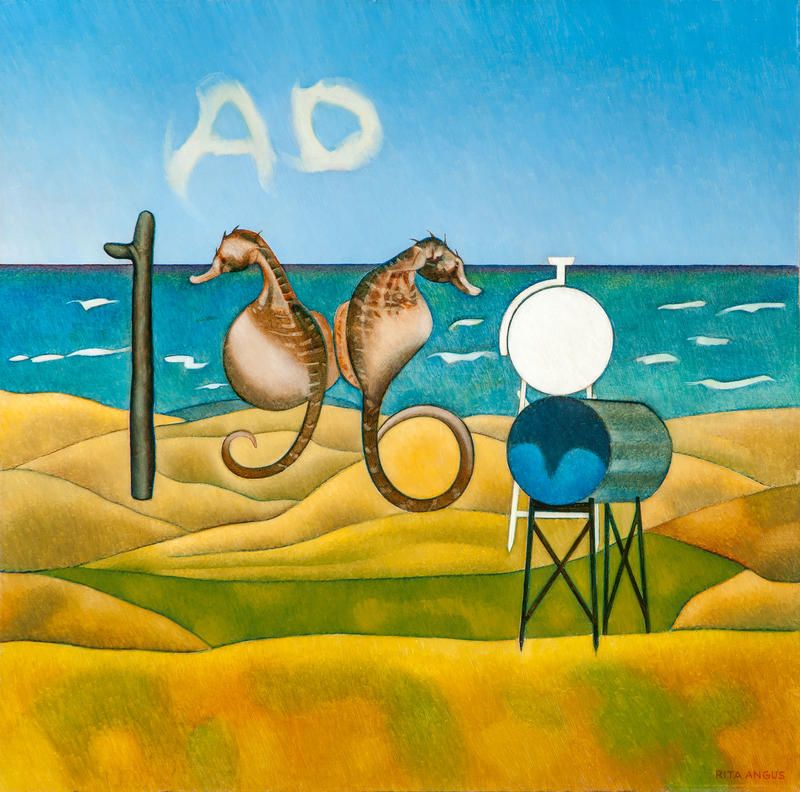
Seahorses, rings, letters and a raised circular form can each be recognised, but together they describe no ordinary place. Angus paints the gathering with a clear surface and offers no equally clear explanation. In Fog, Hawke's Bay, painted a year later, firm houses give the viewer bearings in a soft atmosphere. Here the forms are just as firm, and the bearings are missing.
Nor does the title help. It is simply the year of the painting, formally styled with its AD, and offers nothing that might serve as a key. Do the seahorses and rings stand for something? They may, but the painting does not say.
Angus sets the outlined face against a plain, warm ground that offers it little competition. The pose is frontal, yet small differences around the eyes and mouth break its symmetry, and the open collar interrupts the darker mass of the jacket. The title gives no name, only a general description. The painting is more particular than that: a specific person seems to come through in these limited variations.
The contrast with the Portrait of Betty Curnow is pointed. Curnow is named in her title and given a furnished room. Here there is no name and no room, and the face carries the portrait alone.
In effect, this is the portrait of a single tree. The pōhutukawa spreads low across the coast, and its silhouette carries the picture. Its red flowers are kept to small dots in the dark crown and never break up the mass. Behind it a broad blue sky runs on largely unbroken, and every bend of the tree reads clearly against it.
Friström puts the viewpoint down among nearby grass, which partly hides the rocks and sea beyond. The coast can still be made out, but it arrives in fragments through the vegetation, much as it might to someone standing in the landscape rather than surveying it.
The title names the road and the district, but it names the gum trees first, and the picture gives them the same priority. They stand tall enough to give this stretch of the Great North Road a different scale from the low buildings beyond. Light picks out parts of the trunks and the rough ground at the street's edge, so the untidy margin holds its own beside the road itself.
The hillside closes the view at a modest depth, which leaves little room for distance to separate one thing from another. Friström separates them by colour temperature instead: a tree painted a cool blue, an unlikely colour for a tree but an effective one, against warmer grass. The two stay distinct even where their outlines are loose.
A valley this dense with vegetation could easily have made a thicket of a picture. Wright organises it with overlapping ridges, each paler as it recedes, so the view opens out in stages from the growth close at hand to the profiles of mountains. Friström's Piha Valley, shut in by its hillside, has no such recession to work with.
Light catches only some patches of the vegetation, and that unevenness is how Wright conveys the clearing weather: the light is getting through, but not yet everywhere. A path and a stream lead through the scene. Small figures occupy an opening within it, small enough to seem secondary to the light.
Morning after Rain, from the same year, catches light arriving. Here it is leaving. The near water and shore have already passed into cooler shadow, and only the headland still holds the gleam. Wright keeps it there rather than spreading it across the sky.
Clayton puts the Resolution and the Adventure into heavy weather. Their angled masts take up little of the picture, and the ships look small and exposed on the sea. This is a reconstruction made after the voyage, not a record of it, so the vulnerability belongs to the way the episode was later imagined rather than to anything Clayton witnessed.
Here again Clayton lets the setting dwarf the event. Small groups and boats gather along a shore overwhelmed by the broad harbour, and from that distance the landing looks orderly. Distance does a good deal of tidying. This too is a reconstruction after the event, and its order belongs to the composition; it is no evidence that the colonial event itself was uncomplicated.
Carabain's subject is the street itself rather than anything happening in it. Commercial façades converge towards the distance and give the traffic a clear framework. Pedestrians and vehicles are spread through that architecture without any one incident taking charge, and their small moving figures are what give the buildings their height and extent.
Where Carabain lets the façades of Queen Street frame his view of the city, Gifford half hides it behind the business of the harbour. Masts and rigging stand between the viewer and the buildings, and the wharf, a point of arrival and trade, gets a busy foreground of working vessels.
Nobody is present, yet the room is plainly in use. Everything turns on the hearth, and Atkinson describes this particular interior closely: the kettle, the utensils, the rough boards showing where daily tasks were done. The only occupant is the one supplied by the title, an unnamed settler.
The oldest picture here is also the least obliging. Under a dark sky, horses, weapons and bodies overlap in small actions that are hard to disentangle, and there is no single hero to organise the view. Fragments of architecture hint at a setting without offering any secure vantage over the fighting.
Obsequies are funeral rites, and Weguelin gives an Egyptian cat the full ceremony: carefully arranged vessels, offerings and an animal-shaped coffin, all set out in the detail of a staged scene. This is a nineteenth-century reconstruction of antiquity. Its precision guarantees nothing about archaeological accuracy, and the convincing objects are themselves part of the invention.
Explore this selection in Artline
See the selected works alongside books and events from their period, or compare when the artists lived. The books and events provide context, not evidence of direct influence. Works without confirmed dates remain in this guide.
Seen and imagined
Weguelin's Egyptian cat has this much in common with Clayton's ships and landing: none of them records anything its painter saw. Yet the funeral was painted in the same year as Atkinson's kitchen, and within a few years of Gifford's wharf and Carabain's street, and its vessels and coffin are described with much the same care as Atkinson's kettle and utensils. An imagined Egyptian rite and a settler's hearth at Opua Whanga get the same patient attention, so close description is not much help in telling invention from observation. Nor are the pictures of real places neutral records. Gifford's title promises Auckland and delivers a good deal of rigging, and at Piha Heads Friström lets grass get in the way of the very coast he names.
Harold Speed's manual treats line, mass and rhythm as separate questions. Those chapters give practical terms for the different ways these painters build form: the outlined face in Angus's Head of a Māori Boy, the dark silhouette of Friström's pōhutukawa, the overlapping ridges of Wright's Karekare valley. It is a general drawing manual and says nothing about New Zealand art or these painters.
 Art, literature & history