Twenty works, mostly Australian: landscapes from a cavern to a rough sea, city streets, Dorrit Black's geometric modern pictures, portraits, and stories from the Bible, Roman history and fairy tale.
The Art Gallery of New South Wales in Sydney collects Australian art, Aboriginal and Torres Strait Islander art, Asian art, and painting from Europe and elsewhere. Most of the works chosen here come from the Australian collections, and landscape runs through much of the selection. The colonial painters cover very different ground. Conrad Martens goes underground into a cavern, Thomas Clark into a fern gully, Henry James Johnstone to a billabong on the Goulburn and Louis Buvelot along a worked track at Lilydale. Arthur Streeton moves from a river valley to a wet street by a railway station and then to a harbour cove. John Russell paints coast and sea, and in one picture a man set against the water. Dorrit Black's geometric modern pictures take in a parish hall, a Sydney street and a naval funeral.
The portraits include Nicholas Chevalier's self-portrait and Cecil William Rea's Inez Bensusan. Gordon Coutts's Waiting places a seated figure indoors with landscape beyond. A smaller group turns to older stories: William Strutt's David with the lion, Sir Edward John Poynter's Solomon and the Queen of Sheba, John D. Batten's Snowdrop and Matthias Stom's Mucius Scaevola.
Artline selected these works from documented museum holdings, independently of the museum. Inclusion does not mean a work is on view, because individual works may be on loan or off display. Dates and attributions follow the collection records, qualifications included.
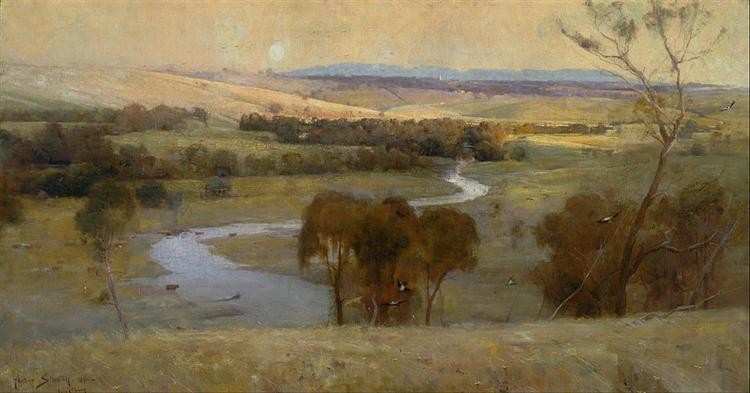
1890 · Oil on canvas, later mounted on hardboard · Art Gallery of New South Wales
Streeton borrowed his title from Wordsworth and gave the line an Australian valley. The words speak of a stream that glides now and will glide for ever, which is a large thought to attach to one valley. The painting answers with a particular river winding from the foreground towards distant hills. Its narrowing width is the main way to judge how far off each stretch lies. Trees break into the near view.
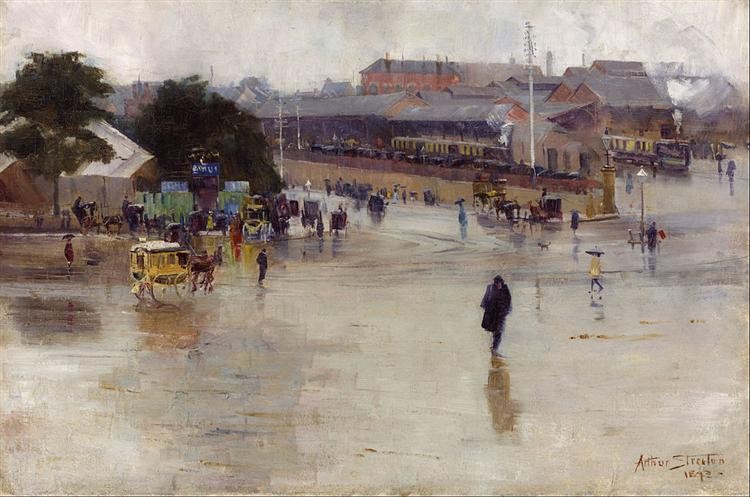
1893 · Oil on canvas · Art Gallery of New South Wales
Streeton's Redfern is a city picture made largely out of weather. The people in the street walk apart from one another, but the wet ground links them. It repeats each dark figure as a reflection and spreads movement across the grey foreground. Smoke and damp air soften the railway buildings, so the solid architecture never quite takes over.
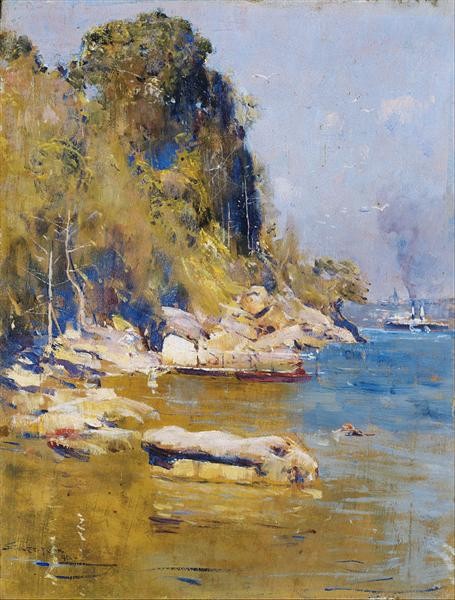
1896 · Oil on plywood · Art Gallery of New South Wales
The title speaks in the first person and places the view at "my camp", and the picture keeps to that scale. After the broad prospect of Still Glides the Stream, this is the harbour as someone standing on the shore would see it. Single rocks come first, close at hand, then small boats on blue water, until a steep wooded bank closes off the view. Attention settles where shade meets sunlight.
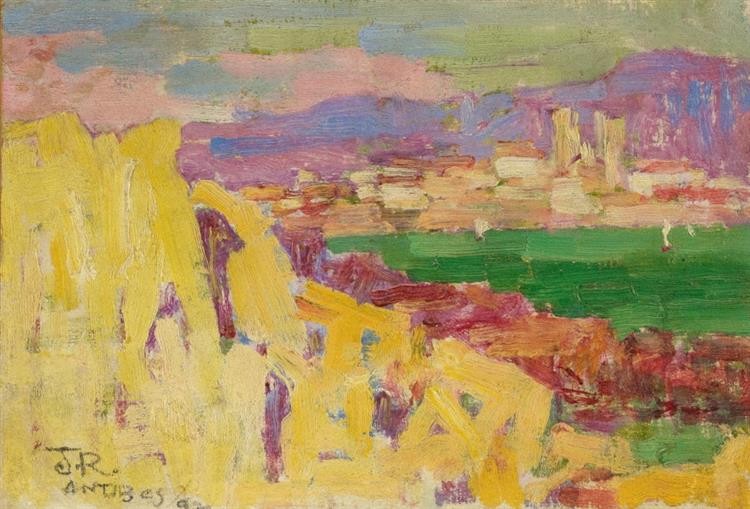
Russell sets out the coast in broad colour: yellow cliffs, pink buildings and green sea. The place is recognisable before any small detail is needed. Foreground, town and water each keep their own area of colour. Where one meets another, the edge between them does the work an outline might otherwise do.
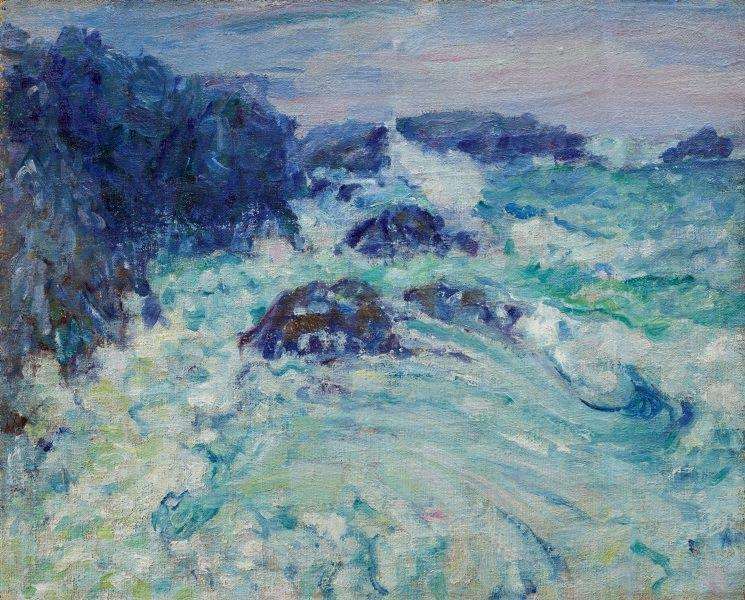
Anyone looking for one great breaking wave will not find it. Russell's strokes curve round the rocks with the moving water and keep changing direction, and in places no complete wave can be picked out at all. The motion is spread across the whole blue-green surface. Only the dark rock holds firm against it.
The title gives the man a name and calls him a friend. Russell sets him against the sea and paints the two in much the same way, with blue running through his beard and clothes and on into the water behind him. What stops him dissolving into that texture is the long tool he grips firmly. It keeps his body distinct and gives the pose its clearest direction.
Angles for the building, curves for the garden. The hall's pointed roofs and straight walls, echoed in the rhythm of its windows, stand against a curved path and clipped green shapes outside. Dorrit Black simplifies the scene by keeping that difference clear. She does not give every surface the same detail.
Tracks curve through tightly packed blocks of red, cream and green, and buildings and trees tilt. The sense of movement comes from the whole design, not from any single incident in the street. Black leaves out much incidental description. What she keeps is what guides the eye through a city: routes, repeated angles, one mass cutting across another.
Dark hats and white crosses repeat across a red field. Individual figures can still be made out, but they stand in ranks, placed as the ceremony requires rather than as they might choose. In The Parish Hall and Elizabeth Street, Sydney, Black's simplifying geometry reorders ordinary places. Here the subject arrives already ordered, and the picture's regularity seems to owe as much to the ceremony as to her style.
David stands bare-legged over the fallen lion, whose mane fills the foreground. The difference in size states the feat at once: the smaller body has overcome the larger. A raised hand completes Strutt's staging of the biblical victory. The title looks further ahead than the scene does, since a first victory implies others to follow.
Even the title puts the gully first and adds the family after it, and the picture keeps to that order. Arching ferns dominate, and the Aboriginal family occupies only a small part of the scene. The land is shown as inhabited, but attention goes to the vegetation. That proportion was the painter's choice about what to make visible. It is not a neutral measure of whose presence mattered.
A billabong is a pool or backwater cut off from a river, in this case the Goulburn. Trees on the dark bank are mirrored in the still water, which extends the bank downwards and closes the pool in further. With so much of the view shut in, a pale opening beyond carries unusual weight. It is the main way into the distance, and a narrow one, squeezed between the trees and their reflections.
A cavern gives a landscape painter no sky to work with. Instead, Martens relies on light catching the irregular edges of the stone and picking each formation out of the darkness. A small figure supplies the sense of scale that an underground view would otherwise lack. The enclosed space still recedes as a landscape would, its depth built from a few lit passages of rock.
Chevalier's wide hat enlarges his silhouette and leaves much of his face in shadow. His eyes, cheek and beard catch enough light to establish a likeness, and the dark mass around them holds attention there. Since he is both painter and sitter, how much of the face stays under the brim is, in effect, his own decision about how to present himself.
Rea gives Inez Bensusan no overt gesture, so a good deal rests on one small movement. She is dressed in green, and her gathered hands anchor the lower part of the figure while her head turns slightly away from the direction of her body. That turn keeps the pose from settling into a single line, and it lets the lit face act independently of the still posture.
The title names a pause without saying what will end it, and the picture does not say either. The figure's hands rest on the chair, and pale fabric catches light from the window. Beyond the room the landscape carries on, in a direction the seated figure does not follow. Is that outside world what the figure is waiting for, or simply what goes on regardless?
1890 · Oil on canvas · Art Gallery of New South Wales
Poynter's imagined ancient court is crowded with steps, costumes and assembled figures, and the meeting named in the title could easily be lost among them. Repeated columns give the scene its framework, and that order is what lets the royal encounter be found within the spectacle. The architecture also marks out rank among those present.
Snowdrop lies asleep across the foreground. Her long horizontal body slows the arrangement of the smaller figures gathered behind her, presumably the little men of the title. Warm reds and golds tie them to the decorated interior. Batten makes the fairy tale a held moment, built around the sleeper and those watching her.
The earliest work in the selection is also the most severe. Mucius holds his hand over the flames, and the light seems to spread from that point across faces and clothing before giving way to darkness. The thing that lights the scene is also the thing doing the harm. Stom concentrates the moral claim of the Roman story in one small, exposed part of the body. The people gathered round witness the act, and its physical cost stays at the centre of the picture.
Cut branches and uneven ground break up the foreground before the track opens out towards fields and hills. The land nearest the viewer has been worked, so the way into Buvelot's settled view begins among things that have been cut or handled.
Explore this selection in Artline
See the selected works alongside books and events from their period, or compare when the artists lived. The books and events provide context, not evidence of direct influence. Works without confirmed dates remain in this guide.
What the landscapes leave small
In several of these landscapes, people, tracks and signs of work take up little of the picture compared with their setting, though not always for the same reason. The figure in Martens's cavern is there mainly to give the stone its scale. In Sirius Cove, Streeton's boats are small marks on the way out across the water. Clark's gully is the case where the scale matters most, because the painting makes small the very people its title names. Buvelot reverses the arrangement. At Lilydale the evidence of work comes first, nearest the viewer, and the open country lies beyond it.
John Ruskin's The Elements of Drawing is a historical drawing manual, built around exercises in looking at trees, water, light and distance. Many of these landscapes are made of exactly those things, from Streeton's winding river to the reflections in Johnstone's billabong. Ruskin offers a practical way to study such effects, which is to draw them.
 Art, literature & history