 Art, literature & history
What artists made of the Space Age
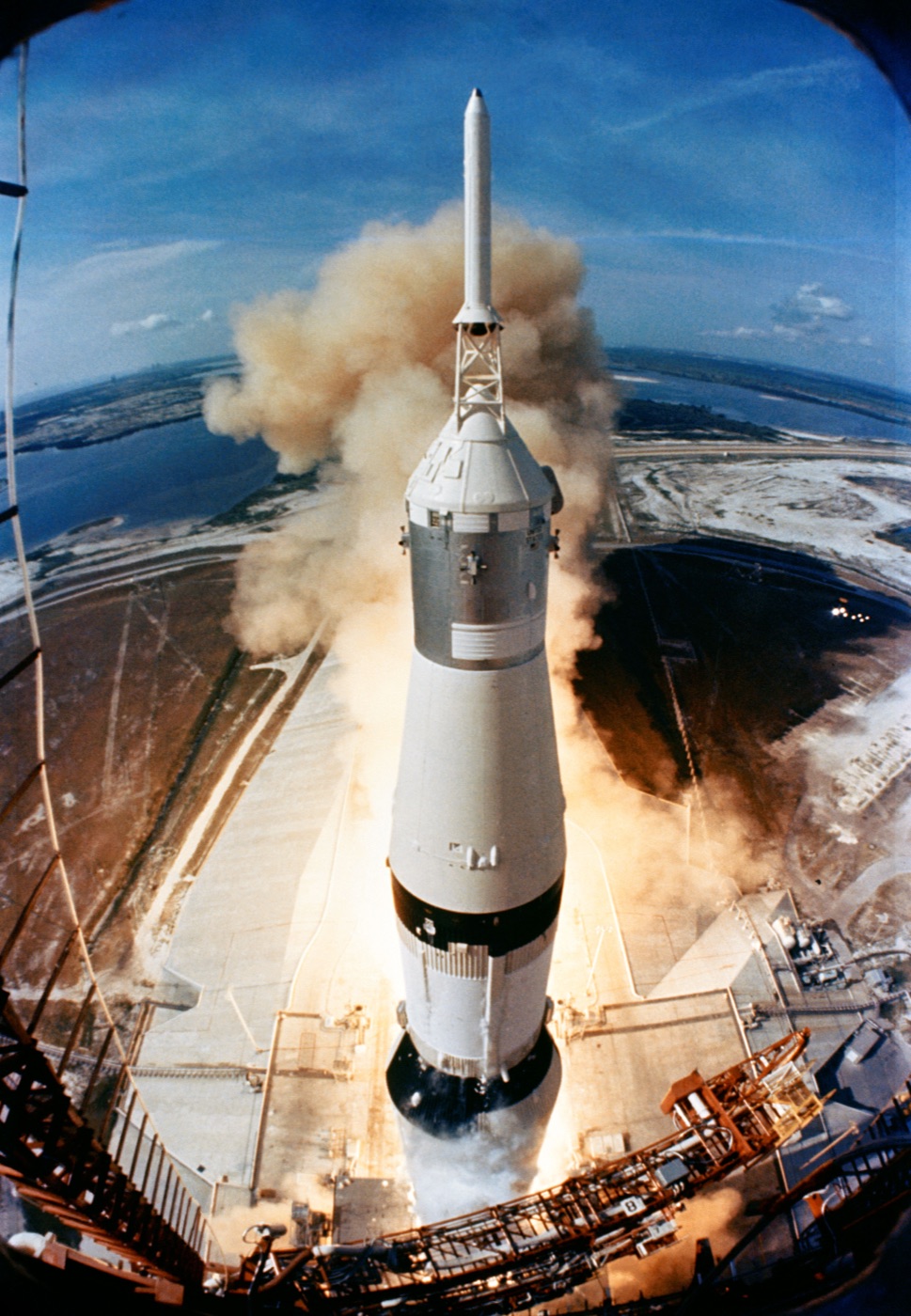
When Apollo 11 lifted off from Florida on 16 July 1969, Robert Rauschenberg had an invitation to attend. NASA also supplied photographs for the prints he made after the launch. By then, artists had already put spaceflight to work as a street spectacle, a political promise and a role anyone might try on. Rauschenberg’s prints ask how much of a public event an image needs to retain for us to recognize it.
Gagarin becomes a public figure
On 12 April 1961, Yuri Gagarin made the first human orbit of Earth. Aleksandr Deyneka’s watercolour of the following year shows Gagarin’s helmeted likeness displayed in a Paris street, where red lettering and smaller printed sheets compete for space. The street already has its own traffic. Pedestrians carry on beneath the bright awnings, and the portrait is there for anyone passing through.
A promise of safe return
In May 1961, John F. Kennedy set a national goal of landing a crew on the Moon and returning them safely to Earth before the decade ended. That second part of the pledge gives the white parachute beside Kennedy’s orange portrait in Retroactive II a particular charge. A small figure hangs below the parachute.
Rauschenberg combined oil with silkscreen, a process that transfers images through mesh. The images keep their distinct edges, and pale vertical bands separate Kennedy’s face from a pointing hand farther down the canvas. In 1963, six years before Apollo 11 lifted off, Rauschenberg could already set a recognizable public image among fragments that altered its meaning. In the launch prints, even the origins of some of those fragments would be hard to discern.
Polke tries on the part
With square eyes and a pale green grin, Sigmar Polke tries on the role of astronaut. His 1968 picture sets the oversized face against a pattern of spaceflight motifs. Polke can let his outsized face cover parts of the repeating pattern and still have enough globes, capsules and astronauts left to establish the part he’s playing.
Gagarin’s date on the screen
Seven years after Gagarin’s flight, Joe Tilson put 12 April 1961 in the title of his 1968 work and printed it beside Gagarin’s name. The rounded black frame gives the photograph-like portrait the look of a television picture, while the date turns it into a commemoration. The name and date stay within the frame even where a blue diamond crosses its lower border.
The weight of the helmet
Renato Guttuso’s 1968 oil portrait brings Gagarin close enough for the equipment to take up much of the canvas. The broad rim encloses his face, while bands, fastenings and a round fitting crowd it from below. The helmet looks heavy. Gagarin’s eyes are turned slightly upward at something outside the picture, and that small movement gives the face a life of its own inside the rigid enclosure.
From NASA’s cameras to the lithography stone
Apollo 11 was planned with viewers on Earth in mind. Its objectives included deploying a television camera to transmit pictures back to Earth and using still and motion picture cameras to document the exploration. NASA supplied photographs for Rauschenberg’s Stoned Moon series, printed at Gemini G.E.L. in Los Angeles in 1969–70. In the studio he drew directly on the lithography stones with crayon and a water-based drawing liquid called tusche. The stone was a printing surface where material from a camera could meet marks made by hand.
The Rauschenberg Foundation identifies those two sources of imagery for the series as a whole. In Loop, made in 1969, it remains uncertain where individual marks came from. A broad gray sweep crosses fine hatching and holds together even where dense strokes break into flecks. The sweep and the two dark circles low on the sheet give the print distinct forms without identifying what they depict.
An uncertain object in Spore
Spore is an unusually suggestive title for a print made in connection with a Moon launch. It brings something living to mind. The pale tapered form could also suggest a piece of equipment, with its framework of light lines and the dark band beneath it. In this 1969 color lithograph, short ochre strokes pack close enough in places to establish an edge. Elsewhere that edge dissolves back into the surrounding color.
Space behind the canvas
There is another history of space in these works, and it starts before Gagarin’s flight. In 1960, Lucio Fontana was already making depth a physical feature of a picture. Four narrow slits open through the blue canvas. One stops well short of the others, and shadows along the curved cuts make their widths appear to vary.
A globe on a flat sheet
Victor Vasarely gets depth out of the geometry of a flat sheet. In his screenprint, dated around 1969, the grid stays regular at the pale corners, giving a measure of how far the squares swell toward the middle. The same deformation runs across the red, blue, green and purple areas and makes them appear to lie on the surface of a single sphere.
Pasmore gives ascent a shape
Victor Pasmore’s 1969 title Apollo 1 Ascending Development may suggest the space program. Its relation to a particular mission remains open. Broad dark forms rise in stages through a tall, pale field. The gaps give the ascent its rhythm. Two edges nearly meet around a lens-shaped sliver, then a higher gap dips into a small loop before the last form rises to a shallow peak.
Events
Launch of Sputnik 1
The Soviet satellite transmitted a radio signal that could be heard from the ground as it passed overhead.
Vostok 1
Yuri Gagarin became the first person to orbit Earth.
Vostok 6
Valentina Tereshkova became the first woman to fly in space.
Apollo 11 Moon landing
Neil Armstrong and Buzz Aldrin landed on the Moon while Michael Collins remained in lunar orbit.
Books
Solaris
Lem’s researchers can observe an alien ocean in detail and still struggle to say what it wants.
2001: A Space Odyssey
Arthur C. Clarke takes his travellers beyond the Moon and into an encounter their instruments can scarcely explain.
The Martian Chronicles
Bradbury’s linked stories ask what human settlers would carry from Earth to Mars, including old habits of conquest.
Historical sources
- Robert Rauschenberg Foundation · Stoned Moon
- NASA · Apollo 11 lifts off
- SFMOMA · Robert Rauschenberg’s Loop
- Gagarin's Day in Paris
- Retroactive II
- Polke as Astronaut (Polke Als Astronaut)
- Transparency I, Yuri Gagarin 12 April 1961
- В космос. Портрет Юрия Гагарина.
- Loop, from the Stoned Moon Series
- Spore, from the Stoned Moon Series
- Concept Spatial
- Vega, Pal No. 6
- Apollo 1 Ascending Development