 Art, literature & history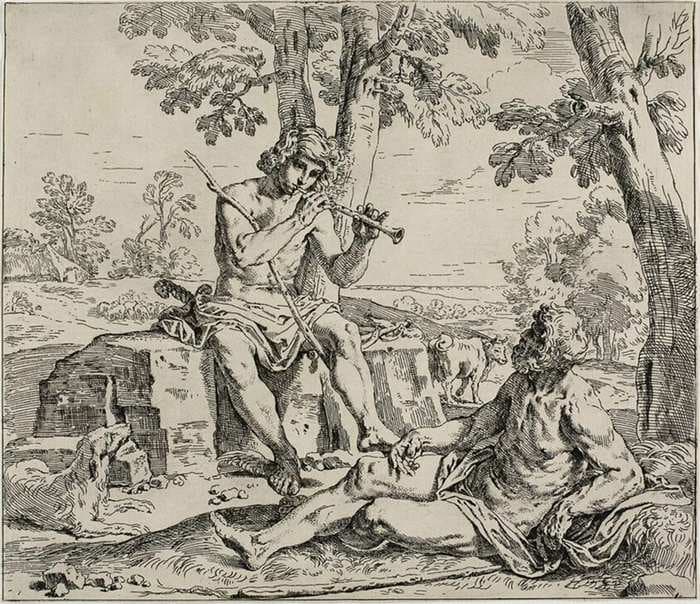
Mercury and Argus
1642/48
- Dating
- Date range
- Held at
- Art Institute of Chicago
- Medium
- Etching on cream laid paper
- Dimensions
- 25.7 × 29.9 cm (10 1/8 × 11 13/16 in.)
- Collection no.
- 1972.985
- Attribution
- By the artist
- Image rights
- CC0 1.0License details
Simone Cantarini. Mercury and Argus, 1642/48. Inventory 1972.985. Simone Cantarini; Art Institute of Chicago. Collection credit: Hannan Fund Endowment. CC0 1.0 (https://creativecommons.org/publicdomain/zero/1.0/). https://www.artic.edu/artworks/40774. Full-frame proportional resize and JPEG compression.
Collection: Art Institute of Chicago
About this artwork
Mercury and Argus — Simone Cantarini. 1642/48.
Medium: Etching on cream laid paper. Dimensions: 25.7 × 29.9 cm (10 1/8 × 11 13/16 in.).
Collection record: Art Institute of Chicago, Chicago. Museum connection according to this source; current display unverified.
Mercury and Argus shows Mercury, disguised as a shepherd, lulling the giant Argus to sleep in order to steal Io, the comely cow in the background of the image, for Jupiter. One of Jupiter’s many mortal lovers, Io was turned into a cow and put under the guardianship of Argus. But Jupiter tasks Mercury with killing Argus and freeing Io—the scene shown here. While Cantarini depicted Argus with two eyes, the giant was said to have a hundred. After Argus is killed by Mercury, his eyes decorate the peacock’s feathers. With its poetic effect and mature technical ability, this is one of the artist's most prized etchings. The composition dates to his late years in Bologna and is also known in a painting now in the Nationalmuseum, Stockholm, which may derive from the etching.
Description: © Art Institute of Chicago, original record, CC BY 4.0. HTML formatting removed; wording retained. Other artwork metadata: CC0.
Source: official collection record. Metadata selected and normalized by Artline from the source export, accessed 10 September 2026; no museum endorsement. Reproduction rights are separate.
Location checked Sep 10, 2026. This does not indicate whether the work is on display.