 Art, literature & history
Qi Baishi
1864–1957
Selected artwork
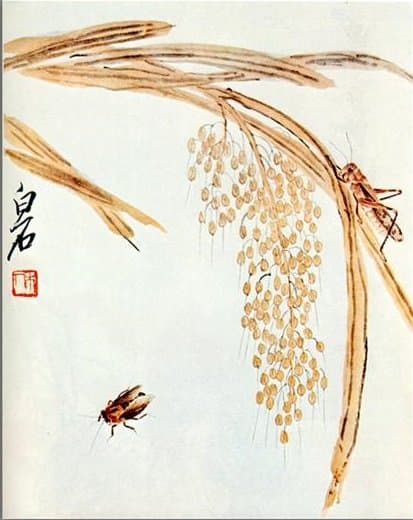
Whisk rice and grasshoppers
1942
Other names (38)
Baishi, Baishilaoren, Baishi Qi, Bai Shi Qi, Baishishanren, Baishi Shanweng, Baishi Shanweng hao Baishi Laoren, Baĭ-shi T︠S︡i, Binsheng Qi, Boshi Qi, Čchi paj-š, Ch'i Pai-shih, Chi Pai Shih, Chʻun-chih Chʻi, Chunzhi Qi, Hakuseki Sai, Hakuseki Sei, Huang Chʻi, Huang Qi, Jieshanyinguanzhuzhe, Jipinglaoren, Lanting, Lanting Qi, Mu-chü-shih, Mujushi, Paek-sŏk Chae, Pai-schi Tschi, Pai-shih Chʻi, Pai-shih-lao-jen, Pai-shih-shan-jen, Paj-si Csi, Pin-sheng Chʻi, Po-shih Chʻi, Qi Huang, Tsʻi-Pai-Shi, Wei-chʻing Chʻi, Weiqing Qi, zi Huang
Biography
Qi Baishi (1 January 1864 – 16 September 1957) was a Chinese painter, noted for the whimsical, often playful style of his works. Born to a peasant family from Xiangtan, Hunan, Qi taught himself to paint, sparked by the Manual of the Mustard Seed Garden. After he turned 40, he traveled, visiting various scenic spots in China. After 1917 he settled in Beijing. Qi was the master of Hu Jieqing, the wife of Lao She.
The subjects of his paintings include almost everything, commonly animals, scenery, figures, toys, vegetables, and so on. He theorized that "paintings must be something between likeness and unlikeness, much like today's vulgarians, but not like to cheat popular people". In his later years, many of his works depict mice, shrimp or birds. He was also good at seal carving and called himself "the rich man of three hundred stone seals" (三百石印富翁). In 1953, he was elected president of the China Artists Association (中國美術家協會). He died in Beijing in 1957.
Wikipedia contributors. Opening excerpt, formatted for reading. CC BY-SA 4.0. Source revision.
Artworks by year
Loading chronology…Museum / collectionAll collections
Finding recorded artworks…
Museums & collections
Documented holdings of works attributed to Qi Baishi. Check the museum’s record for current display information.
- The Metropolitan Museum of Art9 recorded works
- Art Institute of Chicago3 recorded works
- The Cleveland Museum of Art2 recorded works
- Minneapolis Institute of Art1 recorded work